

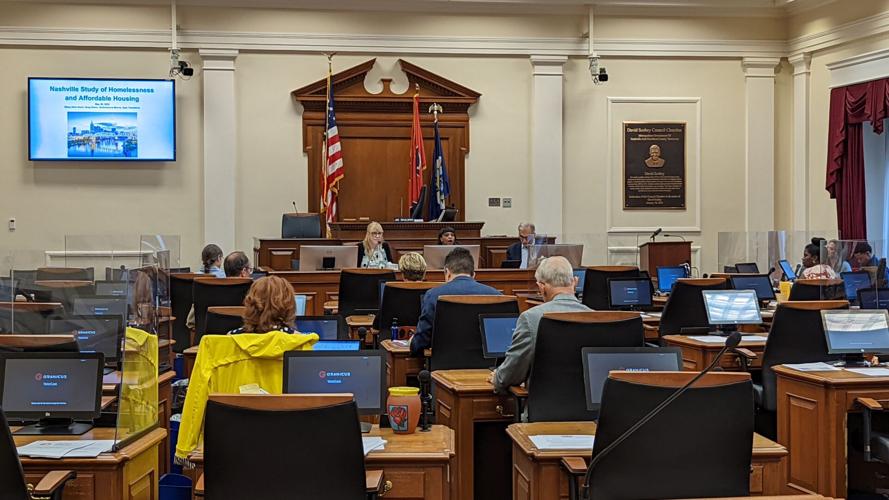

A new audit recommends Nashville create a stand-alone Office of Homeless Services, which would alter the systems and structures directing how the city approaches housing issues. The preliminary findings of the report were released Thursday at the Metro Council chambers, at a special midday meeting with some members of the Continuum of Care Homelessness Planning Council, a governance board composed of services providers and other stakeholders, as well as Metro councilmembers.
The study, conducted by the Louisiana-based firm HousingNOLA, suggests that Nashville needs to focus more resources into addressing chronic homelessness. The Department of Housing and Urban Development defines chronic homelessness as occurring when an individual with a disabling condition has either experienced homelessness for longer than a year or experienced homelessness four or more times in the past three years.
Nashville’s chronically homeless population is proportionally higher than the nation’s average, and presenters from HousingNOLA noted that improving local attempts to house those individuals could result in more federal funding — other Southern cities like Birmingham, Ala., and Atlanta are receiving more for their efforts, for example.
The presenters stressed the need for a housing-first model that emphasizes individuals receiving housing as soon as possible, in addition to treatments and services needed to stay in place. Sam Tsemberis, a pioneer of housing-first policies, was one of the report presenters. Permanent supportive housing units, which are reserved for people experiencing homelessness, will be crucial to the effort, and the city needs to ramp up its production of those units. Specifically, Nashville needs to add 650 new PSH beds to the city’s current inventory of 1,223. Relatedly, the city also has gaps in its data regarding these units, like missing the locations of more than 15 percent of people receiving PSH.
A 90-unit permanent supportive housing complex is tentatively scheduled to break ground on May 31, following a delay of more than two years. The delay is due to Mayor John Cooper pursuing a redesign of the project, per a previous statement to the Scene.
While Nashville has struggled to address chronic homelessness, it has increased its rapid rehousing beds by 656 percent since 2017. However, Tsemberis said that rapid rehousing basically covers short-term rent and does not solve chronic homelessness. Additionally, said the presenters, many of the people experiencing short-term homelessness who received help from Nashville likely would have found a solution within three months without intervention.
The Homelessness Planning Council was also listed as an area in need of improvement in the report. Describing the governing body as “cumbersome,” the report recommends paring down the 25-member board and restructuring the executive committee. Presenters also noted the board lacks diversity, and isn’t representative of the city’s demographics.
One presenter, Stacy Horn Koch, said it was upsetting to hear about the amount of aggression at recent HPC meetings, adding it was not conducive to dealing with communities that have experienced trauma.
An especially notable recommendation made during the presentation was that the city create an independent Office of Homeless Services, incorporating the Metro Development and Housing Agency and Metro Homeless Impact Division. This audit was conducted after District 19 Councilmember Freddie O’Connell, who also sits on the HPC, filed a bill to create a new Office of Housing and Homelessness. O’Connell and members of the service-provider community have expressed concerns about the current leadership structure, especially following the departure of former Metro Homeless Impact Division director Judith Tackett and several other employees over the last few months.
One difference between O’Connell’s original bill and HousingNOLA’s recommendation, however, is that the new department would still answer to the mayor. The director would also be appointed by the mayor.
The report stressed the need for clear and unified leadership, as well as overall improvements to communication between departments and service providers.

Presenters from HousingNOLA at the Metro Council chambers
O’Connell, who announced in April that he’s running for mayor, tells the Scene he has mixed feelings about the report.
“I'm obviously encouraged that this may be the thing that finally helps us break through and set targets for housing specifically for homeless people … which we've had a really hard time doing as a city,” O'Connell says. “I'm a little interested in the way that it does seem to almost slant some criticism there toward people who have worked in this space for a long time and … [how it is] a little less skeptical or critical at some of the choices of this administration.”
Citing the delay on permanent supportive housing units, O’Connell says, “I am not persuaded that in this moment an accountability structure flowing from the mayor's office is going to deliver the outcomes they’re hoping for.”
Karri Gornick, vice president of housing and workforce development at Oasis Center, which works with youth experiencing homelessness, tells the Scene that the report’s findings didn’t reveal anything new from a service provider’s perspective.
“I am grateful and excited that this report backs up what our community has been saying for years,” Gornick says. “We do need a separate office of homelessness in the city, we do need more money to focus on ending chronic homelessness, and we do need more permanent supportive housing.”
While she agrees with O’Connell’s assessment that the report seems to criticize outreach workers, she says its critiques of the HPC are similar to discussions members of the body are having regarding its unclear role.
Councilmembers who attended the presentation also asked questions of the report and its recommendations. Councilmember At-Large Burkley Allen asked if new criteria for assisting unhoused Nashvillians would be needed, instead of the vulnerability index currently used to determine who is most in need. Tsemberis responded that new standards would be needed and noted that many cities are moving away from that vulnerability index, saying it has led to discrimination against African Americans and women.
Councilmember At-Large Sharon Hurt wanted clarity on the contract with HousingNOLA. The group has a two-phase contract — the first phase to conduct a 12-week study and the second phase to help guide implementation of new practices.
District 6 Councilmember Brett Withers noted that for all the discussion about improving communication, he and other councilmembers only found out about the report’s recommendations from that morning’s copy of The Tennessean.
The report will be presented to the full Homelessness Planning Council at its monthly meeting in June. The presentation can be seen online. A more detailed version of HousingNOLA’s findings is expected to be released at a later date, according to the mayor's office.
O’Connell’s office of housing bill comes back before the council on June 2 for its second reading. The councilmember says he has an amendment to the bill that takes into consideration recent discussions.



Post a comment as anonymous
Report
Watch this discussion.
(0) comments
Welcome to the discussion.
Log In
Welcome to the discussion.
Keep it clean. Please avoid obscene, vulgar, lewd, racist or otherwise abusive language. Comments featuring hate speech or threatening or violent content will not be tolerated.
PLEASE TURN OFF YOUR CAPS LOCK.
Be truthful. Don't knowingly lie or mislead.
Be proactive. Use the “report” link on any comment that violates our comment policy.
Share with us. We'd love to hear your feedback.