
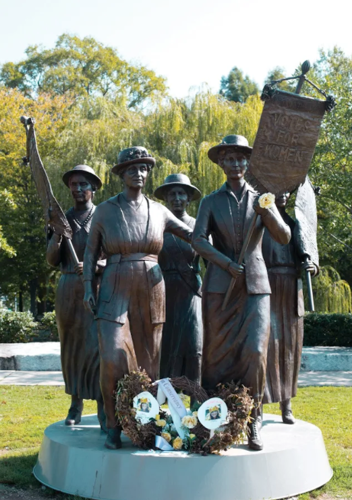
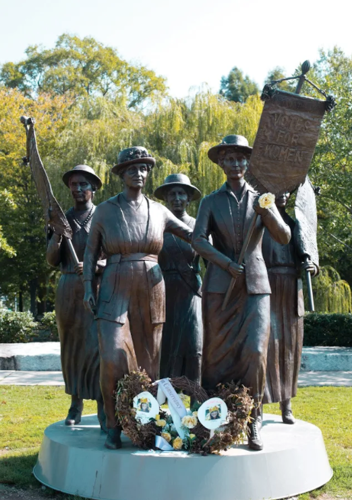


Tennessee Women's Suffrage Monument in Centennial Park
The Tennessee state legislature sat at an impasse 98 years ago this month, with 48 house members voting to extend the right to vote to women in the state and another 48 voting to withhold it.
Phoebe “Febb” Burn of East Tennessee wrote to her son, Harry, urging him to use his vote to support the passage of the 19th Amendment. With her letter in his hand and no sign of a yellow rose pinned to his chest, he cast his vote — one that would make Tennessee the 36th in the country to approve the 19th Amendment. With that, the amendment was ratified and could be added to the U.S. Constitution.
Yvonne Wood, president of the Tennessee Women’s Suffrage Monument board and women's suffrage history buff, said after Burn cast his vote, the house burst into pandemonium.
“They chased him around the room, and he crawled out of a third story window around the edge of the capital up into the attic. The next day when tempers had cooled down, they wanted Burn to explain,” said Wood. “He said, ‘ “I’ve always been told that a man should do what his mother asked him to do, and that’s why I changed my vote," and that it occurred to him that the chance to free millions from political slavery comes to normal man but once in his life, and he knew that it had come to him.”
This Saturday, hundreds of women are expected to gather at the Tennessee Women’s Suffrage Monument in Centennial Park to honor that vote and to celebrate the 98th anniversary of the 19th Amendment’s ratification.
Organized by the board of the Tennessee Women’s Suffrage Monument, the event will feature leaders from across the state who will share plans for future Suffragette monuments in other cities across the state.
“As we traveled to various events and read about suffrage events, we were distressed that Tennessee was never mentioned. As you dig into it, it becomes even more interesting because it was just by one vote that women were granted a voice in their government for the first time," Wood said. "We decided to come up with a plan to honor women who actually were present in 1920 or who at least were the representatives of those women."
Metro Parks and Recreation Director, Monique Odom, will speak at the event, and for her, the monument has significant meaning.
“As an African American and as a woman, it’s not lost on me the history of omission that took place during the suffrage movement across the country,” Odom said. “Relatively speaking, African American men and women’s right to vote is fairly recent, and we cannot erase or forget what happened in the past, but we can move forward in a spirit of unity to address important issues. It’s important to honor and remember those who made contributions that resulted in change, and the Suffragists changed the dynamics of voting in this country — for that, we owe them tremendous gratitude.”
Featured in the monument in Centennial Park are Abby Crawford Milton, Anne Dallas Dudley, J. Frankie Pierce, Sue Shelton White and Carrie Chapman Catt, five prominent suffragists who campaigned for the women’s vote. Anne Dallas Dudley was one of the organizers of the South’s first suffrage parade, and J. Frankie Pierce went on to make the first speech at the League of Women Voters meeting in Nashville.
“I think if we hadn’t done it then, I hate to think how many years it may have been. The anti-suffragists thought it would die, and it might be that it would have,” Wood said. “I tell you, it just makes the hair on the back of my neck stand up to know that we came that close to not having the vote, and the fact that we did have the vote, it makes me so grateful to my foremothers that fought so hard for us and to the men that voted yes. We all have a voice because of them.”



