
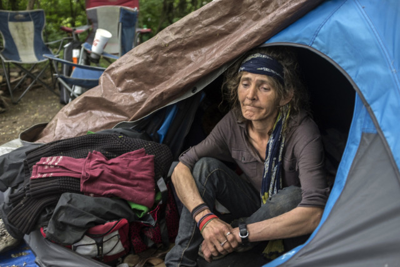


Resident of a homeless encampment at Fort Negley, 2016
In an email obtained by the Scene, a homeless-services provider says that people experiencing homelessness are not responding well to Nashville’s new winter overflow shelter — in part because it’s a converted jail.
“We strongly believe Metro's Overflow Shelter needs to be moved to a new location that is not associated with DSCO/law enforcement immediately,” says Lindsey Krinks of local homeless-outreach nonprofit Open Table in an email to Metro officials.
In the message, Krinks criticizes Metro’s choice of 5131 Harding Place, the former site of a sheriff's office dormitory for work-release prisoners. Krinks says the location makes it harder for providers to build trust with people who need shelter, and argues that the city didn’t consider guests’ histories of trauma when choosing the site.
She also summarizes the findings of outreach teams that Open Table dispatched throughout the city on Nov. 8, the first night the emergency overflow shelter was used.
“Out of the 220+ people we encountered Friday night, less than 18% were willing to go to the Harding Place facility, and a large portion of the people who declined shelter said it was because of the location,” Krinks writes. “On Saturday, we also heard that some of the people who went to the shelter will not go back because of the location and because the environment ‘felt like jail.’”
The email includes quotes from people the outreach teams met that evening. Krinks describes one couple that was willing to stay at the Metro shelter until they learned it was at Harding Place, telling outreach workers: "If we wanted to be treated like we were back in jail … we'd just get drunk and get picked up for [public intoxication].”
Krinks also says guests were searched and many weren’t sure if they were allowed to leave during the night or take a smoke break in the evening.
The Scene also obtained a Metro spokesperson’s response to Krinks’ email.
“The overflow shelter site was chosen because of its many favorable operational features, including built-in beds, commercial kitchen, showers, bathrooms, on-site laundry, and the ability to provide in-room kenneling for guests and their pets,” says Chris Song of Mayor John Cooper's office in an email to Krinks. “Past overflow shelter sites would not allow us to provide all these services to as many as 150 guests, and agencies would often have to move the shelter site to different locations throughout the cold weather season, which would add burden to those seeking shelter and the canvassers providing outreach services.”
Regarding concerns about how guests may feel about staying in a former jail, Song writes: “Though the nature of the shelter’s location is challenging for certain members of the homeless community, Metro Social Services hopes to work closely with you and your colleagues to successfully communicate the overflow shelter’s life-saving benefits with our guests’ mental health wellness in mind.”
Song also expresses concerns about the occupancy rates of Metro’s partner shelters, the Nashville Rescue Mission and Room In The Inn. In the email, Song says neither shelter was at full capacity on Friday evening, and that the Mission only reached 65 percent capacity.
“It is critical to protect the integrity of the overflow shelter and its role as a life-saving resource to provide enough warm, safe beds for Nashville’s homeless community, especially its most vulnerable populations, should primary shelter space run out,” Song writes. “To do so, our community partners must work to address the problems around filling capacity at Nashville’s primary shelters.”
Song adds the city will do a better job communicating with guests, letting them know that they are able to leave at any time and that evening smoke breaks are allowed.
Metro’s overflow winter shelters open and operate on nights when the temperature drops to 28 degrees or colder. They are designed to be low-barrier access shelters, which accept individuals with few restrictions: These guests might have pets, they might be under the influence of drugs or alcohol, or they might lack an ID. Last winter, the Shelby Park Community Center was used as the overflow shelter.
Other cities have started using old jails as shelters, including Seattle and Oakland. However, researchers have argued that there is a revolving door between homelessness and incarceration. Most recently, a 2019 report from the Texas Criminal Justice Coalition found that "people experiencing homelessness are 11 times more likely to face incarceration when compared to the general population, and formerly incarcerated individuals are almost 10 times more likely to be homeless than the general public."



