

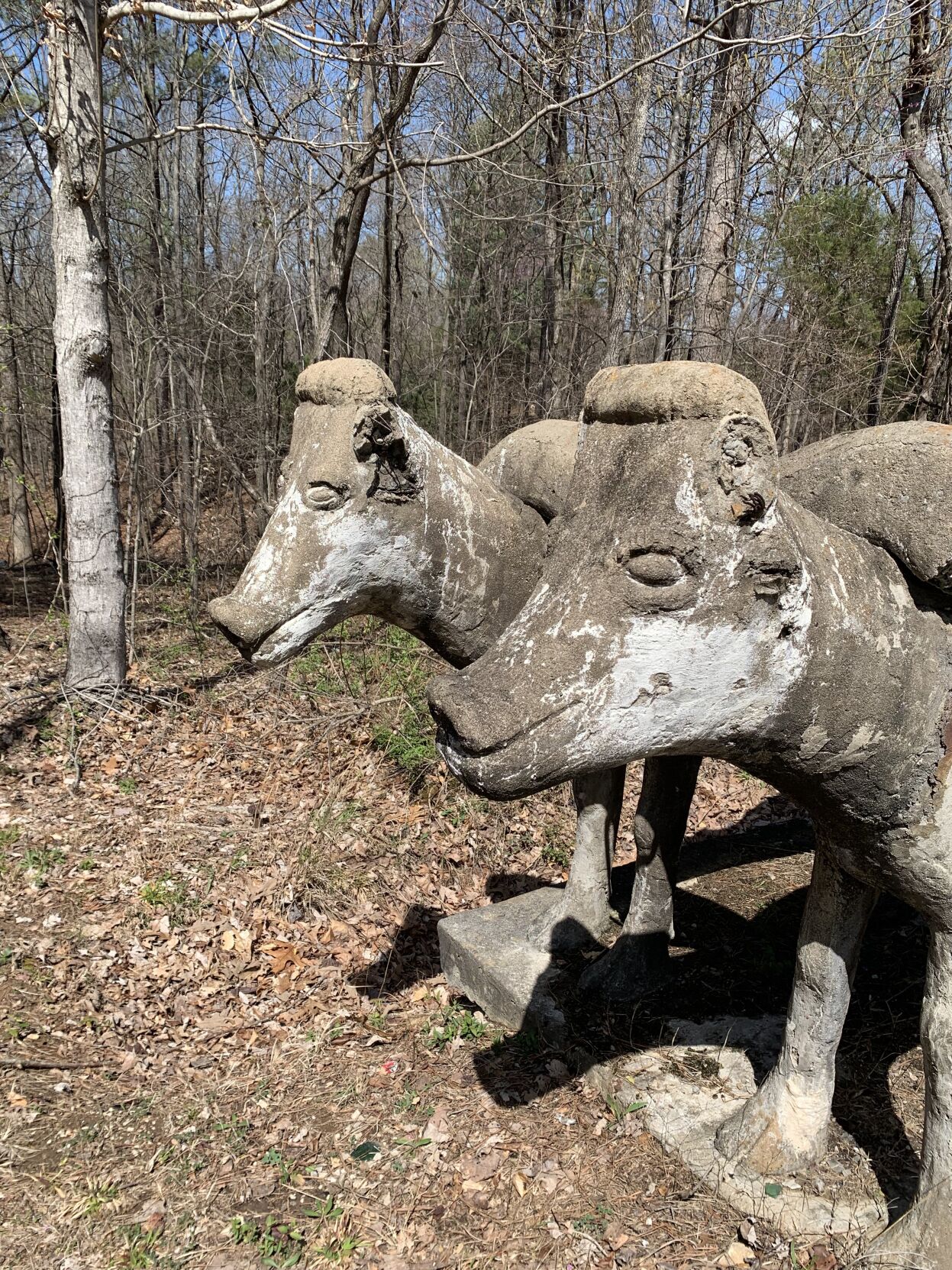
E.T. Wickham's statues in Palmyra, Tenn.
Y’all, there are life-size, concrete ox testicles up in Cheatham County, just sitting on the side of the road. Well, they're attached to a concrete ox — not sitting solo, enjoying the sun, just having a little picnic, chatting about family business. Though at this point, that would not be any less surprising.
Many years ago, national treasure and former Scene staffer J.R. Lind and his family took me up to Mayfield, Ky., to look at some sandstone testicles. Well, they went to show me the grave of Henry Wooldridge. I, being me, was staring and laughing at the very prominent dog testicles, enshrined for eternity on Henry’s grave. Oh, silly Kentucky. You would never see us down here in Tennessee doing such a thing.
Well, I was wrong. Because there I was on Saturday, standing along a very country road just outside of Palmyra, Tenn., looking at some crumbling concrete statues where Nature (and vandals) had seen fit to make sure that concrete ox testicles stayed intact.
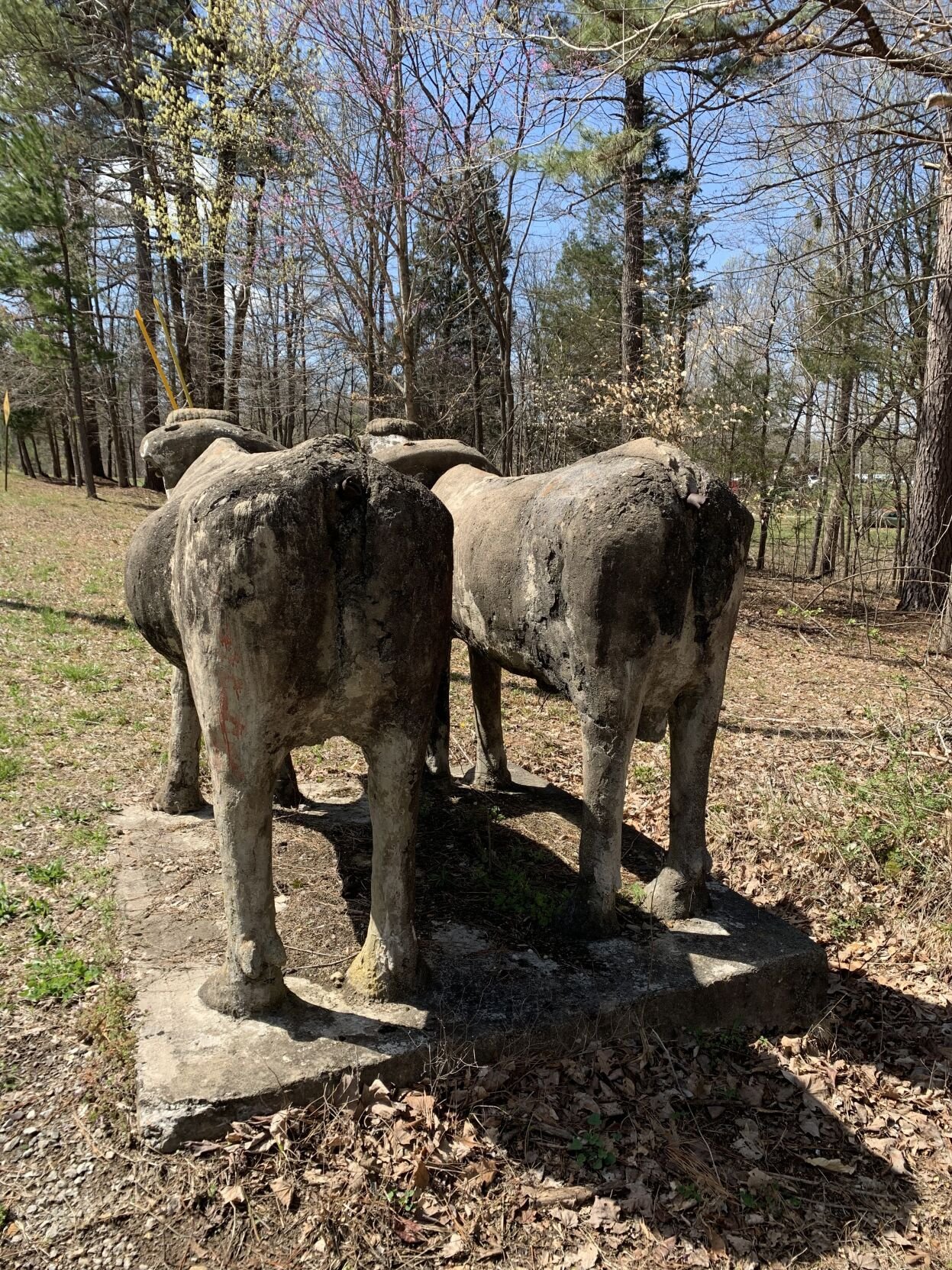
E.T. Wickham's statues in Palmyra, Tenn.
Both my mom and dad were pestering me with questions — the one they kept repeating was “What is this?” but my dad also wanted to know what this dude’s preoccupation with bulls was, since my dad had parked the car near a second concrete bovine statue.
I didn’t know. What do I look like, the expert on testicle sculpture? I’m not mature enough for that job! If I had that job, I’d spend all my day giggling and blushing. What’s worse? That men in Kentucky and Tennessee want to share their testicle sculptures, or that I want to look at them and laugh?
OK, so let’s back up. Up along Buck Smith Road outside of the aforementioned Palmyra are a bunch of crumbling concrete statues. On the bases of the statues are carved patriotic admonitions, and many of the statues clearly had been men, though often there were only feet or torsos left. The setup has the feel of the obsessive yard artist, but it is not quite the singular, insulated vision of, say, Billy Tripp’s Mindfield over in Brownsville, where you can see there is deep meaning to the artist that isn’t accessible to the viewer. Staring at these statues, you do feel like, if they were still all there, you could piece together what the artist was trying to convey — something about patriotism and public service and manhood. But as they are now, crumbling and broken, it’s like playing “Name That Tune” on a radio station that’s mostly static.
I’m not an art person, so I don’t really know how to talk about it. But even with all the damage, there’s still a kind of frisson you get looking at them. Like, you feel that these are places where a dude’s creative interior life and the regular outside world have been twisted together, and the lines between them are no longer very clear. Or to put it another way, this is a spot where a dude tried to share with whoever might come by some things internal to him that he clearly cherished. And the place still echoes with that feeling. Which makes the vandalism and the graffiti somehow more insulting. It doesn’t just feel like the ruination of some physical thing this dude spent a lot of time making, but rather the rejection of and closing off of the space where his heart tried to touch his world. And it’s worse because that desecration had to have been at the hands of his neighbors. Who else would have known how to get there?
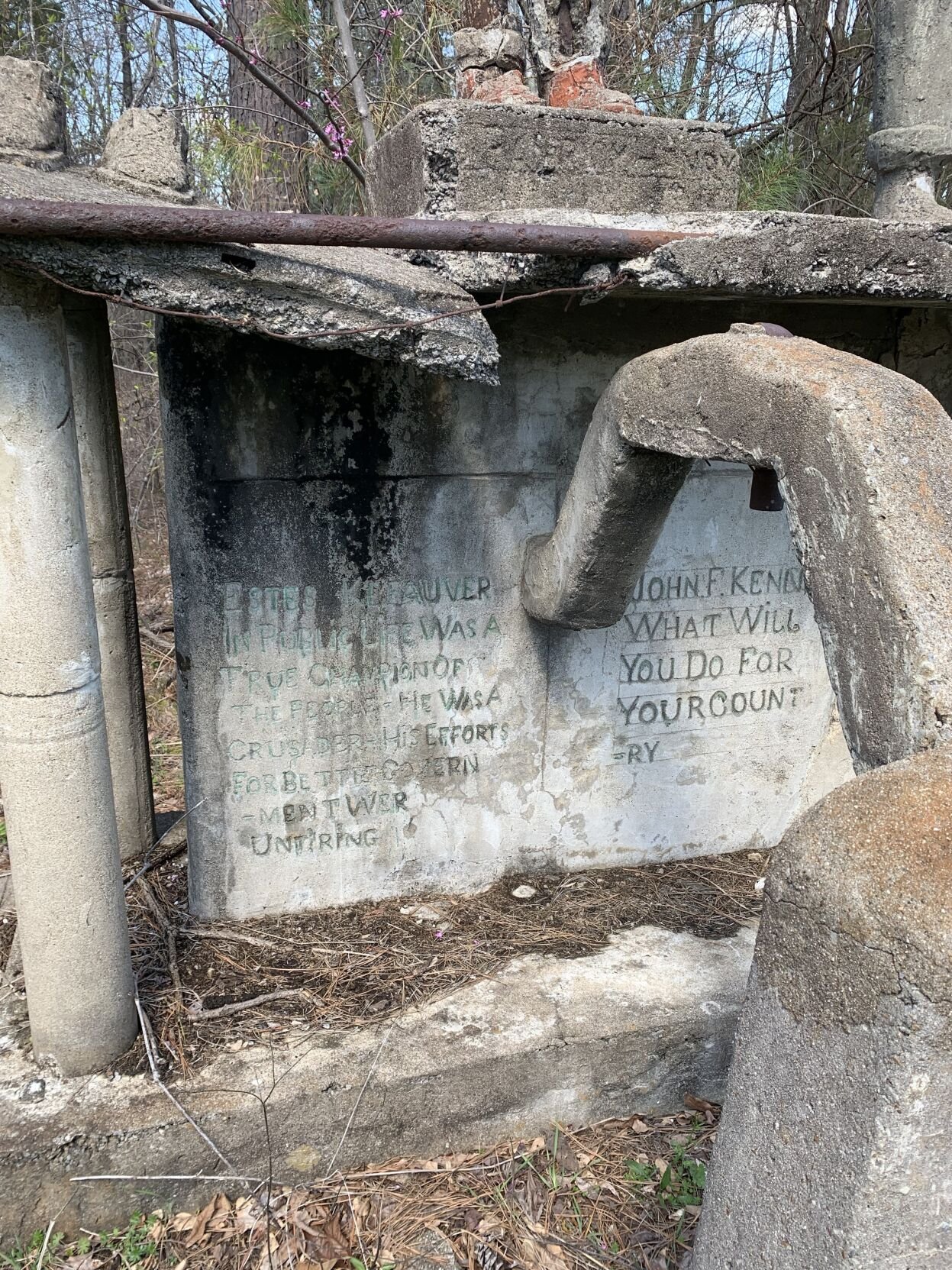
E.T. Wickham's statues in Palmyra, Tenn.
I posted the pictures I took on Instagram, and of course, Jim Hoobler, king of Tennessee art, knew immediately who the sculptor was — E.T. Wickham. I looked him up, and apparently we missed a whole bunch of these that have been moved and better preserved, just up the road. Wickham was apparently a self-taught artist who was born in 1882 and died in 1970. He began sculpting at 67. One article I read said he had been a tobacco farmer, but I honestly didn’t see any flat places up there big enough to grow much tobacco, so maybe the statues aren’t where his farm was?
Wickham made his sculptures by making framework out of old wire and cans and scrap metal and then covering them with concrete, which he molded into shape. When he was alive, the sculptures were brightly painted. Get this — according to that article I found:
Wickham’s only existing self-portrait, of himself riding a longhorn bull, also demonstrates his sense of humor. Undocumented, but remembered by Michael Dinsmore, who was a boy at the time, as being created soon after the York and Jackson works, the bull had electrified light bulbs in his eyes and a red light bulb under his raised tail.
I die. This is the best. But also, this is one of my favorite things about Tennessee: There are still surprises. We were just driving around, enjoying the beautiful day, and suddenly we’ve stumbled across something that, while I’ve never heard of it, has this whole interesting story to it. Wickham’s art has been displayed places. He’s well-known enough that Jim Hoobler instantly recognized his work from my photos. Now, granted, this is Jim’s area of expertise, and I suspect that no art happens in the state without him knowing about it. Hell, I suspect he may know the names of the crawdads in Tennessee who make the most majestic mud towers. But still! Scholars have studied it. There’s a whole world of research and discussion and appreciation of Wickham’s work that I stumbled into just by turning a corner at a stop sign.
And how many more things might there be out there like this? How many places might we stumble across where a person has shared their heart and we can stand there and receive it?
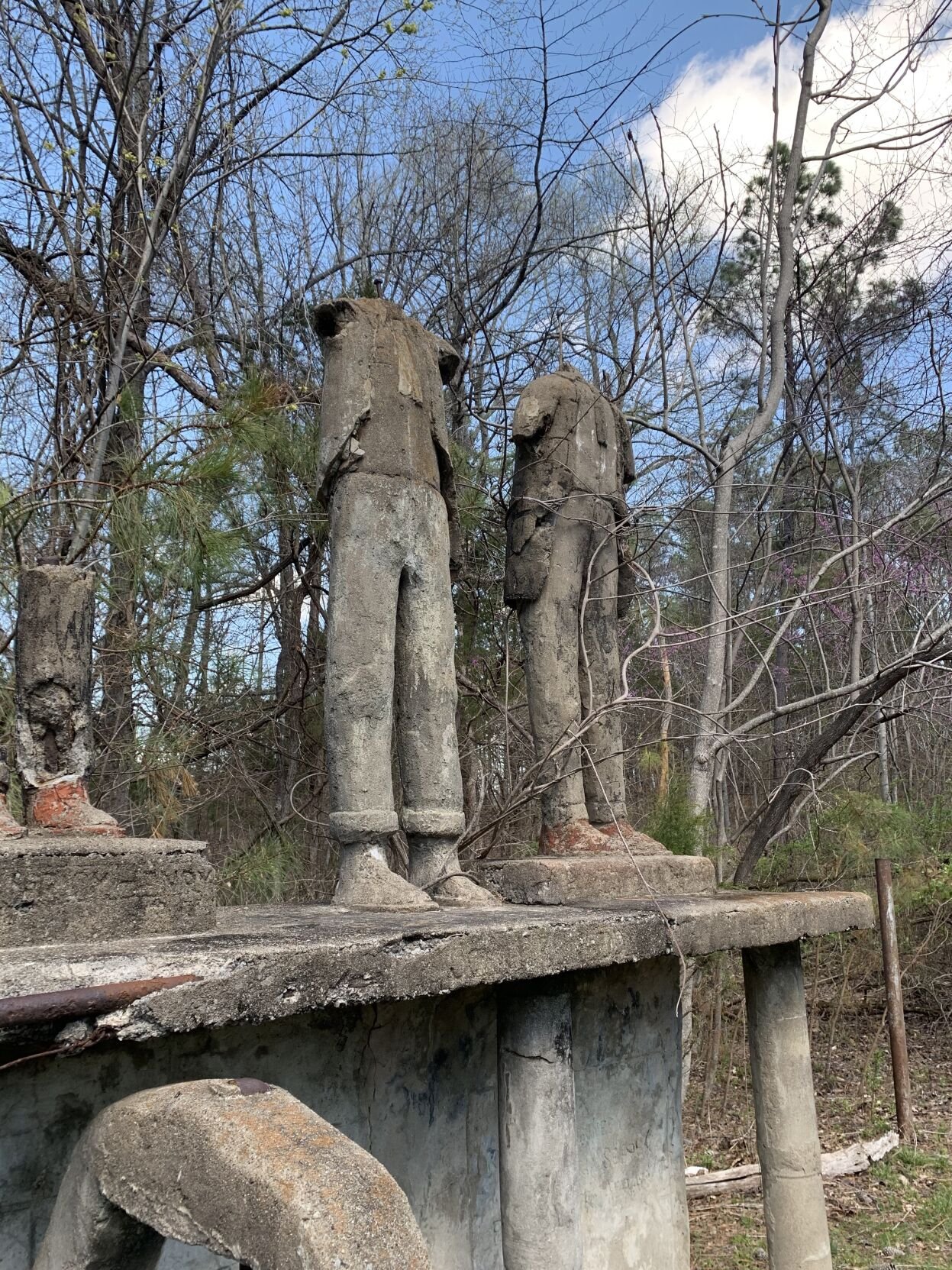
E.T. Wickham's statues in Palmyra, Tenn.



