
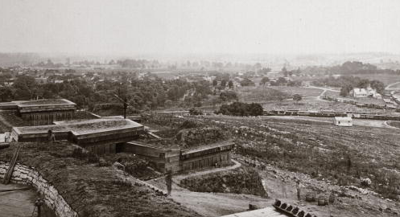
On Saturday, the Tennessee Historical Society, the Friends of Fort Negley, and the Vanderbilt University Robert Penn Warren Center for the Humanities sponsored a program to celebrate the dedication of a new interpretive sign at Fort Negley highlighting the work of African Americans to build the Civil War fort and the fort’s symbolic role in Nashville’s civil rights history.
The morning program started out with a keynote address from recently-retired TSU history professor and living history legend, Bobby Lovett, in which he recounted Fort Negley’s African American origins. This was followed by a panel, comprised of professors Crystal deGregory, Reavis Mitchell, Daniel Sharfstein, and the aforementioned Lovett. The panel discussion was part in-depth look at the roll of Fort Negley in our city, both in the past and what it should be now, and a roasting/loving-appreciation of Lovett and his unique place as the historian of black Nashville.
Lovett sketched a history of Fort Negley that I would hope by now is at least a little familiar to the people of Nashville. Enslaved black people, ex-slaves, and free people of color were conscripted into service building the fort. Roughly 2,000 people — men, women, and children — worked long days and then slept out in a camp located roughly between the Adventure Science Center and the city cemetery. They were supposed to be paid roughly $85,000, but instead got about $13,000. And then the community that developed on the side of that hill grew into the Edgehill community.
But, obviously, the reality is more complicated than that and if you’re talking about the fort and its role in civil rights history, the symbolism is also more complicated. Just as an example, the construction of Fort Negley started before Lincoln had decided to free the slaves, so the enslaved workforce was just that — enslaved and forced to work for the Union. Most of the people who worked on the fort at first had no choice but to work on the fort. Is being forcibly removed from the work farm you’re being kept prisoner at and moved to a hill where you’re not allowed to leave and forced to work really that meaningfully different? But it’s also true that the fortress they built was their defense from the Confederate army. The Confederates couldn’t take Nashville because the people they enslaved made Nashville impenetrable.
Or take the matter of pay. It’s true that the Fort Negley workers were not paid what they should have been paid, which, obviously, isn’t a great victory for freedom. But the fact that there was even this idea that enslaved people should be paid anything, that any enslaved person got money for his or her work and should be allowed to keep the money their labor earned is extraordinary, a sea-change. Even if it wasn’t the “right” amount of money, imagine the paradigm shift in Nashville culture that there should be any money that was an enslaved person’s at all.
Lovett pointed to what might be considered Nashville’s first civil rights protest, which was organized there at the Fort, when a delegation of black men went to the military men overseeing the project and demanded more pay. That happened on April 29th, 1863. Lovett also pointed out that the thing these men wanted, the thing the fourteenth amendment codified — the same rights to everyone born in America — is still controversial, still playing out even in our current presidential elections.
Daniel Sharfstein raised the point that, when African-Americans were building Fort Negley, no one really knew what freedom for black people could look like. As hard as life was for workers on the hill, the new lives they were creating for themselves were the first inklings of what freedom would look like for enslaved people when it came. They were literally creating the new world their friends and families would soon live in and Sharfstein said that the results were immediate. It was the hard work of these African Americans that proved to Union soldiers that the war wasn’t just about keeping the United States together, but that it was a necessary war for enslaved people’s freedom.
Reavis Mitchell, along those same lines, pointed out that the fort still has resonance for African Americans in Nashville because it stands as a testament to what African Americans are capable of doing. Building these extraordinary structures that then kept the city safe.
Throughout the morning, there was a lot of emphasis on using the past as a way to understand our present circumstances and I admit I was struck by the powerful and convincing testimony of the lived experiences of the black workers — that white soldiers who met these people and interacted with them were deeply changed by that experience. When white people who hadn’t been exposed to the horrors of slavery heard first-hand accounts or saw the toll it took on the bodies of people they had come to like — and I don’t want to let the Union off the hook here; clearly they were still racist — they changed their reason for fighting.
And it made me think of the importance of segregation, both in the Jim Crow South and in the redlined, sundown-town north, in the oppression of black people. One lesson white supremacists learned was that if white people and black people lived together and came to know each other, even racist white people could change their opinions of black people and their behavior toward them. So best to instill systems and traditions that would keep us apart.
The conversation then turned to what should happen in the future to Fort Negley and to the old Greer Stadium and gentrification in general. Crystal deGregory pointed out that our current circumstances are still echos of history. She said, “The two bedrocks of American wealth are slavery and land-speculation.” And here we still are, dealing with the repercussions of those two approaches to accumulating wealth. The land around Fort Negley has the value it does now first due to the labor of the enslaved people who cleared the land and laid the train tracks and lived in the neighborhood for a century. And due to the fact that historically, it’s been very hard for African Americans to buy property, so a lot of the people who’ve lived around Fort Negley for generations haven’t had access to home ownership. As Lovett pointed out, if you don’t own the place you live, it’s easy to move you out of it.
But also, because it has historically been majority black with pockets of deep poverty and therefore not high on Nashville’s priority list, the area of Nashville south of 40 and inside the 65/24/440 loop, what we might loosely call South Nashville is terribly low on park space. There are three tiny parks — Dudley, Napier, and Shute — and Fort Negley. The plan that Fort Negley is putting forward for the old Greer Stadium site would include expanding their park area with walking paths with a connection to the city cemetery — one of them would let you explore the old Catholic cemetery — green space for movies in the park or old-timey baseball, and a large play area with a replica fort for children. It would also allow archaeological access to the site of the workers’ camp. Obviously, I’m in support of this.
I came away thinking that deGregory was right to keep stressing that history is messy and the historical sites we have, if we’re honest about them, are often confusing and paradoxical. Places and events don’t have only one meaning. We may want a place like Fort Negley to serve one straight-forward purpose, but, actually, it’s healthy and honest for it to be a hard, complicated place to understand.
But I was really pleased to see the room we had the discussion in so crowded. People care about Nashville’s history and that makes me optimistic for Nashville’s future. And we have a chance to expand the park to include more of the historic site and thus to learn more about Nashville’s history. I hope we’ll take that opportunity.



