
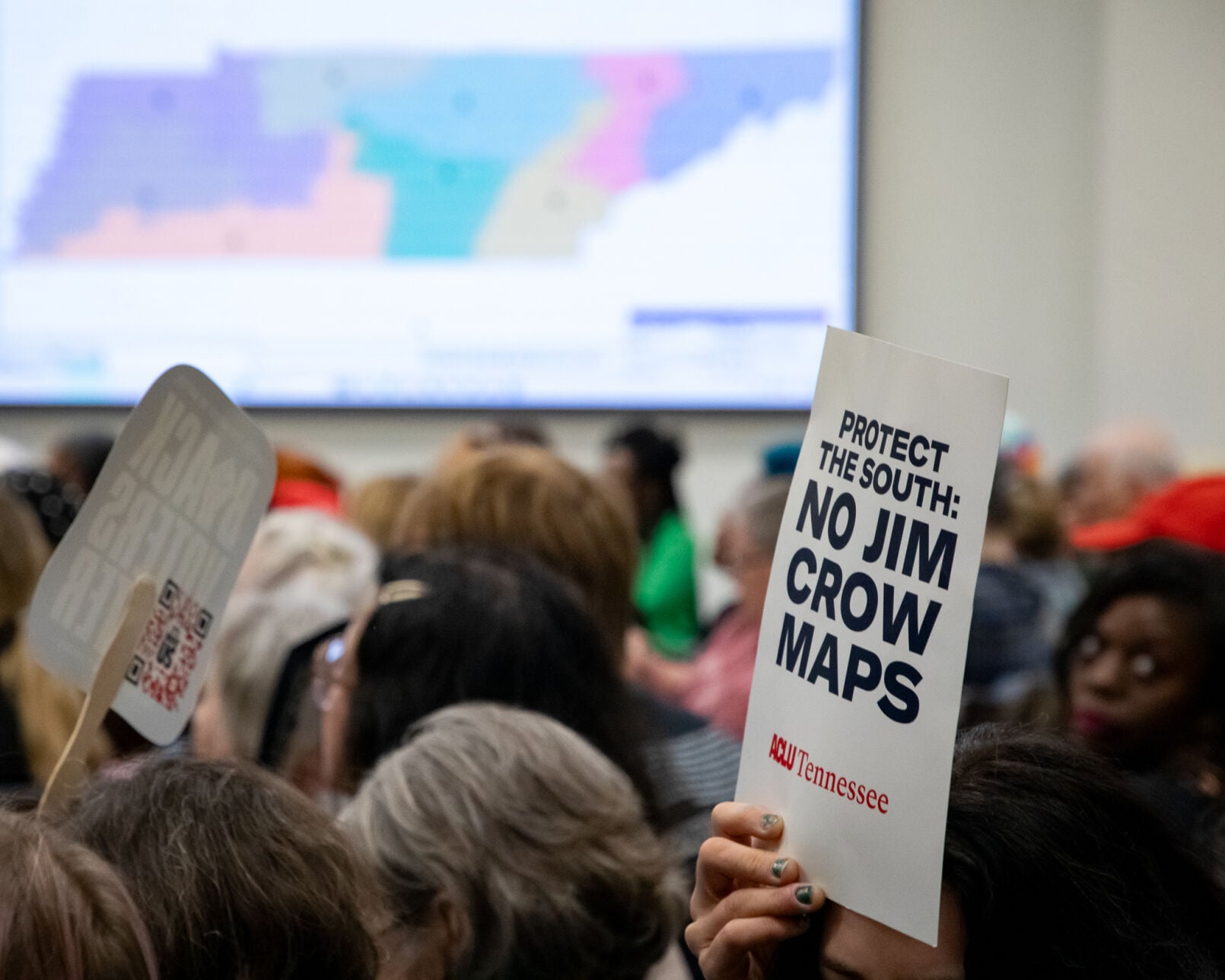

A three-judge panel has denied a request to temporarily pause implementation of Tennessee’s new congressional map as it faces multiple lawsuits over alleged racial discrimination.
The request for a preliminary injunction comes after the American Civil Liberties Union and the ACLU of Tennessee filed a federal lawsuit in May on behalf of the Equity Alliance, Black Clergy Collaborative of Memphis and the Memphis A. Philip Randolph Institute, as well as three Memphis voters: Kermitt Moore, Amber Sherman and Rachael Spriggs.
The filing alleges that the new map will dilute the votes of Black Tennesseans. The injunction seeks to block the map from taking effect before the August primary elections, declare the redistricting unconstitutional and restore the previous district lines.
On Thursday, a panel of three federal judges blocked the request for an injunction, saying the “plaintiffs won’t succeed on their vote-dilution claim because they haven’t presented meaningful evidence that race — not politics — motivated Tennessee’s May 2026 map.”
The historic redistricting eliminated Tennessee’s only majority-Black district covering most of Memphis and only Democratic stronghold at the federal level. The new map splits the Memphis area into three districts and will likely result in Tennessee’s congressional representation becoming fully Republican after this fall’s midterms. The redistricting came just over a week after a landmark U.S. Supreme Court ruling that gutted much of the Voting Rights Act.
The ruling allows the redrawn map to apply toward the upcoming August primary election as well as the general election in November — all while several pieces of litigation work their way through the court system.
“Here, the map’s effects — breaking Black Memphians into three separate congressional districts — are readily explainable by political motivations,” the ruling reads.
“It’s no secret (supported by Plaintiffs’ own statements) that city voters prefer Democratic candidates and that rural voters prefer Republican candidates. So it makes sense that Tennessee’s legislature would split Memphis into thirds when attempting to create a map that favors Republican candidates,” it continues. “And it’s no surprise that the resulting map would also split the Black population of Memphis into thirds.”
Several lawsuits have been filed over the redrawn congressional map but so far none have been successful. A three-judge panel for the state Supreme Court blocked the NAACP's redistricting challenge and the Tennessee Democratic Party recently dropped its lawsuit.
This article was first published by our sister publication, the Nashville Post.



Post a comment as anonymous
Report
Watch this discussion.
(0) comments
Welcome to the discussion.
Log In
Welcome to the discussion.
Keep it clean. Please avoid obscene, vulgar, lewd, racist or otherwise abusive language. Comments featuring hate speech or threatening or violent content will not be tolerated.
PLEASE TURN OFF YOUR CAPS LOCK.
Be truthful. Don't knowingly lie or mislead.
Be proactive. Use the “report” link on any comment that violates our comment policy.
Share with us. We'd love to hear your feedback.