



"No trespassing" sign under the Jefferson Street Bridge
On June 1, the city plans to close down a campsite underneath the Jefferson Street Bridge, and one homelessness outreach organization is calling on officials to reverse the decision.
“It is inhumane to close encampments when there is not enough affordable, accessible housing for those in need,” says a press release from Open Table Nashville, a nonprofit dedicated to homelessness outreach and alleviating poverty.
The release notes that service providers are working with residents of the encampment to find them housing, but criticizes the fact that those who don’t accept the assistance will be relocated to Old Tent City, another encampment south of downtown for people experiencing homelessness. The organization also issued a call to action to organize around the issue.
“Forcing the residents to move somewhere else is just adding more instability to their lives,” says India Pungarcher, who does housing navigation and street outreach for Open Table. “We know that a lot of folks do have housing navigators down there, but the reality is they're not going to have housing by June 1.”
She adds that moving more people to Old Tent City will also cause more stress for that encampment's current residents, who are also worried about a potential closure.
A statement from Mayor John Cooper’s office pushes back against Open Table’s press release.
“We’re not content to let our unhoused neighbors live under a bridge or anywhere they’re exposed to extreme heat and other dangerous conditions — especially not when we have an infusion of federal dollars to help encampment residents with alternative housing solutions,” says spokesperson Chris Song via email.
Song adds that the city plans to fund housing efforts with federal dollars from the CARES Act, as well as with upcoming funds from the American Rescue Plan.
The city says it is also looking for indoor facilities that can host nonprofits who provide food and resources to the encampment. Affected nonprofits would include The Bridge Inc., an organization that began in 2004 to assist the camp underneath the Jefferson Street Bridge.
Salvation Army has also been assisting with outreach and housing efforts at the encampment.
Kris Mumford, a spokesperson with the Metro Nashville Police Department, says there were also concerns about crime and public health in the area. Residents of the camp have themselves been the targets of crime, she says, and last week a woman staying there overdosed and fell into the river.
“We’re not naive — we know there has been violence down there,” says Pungarcher. Staying out on the streets is “not safe,” she says, but “that's the reality of the situation … when we don't have enough affordable housing.”
Open Table members were also frustrated by an email sent to homelessness service providers back in March about the plan to remove the camp before the summer. Open Table was not included among the recipients.
“There is already a lot of pressure on the Mayor's Office to have the camp removed,” reads the email from a police officer with the Central Precinct’s Quality of Life Team. “If we form a plan and enact it we can end homelessness under the bridge in a manner that benefits the displaced individuals who live there.”
The email, a copy of which was shared with the Scene, also said that closing the encampment would save lives and prevent crimes. “I have worked with Central Precinct as a patrol officer for 1 year and almost 6 months [as] an officer on the Quality of Life Team," reads the email. "In that time I have seen several individuals die under the Jefferson Street Bridge from overdoses or more violent means.”
Open Table would prefer that the city consider alternatives, like designating the site an “official, sanctioned encampment.” Pungarcher also points to a FEMA program that would reimburse counties that house the homeless in noncongregate settings like unoccupied hotels — a program that cities including Nashville have failed to tap into.
While it would take money and effort up front, if done correctly, "Every single person under the bridge could be put up in a hotel through the end of September," Pungarcher says.
Mumford says June 1 is “not a hard date” and police won’t just “go in there and kick people out.”
“There's no enforcement planned, no arrests planned,” she says. The focus will be "to go in there, clean up, and effort to find people housing.”
A "no trespassing" sign near the encampment is postered over with notices about a community meeting on May 28.
As of Friday, Mumford says there are currently 14 people under the bridge and all but two of them have accepted housing navigation help. MNPD says the current population is much lower than it was last summer.

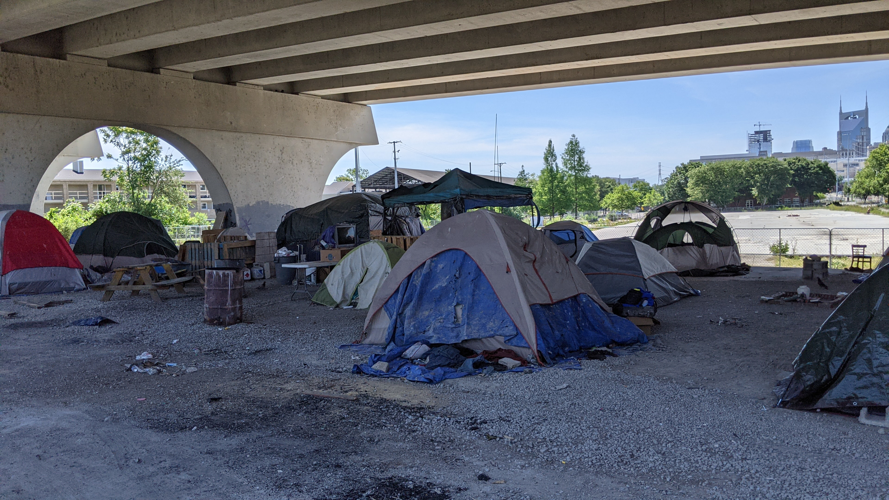
Tents underneath the Jefferson Street Bridge
While Pungarcher agrees the population at the encampment seems lower than months ago, she says Open Table’s outreach teams have met more people at the encampment than the city’s headcount reported.
“There's … lots of movement down there,” says Pungarcher. “Homelessness itself is this fluid experience that people transition in and out of. I know folks down there that are working, and they might have a hotel for a couple of nights … but then they might be back down under the bridge while they're waiting for their next paycheck or things like that.”
She says that many of the camp’s residents do have a housing navigator with the city, but there are still people who either don’t have help or don’t realize a navigator has been assigned to them.
Major Ethan Frizzell, Area Commander for The Salvation Army Nashville, has been working closely with the city to assist in outreach and housing efforts at the Jefferson Street Bridge. In a statement to the Scene, he says:
The Salvation Army has been working directly with the encampment under Jefferson St. Bridge since the March 2020 tornado. During that time, we have assisted the city in helping the encampment follow Covid-19 guidelines, provided daily meals, and most importantly, worked directly with the residents to find rapid rehousing solutions to move them into permanent housing through our LIFNAV program.At this time, 150 individuals across the city, including Jefferson St. encampment, have found permanent housing through our LIFNAV program, and many others have found housing through partner agencies using similar approaches. … We continue to work with those individual towards housing solutions that will best suit their needs, and will continue those services across the Metro after June 1.”
The Scene visited the Jefferson Street Bridge encampment on Friday morning, and more than 20 tents were set up — though only four or five men appeared to be present at the time. A couple of men at the camp didn’t want to reveal their names but still agreed to speak to the Scene. One man says he hopes to be housed in about two weeks through Section 8 — he had avoided visiting the public housing office while waiting for his COVID-19 vaccine. He had seen city workers helping folks at the camp, but even if the camp is closed down, he doesn’t think much will change. “It’ll be something else,” he says with a shrug — another camp will show up somewhere else.
Another man says he had been at the camp for eight months and was grateful for the help he received from outreach workers. He was pleased with the help the city had been providing and hoped to receive housing soon, though he wasn’t sure he’d have a new home by June 1. He points to all the new developments going up in nearby Germantown, and says he understands why the encampment may get cleared as the neighborhood changes. Despite the uncertainties, he sounds optimistic.
“It’s time to move on,” he says. “I’m ready to get some stability.”



Post a comment as anonymous
Report
Watch this discussion.
(0) comments
Welcome to the discussion.
Log In
Welcome to the discussion.
Keep it clean. Please avoid obscene, vulgar, lewd, racist or otherwise abusive language. Comments featuring hate speech or threatening or violent content will not be tolerated.
PLEASE TURN OFF YOUR CAPS LOCK.
Be truthful. Don't knowingly lie or mislead.
Be proactive. Use the “report” link on any comment that violates our comment policy.
Share with us. We'd love to hear your feedback.