
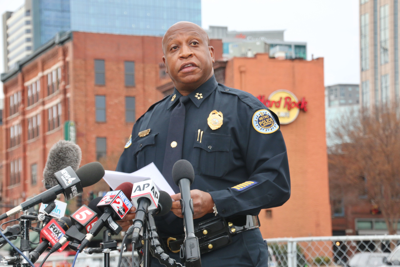


Chief John Drake addresses reporters at a press conference Wednesday afternoon
At a press conference Wednesday afternoon just a few blocks from the site of the Christmas morning bombing on Second Avenue, Metro Nashville Police Chief John Drake defended the department's handling of a warning they received in 2019. The warning: that alleged Christmas Day bomber Anthony Warner was building bombs at his home in Antioch.
The report came from Warner's then-girlfriend, who told police that he was building bombs, and her attorney, who told officers that Warner had the knowledge to do so.
Standing at the corner of Lower Broadway and First Avenue, Drake told reporters that officers who went to Warner's home in 2019 did not have "any evidence or reasonable suspicion that a crime was being committed" and thus "had no legal basis to go into Warner’s fenced-in yard or home." Officers did not seek a search warrant from a judge, but Drake insisted that such a request would have been denied. Steve Anderson was Metro's police chief in 2019 when MNPD received the warning about Warner. Drake was named chief in November. He's been leading the department since August, when he took over as interim chief following Anderson's abrupt retirement.
Since the 2019 incident was first reported Tuesday night, a number of local attorneys have been disputing that notion. Alex Little, who spent eight years as a federal prosecutor and whose work included national security matters, tells the Scene he's baffled by the way the department ultimately dropped the matter.
“This is as clear a warning as you could have had, and the failure to even attempt to get a search warrant is, I think, a real grotesque failure," he says. “They absolutely have gotten search warrants for drug cases on far, far less.”
At Wednesday afternoon's press conference, Drake repeatedly said police didn't have enough evidence and suggested the claim from the girlfriend — who police say had been making suicidal threats — lacked credibility.
“You have a girlfriend that said that, and really they could say that about me," Drake said. "They could say that I’m making a bomb, that I have the ability to do so, but it doesn’t give people the right to go inside.”
Drake said that officers on the scene called Mobile Crisis Services "out of concern for the woman’s emotional state," and she was eventually taken by ambulance to a medical facility.
As for Warner, Drake said officers tried to make contact with him — by driving by his home to see if he was there and calling him on his land line — for about a week, but never spoke to him. The MNPD shared the information they'd received about Warner with the FBI. When asked what he thought the department could have done differently, Drake acknowledged that officers could have done more follow-up, but even then, he argued that they didn't have much to go on.
The revelation of the 2019 incident report raised questions about when Drake knew about its existence and why the department had not released the information publicly until journalists demanded it. Drake said he "believes" he became aware of the report on Sunday evening, Dec. 27. The department regularly releases the records of people it has arrested and charged with a crime. In recent cases in which a police officer has shot and killed someone, the department has quickly released information that is damaging to the person in question or appears to bolster a justification of the officer's actions. But in this case, days went by before the 2019 incident was acknowledged, and only then because of records requests from journalists.
Asked why the department didn't release the 2019 incident report and then follow up with more information as they had it, Drake said: "We have to know what we have. I don't think you want me to put out a report and then stand here and say, 'I don't have any further information, I can't give you any more.'"
Among the things left unresolved by the press conference was a discrepancy between the department's narrative of the 2019 incident and that of the woman's attorney, Raymond Throckmorton III.
Here is Drake's statement about officers' interaction with Throckmorton as they attempted to follow up on the tip about Warner making bombs.
On August 29th, 2019, Officer Pollard phoned the attorney who was on the scene during the suicidal call. During that conversation, Officer Pollard said that he was attempting to locate Warner, and was told that he was known to go on camping trips for weeks at a time. Officer Pollard recalls asking whether he could just take a look inside the RV parked behind Warner’s home. Officer Pollard recalls the attorney telling him that Warner did not care for the police and 'I am not going to be able to let him let you all do that.'
But Throckmorton
told The Tennessean, "I have no memory of that whatsoever," adding: "I didn’t represent him anymore. He wasn’t an active client. I'm not a criminal defense attorney."
Throckmorton couldn't be reached Wednesday afternoon for comment.



Post a comment as anonymous
Report
Watch this discussion.
(0) comments
Welcome to the discussion.
Log In
Welcome to the discussion.
Keep it clean. Please avoid obscene, vulgar, lewd, racist or otherwise abusive language. Comments featuring hate speech or threatening or violent content will not be tolerated.
PLEASE TURN OFF YOUR CAPS LOCK.
Be truthful. Don't knowingly lie or mislead.
Be proactive. Use the “report” link on any comment that violates our comment policy.
Share with us. We'd love to hear your feedback.