
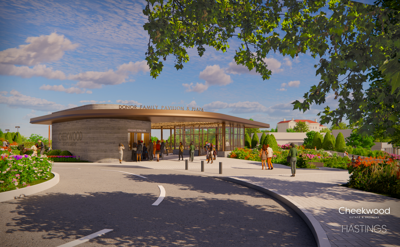

Cheekwood Estate and Gardens officials announced on Tuesday the launch of a petition-focused initiative. The initiative counters a neighborhood group’s effort to stop the construction of a parking facility at the site of the West Nashville cultural attraction.
According to a release, Save Cheekwood (stylized as “SAVE CHEEKWOOD”) is billed as a grassroots mobilization campaign being undertaken as a response to Neighbors for Safety BMH (Belle Meade Highlands) having recently filed an appeal with the Metro Board of Zoning Appeals.
As first reported by Scene sister publication the Nashville Post Tuesday morning, the citizen group contends that Cheekwood, with the construction of its Cheekwood Estate and Gardens Parking Pavilion and Welcome Plaza, is violating the special exception conditional use the BZA granted in 1996.
The Cheekwood Board of Trustees, led by chairman Matt Kisber, notes in a letter addressed to the general public that, if the Neighbors for Safety BMH effort to stop work on the parking facility is successful, the action could cause Cheekwood to cease operations.
"We are deeply disturbed that a self-serving faction of neighbors is pursuing legal avenues that would shutter Cheekwood as Nashville knows it," Kisber writes.
"By attempting to freeze public access and halt construction of a city-mandated parking facility, this group is threatening the future of a nonprofit institution that has served generations of families. We will not allow this treasure to be stripped away from the Nashville community."
Cheekwood officials previously told the Post the future parking facility is not being constructed to grow attendance, but rather to effectively accommodate current-level attendance. About 65 percent of the nonprofit’s annual operating revenue is generated by admissions, most of which comes from attendees who visit the botanical garden and art museum via private vehicles.
The officials added that the parking facility will satisfy Cheekwood’s agreement with the Metro Parks Department, which allows for Cheekwood overflow parking on adjacent Warner Parks property until the 2027 garage construction completion date.
Cheekwood maintains that it is fully compliant with Metro and continues to seek the most effective way to serve the entire community — which includes “city-led traffic solutions like a shared-use Highway 100 access drive.”

Nonprofit recently announced parking structure to satisfy agreement with Metro Parks
The letter offers readers a link that provides facts about the issue and the petition.
“Urge our city leaders to protect this landmark and let the Board of Zoning Appeals know that Cheekwood belongs to all of Nashville,” the letter reads.
“We cannot fight this unprecedented overreach alone. We need the voices of our members, donors, visitors, and friends to send a resounding message of support.”
In addition to Kisber, other members of the Cheekwood Board of Trustees include Neil Krugman, vice chair; Cameron Wells, treasurer; Vicki McCluggage, secretary; and Jane MacLeod, Cheekwood president and CEO.
Metro recently approved Cheekwood’s special exception permit (SEP) application related to the structured parking garage, which could carry a cost of about $25 million. On June 8, Cheekwood communicated to Belle Meade Highlands neighbors that the project received the special exception building permit on May 14. Cheekwood is underway with work on the facility, which will yield 674 new parking spaces and approximately 750 total on-campus spaces when combined with existing parking. The future 750 spaces are 60 spaces fewer than the number Cheekwood has had to date.
Cheekwood is located in an area zoned R20 — defined by Metro as low- to medium-density residential, requiring a minimum 20,000-square-foot lot and intended for single- and two-family dwellings.
The cultural attraction historically has operated pursuant to a conditional special “non-assembly, cultural use” approval the BZA granted 30 years ago. The approval included conditions relating to compatibility with surrounding residential uses, access, screening, lighting, parking configuration and compliance with an approved site plan.
Non-assembly, cultural use is designed for an asynchronous (with events occurring independently of one another), fluid flow of patrons through a public space (such as an art gallery or botanic garden). It is distinguished from “assembly” uses, the principal characteristic for which is a static gathering of people assembling at the same time in the same place for an event, performance, meeting or audience experience.
The Metro Nashville Zoning Code’s "non-assembly cultural" use refers to uses that provide cultural, educational or historical enrichment to the public but do not host large spectator gatherings, events or assemblies.
Specifically, Neighbors for Safety (NFS) and its representative Jackson Moore are asking the BZA to reverse what they contend is an "improper and illegal" approval of the building permit application, enforce the zoning code and the 1996 order, and issue a stop-work order “until Cheekwood can demonstrate how it intends to come into compliance” with the terms of the 1996 order.

Agreement details between parties engaged in legal battle over trademark unclear
This is the latest legal challenge Cheekwood has faced during the past two years. In October 2024, the nonprofit and SB Initiative Inc. finalized an agreement to resolve a months-long dispute regarding ownership of the Swan Ball event and trademark.
Located at 1200 Forrest Park Drive, Cheekwood attracted about 370,000 patrons in 2025. It has drawn upwards of 400,000 visitors some years.
Neighbors for Safety BMH is represented by Chanelle Acheson, a partner with Nashville-based Waddey Acheson. She declined comment.
Formerly the family home of the late Mabel Cheek and Leslie Cheek, the 1930s estate — with its 30,000-square-foot mansion and 55 acres of gardens — serves the public as a botanical garden, an arboretum and an art museum with furnished period rooms and galleries devoted to American art from the 18th to mid-20th centuries.
The property includes 13 gardens — including the Blevins Japanese Garden and the Bracken Foundation Children’s Garden — and a 1.5-mile woodland trail featuring outdoor monumental sculpture.
This article was first published by our sister publication, the Nashville Post.



