
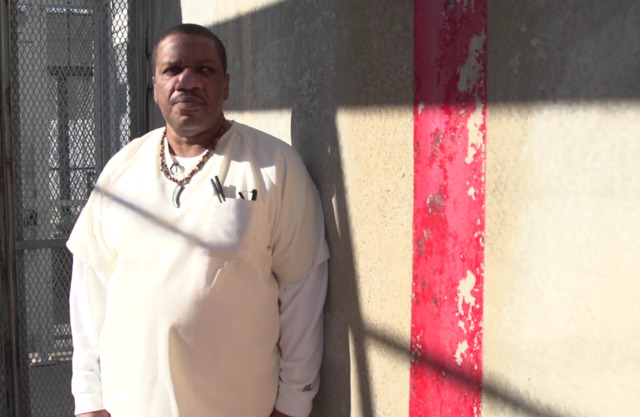

Charles Wright
Charles Wright, a death row prisoner from Nashville who was scheduled to be executed on Oct. 10, died Friday morning at age 64. He was moved off of death row to an infirmary at Riverbend Maximum Security Institution late last year and had been suffering from end-stage cancer for months.
Wright died at 11:57 a.m., a little more than 16 hours after Don Johnson was put to death in a small execution chamber not far from the infirmary where Wright has been bedridden for months.
He was was convicted in 1985 for the murders of Gerald Mitchell and Douglas Alexander during a drug deal in Nashville. The cancer that started in Wright's prostate spread to his bones, and with his death appearing imminent earlier this year, his attorneys and supporters asked then-Gov. Bill Haslam to grant him clemency so that he could apply for compassionate release and die with his family. Two of Wright’s sisters have also passed away in recent months.
Haslam declined that request.
Kelley Henry, the assistant federal public defender who was present at Johnson’s execution Thursday night, has known Wright for nearly 20 years. She described him as a “very easy-going client” who “was always kind and respectful.” He was a skilled mechanic, and he loved Motown music and motorcycles.
“He had a large and loving family,” Henry says of Wright, who was one of 10 siblings. “His brothers and sisters have faithfully visited him since his incarceration in 1985. His passing is particularly hard for his family. They lost their beloved sisters Rose in February and Brenda just last week.”
Before he was moved to the infirmary, Wright was a beloved member of the community of death row prisoners on Unit 2. Some of his fellow prisoners cared for him as his health began to deteriorate. Among them was Don Johnson.
“Charles was a great cook and worked as a cook at RMSI for over two decades,” Henry says. “He had many friends in Unit 2. He received two write-ups during the entire time he was in prison: one for having an extra watch and one for an extra washcloth.”
“I am sure that my guys are hurting today with the loss of Don and Charles in less than 24 hours,” she adds.
Henry praised Wright’s caregivers at the prison, saying they “treated Charles with care and compassion.”
“I am heartbroken,” she says.
A longtime visitor of Wright’s was beloved local news anchor Demetria Kalodimos, who first met Wright when she interviewed him years ago. She remembers a man who was always concerned for her despite his own circumstances.
“He fussed and stressed over whether I locked my doors at home and wanted to make sure I didn't drive my convertible with the top down in bad neighborhoods,” Kalodimos told the Scene in an email earlier this month. “He cooked me special concoctions from his hard-earned commissary food — ice cream made with Kool Aid mix!! He was concerned and protective. He didn't want other men on the row to 'take advantage' of me asking for help on their case or money on their accounts. Only once did I send Charles any money. It was actually the Christmas box the men are allowed once a year. Turns out he had already been gifted one, so according to the rules, mine could not be delivered. I got a refund.”
Noting his execution date later this year, Kalodimos expressed a sort of relief about the fact that he was unlikely to live to see the execution chamber.
“But he's watching his own clock,” she wrote. “He will not have to lay in front of that glass window, with witnesses watching. He will never walk on grass again, until he walks with his savior. For that I am grateful.”



