
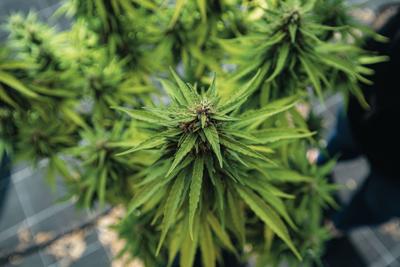
Fears among members of the hemp industry are growing, as a bill progressed in the state legislature this week that they say threatens a $100 million revenue stream and thousands of jobs.
On Wednesday, HB1927 — legislation that would prohibit any hemp-based products from being sold with THC contents above 0.3 percent, including Delta-8 — received another green light from lawmakers. The bill would effectively ban all Delta-8 products being sold in Tennessee. It also adds on criminal penalties for anyone in possession of Delta-8, as it would now be classified as marijuana.
“I think the committee has the votes,” said Rep. Michael Curcio (R-Dickson) as time ran out in the House Criminal Justice Committee hearing. “For the sake of time — we usually give four minutes to each person who testifies — each person will have one minute to testify.”
“These lawmakers made up their minds before hearing any testimony,” says Derek Besenius, co-owner of LabCanna East, a hemp dispensary in East Nashville. More than half of the products Besenius sells at his small shop contain Delta-8.
“If signed into law, this bill would result in an immediate economic loss on the scale of millions of dollars in state tax revenue, family income and certainly business income, including LabCanna’s,” he says.
Retailers like Besenius wouldn’t be the only ones affected. The bill could force hemp farmers to harvest their crop early to avoid being in possession of what would now be considered marijuana.
The bill’s sponsor, House Majority Leader Rep. William Lamberth (R-Portland), said it's not about money but safety. He cites 115 cases of accidental overdoses of Delta-8, reported to the Tennessee Poison Center in 2021. He says 30 percent of those were children under the age of 5.
"It's very disturbing when you hear these stories ... of a child picking up a product that is not properly labeled,” said Lamberth, “that is not properly inspected, is not properly managed, picking that up and going to the emergency room because it has a very high level of THC.”
Many in the cannabis industry question the validity of the alleged overdoses TPC reports. The U.S. Food and Drug Administration's statistics on Delta-8 complications report just 104 adverse events involving Delta-8 products nationwide (with effects including hallucinations, vomiting, tremor, anxiety and dizziness), and a single death related to consumption.
Alex Valley is the founder of Unity Wellness, a CBD beverage company headquartered in Nashville. He says that while his products do not contain Delta-8, the bill causes concern for him because it contradicts the federal Farm Bill, which classifies the non-psychoactive cannabis product CBD — which his products do contain — as legal.
Besenius echoes Valley: “This bill and Rep. Lamberth’s comments go directly against the Federal Farm Bill and the statement from the DEA’s chief of intergovernmental affairs that no hemp-derived cannabinoid is a controlled substance, other than Delta-9 THC.”
The debate over the legality of Delta-8 stems from language in the farm bill that legalizes hemp products with less than 0.3 percent Delta-9 THC concentration. Delta-9 THC molecules are mostly found in marijuana plants but hemp plants do contain small traces of the substance as well. (For more on the difference between the cannabis-derived products Delta-8, Delta-9 and CBD, revisit this feature from last year’s Scene Cannabis Issue.)
Delta-8 supporters argue that since Delta-8 was not explicitly defined in the Farm Bill, there is not a limit on the amount of Delta-8 THC a product can contain.
Both Besenius and Valley say they want to see Delta-8 regulated, just not outright banned.
“Requiring certified lab testing, adherence to packaging and labeling requirements, and dosage limits are a few ways we can ensure consumers are protected,” Besenius says.
“I believe regulation will be a catalyst for adoption and scalability, but banning Delta-8?” Valley says. “It feels like a frantic move from those that don’t understand the intricacies of the space. Why not regulate and tax all of the cannabinoids?”



