
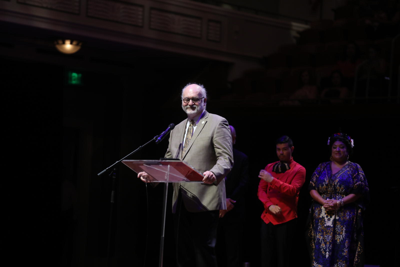


Fabian Bedne
With 15 candidates seeking the five at-large seats on the Metro Council in the August election, it may be challenging for aspirants to stand out in the crowded field.
We spoke with most of them and will publish edited, condensed transcripts of those conversations in the days to come.
First up was Burkley Allen. Today is Fabian Bedne’s turn.
Bedne, an architect by training, immigrated to the United States from Argentina nearly three decades ago. He moved to Nashville 25 years ago and, in addition to his architecture business, he has worked with nonprofits, including the Hispanic Family Foundation.
Bedne is currently finishing his second term as the Metro Council representative for District 31, which includes Cane Ridge in southeast Nashville.
How do you stand out in such a big field?
There are some really great candidates running. Other years, many people would just put their name in and they wouldn't campaign very hard or they didn't have unique ideas or stories to share. This time maybe there are less candidates, but many of them are really amazing and I think many of them will be great at-large council members, so I'm proud to run in that crowd.
I'm honored to run with them. That's the beauty of the at-large race. It's not confrontational as much because people can vote for five candidates. It just creates a better relationship on the trail.
Having said that, obviously I have a unique background, and my stand on issues in the council has been informed by my history and my convictions, so I always tend to have a unique point of view about things. My main thing is making sure that we work to bring justice to people. We should really be trying to address what the majority wants, but also without leaving anybody behind in the process. It's kind of hard to do unless you really take the time to engage with everybody who lives in the city, and that's been my passion, to try to put myself into all the different issues.
What are some of the main issues you've been working on for the past eight years?
For me, housing is important, but we have to be careful that it doesn't become a real estate issue. It has to do with community. Houses are where people live, in the very specific part of the city with a network of support and friends, and that really matters to see the people being successful. For me it's not so much about housing but dealing with gentrification and the impact of displacement. There is a narrative that in Nashville we can address affordable housing if we build houses where the land is cheaper, but that doesn't really address the issue of communities being broken apart. When I was the chair of the Affordable Housing Committee, we pushed forward legislation that will preserve, rebuild, repair communities in parts of the city where we're seeing displacement.
How do you preserve and maintain those neighborhoods? What were those policies?
For example, the Barnes Fund works with nonprofits that will help. By creating smaller projects that allow the city to partner with nonprofits that will help people stay put in the community, you're helping prevent that person from having to sell the house or move to a new house. Some of the things we saw during the transit referendum had to do with creating these transit-oriented developments, and these were big, flashy, massive developments. Me and people like me were pushing for, “No, let’s look at investing and expanding these TODs to where we can also take care of the communities that surround these TODs and help people stay put and preserve displacement.”
How do you plan to communicate that message to voters?
My campaign strategy has been to go to as many neighborhood meetings, as many community events, get in front of as many people as possible to listen and to answer questions and to offer my perspective on how to address those issues. That's what I've been doing since I started running, and that's what I plan to continue doing.
Is it different from how you communicated with constituents in a single district?
That's the way I did things in my district. I will do my office hours every month, and people have my cell phone number, and they'll call me. I will go to neighborhood meetings, and I will use Facebook, Twitter, email blast. My plan is to have a very strong communication pipeline with residents and to ask them for feedback.
Is that harder when running for a countywide position?
It is harder, but that's what is missing, I think. When people call me, I answer the phone, they always go, “Oh, I didn't expect you to answer,” and that's really a bad sign. People shouldn't be surprised that you answer the phone. I always tell people, call me when the problem is small; don't wait till it becomes a huge problem. When it's small maybe we can do something to address it.
It helps me because when people tell me the problem, maybe there's a policy tweak we can do to prevent that from happening to other people. Me getting that information from the residents in Davidson County, it helps me be a better council member. The way I'm running right now is probably the way I'm going to serve after I get elected. Openness and communication, it's key.
I'm telling you this and I sound like every politician, but I've done it. That's how I've done things before and that's what I want to continue doing.
Do you agree with the way the city is handling economic incentives for private businesses?
I think this council was elected with a mandate to get tougher on incentives and each one of us in different ways did that. I had legislation that just passed that requires a match between offering an incentive and the potential impact that it would have by funding the Barnes Fund. For me, it was important that we realize that when 5,000 people come to Nashville that that's going to have an impact on the availability of homes in the city. I didn't vote for the Amazon incentive because I didn't think that we were ready, that we had the infrastructure to absorb that many people. But I think incentives are really a small part of the picture. You hear all over the city that people are concerned about having the infrastructure capacity to carry the people that are in the city, so I think that's key.
I'm filing a resolution that is going to work on something that I think is key to do a better job with budgeting, and that is called participatory budgeting. Participatory budgeting allows citizens to have a more direct impact in how we spend the city budget to deal with the built environment. If we do that, if we can help the local residents to help us find solutions to the problems, we'll be better equipped to deal with those deficiencies.
Anything else voters should know?
Equity is more than a word. It really means a lot to me: equity in transit and education and services to make sure that we don't leave anybody behind. It's our main responsibility right now, and everybody paid taxes for a long time to get us where we are. Now we have a responsibility to make sure that everybody has access to services.



