
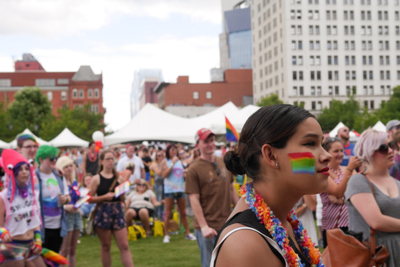


Attendees at the 2015 Nashville Pride Festival
A federal appeals court on Wednesday ruled in favor of two preachers who were told to take their anti-LGBT message across the street from the 2015 Nashville Pride Festival at Public Square Park.
The protesters — John McGlone and Jeremy Peters — sued Metro after they were “ordered to leave a public sidewalk, or else face arrest, for preaching against homosexuality outside of an LGBTQ pride festival in downtown Nashville.” But last year, local federal district court Judge Waverly Crenshaw agreed with Metro that the case should be dismissed because the protesters were still permitted to preach to festival attendees for four or five hours, even though they were told to move across the street. The court’s task, Crenshaw noted, “‘is to strike a balance between the rights’ of event organizers and counter protesters.”
But a three-judge panel of the Sixth Circuit Court of Appeals disagreed, and on Wednesday the panel reversed Crenshaw’s ruling and found that Metro violated the preachers’ free speech rights by enforcing a “restriction against the preachers because of the anti-homosexuality content of their speech.” The case was sent back to the district court.
Metro Legal Director Jon Cooper says his office is still reviewing the appellate court’s decision and will decide whether to ask the full Sixth Circuit to rehear the case.
McGlone and Peters originally set up their protest on public space that was outside the festival’s barricade but still within Pride’s permitted area. Festival security and police did not ask others in the area outside of the barricade to leave.
“The First Amendment does not give you the right to stand exactly where you want,” Metro attorney Keli Oliver said during oral arguments before the appeals court earlier this summer, according to Courthouse News.
But the appeals court ultimately disagreed.
“Nashville excluded McGlone and Peters from a traditional public forum for expressing a message opposed to homosexuality and Nashville provides no compelling reason for doing so,” Judge Alice Batchelder writes on behalf of the panel.
But in a dissent, Circuit Judge Karen Nelson Moore disagrees with her colleagues. She writes that it was reasonable for officials to ask the protesters “to continue shouting disruptive messages through bullhorns during a permit-authorized event in a public park.”
“The First Amendment requires individuals and groups to tolerate the expression of many views with which they disagree, but it does not require anarchy,” she writes. “In this case, a municipality sought to regulate the position of a group of continuously disruptive speakers with bullhorns in order to prevent that group from interfering significantly with another group, which had secured a permit enabling it to use public land for its own expressive purpose. The municipality regulated the first group’s position in a way that did not silence them or seriously curtail their communication; it simply required them to cross the street.”



