
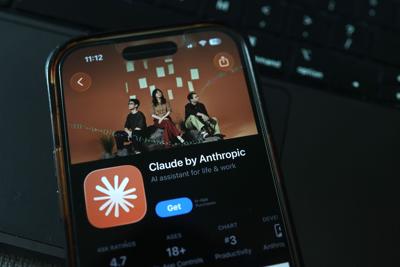

Cybersecurity attacks could become more prevalent over the next several years as AI capabilities increase, an official with AI company Anthropic told a board of state business and government leaders Monday.
Thompson Paine, head of geopolitics at Anthropic, gave a presentation to the Tennessee AI Advisory Council on Nov. 16, during which he noted that governments should be preparing for an increase in cybersecurity threats perpetuated by AI in the coming months and years.
“We really feel we are entering into a pretty tumultuous cyber era over the next six to 24 months,” Paine told the council. “We want to make sure that we are protecting American critical infrastructure as best possible.”

Looking at how real-life Metro employees are keeping these tools safe and accurate
Paine said Anthropic wants to work with the state of Tennessee and other state and local governments to prepare for a “coming wave of cyberattacks.” He told the council this can be done through implementing cyber defense programs for governments and focusing on protecting critical infrastructure like power, water and transport. He also suggested widely deploying open-source software that can provide free recurring scans.
“AI is giving not just traditional attackers advanced capabilities; it’s giving anyone advanced capabilities," Paine said. "I don’t need to know anything about writing code to build software. That means I also don’t need to know anything about cyberattacks to execute a cyberattack now. I think that’s where we’re very concerned.”
He said the challenge comes with finding the vulnerabilities in current systems and working to quickly fix them.
Paine also referenced increased tensions between the U.S. and China in the so-called AI race. This includes reports from Anthropic last year saying that Chinese hackers used Anthropic AI chatbot Claude to target about 30 companies and government agencies. This is largely believed to be the first cyber espionage campaign carried out by AI.

Microsoft OneDrive and Box still off limits, leaving research and coursework in jeopardy
Tennessee Attorney General Jonathan Skrmetti, who sits on the council, questioned Paine about the future of the competition with China. Paine noted that it’s estimated that the U.S. is six months ahead of the Asian power when it comes to AI. And while China has leading talent and cheap and abundant energy, the country lags regarding indigenous compute.
“They are several years behind us on the ability not just to produce chips at the same quality of [AI] chip companies in the U.S. like Nvidia, but also at the same quantity,” said Paine, noting that if federal policy says China has less access to U.S.-made chips, then the country will fall even further behind.
Nvidia — currently shrouded in its own espionage scandal — said Wednesday that it will stop shipping certain chips to China.
Monday’s presentation comes at a key moment for Anthropic, which on Wednesday sold more than 956 million shares at $83 a piece, breaking a record for an initial public offering and making it one of the highest-value companies in the world.
Anthropic raised approximately $79.4 billion through the IPO. The company later said in a statement that other stockholders sold more than 23 million shares, bringing the total earnings to more than $83.1 billion. The offering was oversubscribed, and both the number of shares sold and the price per share exceeded Anthropic's initial expectations of 825 million shares at $70 to $78 per share.
The Anthropic presentation also follows an uptick of cyberattacks and communication outages across the U.S. — including at companies such as Microsoft, United Airlines and Apple and at agencies like the Federal Aviation Administration and schools including Vanderbilt University.
This article was first published by our sister publication, the Nashville Post.



Post a comment as anonymous
Report
Watch this discussion.
(0) comments
Welcome to the discussion.
Log In
Welcome to the discussion.
Keep it clean. Please avoid obscene, vulgar, lewd, racist or otherwise abusive language. Comments featuring hate speech or threatening or violent content will not be tolerated.
PLEASE TURN OFF YOUR CAPS LOCK.
Be truthful. Don't knowingly lie or mislead.
Be proactive. Use the “report” link on any comment that violates our comment policy.
Share with us. We'd love to hear your feedback.