
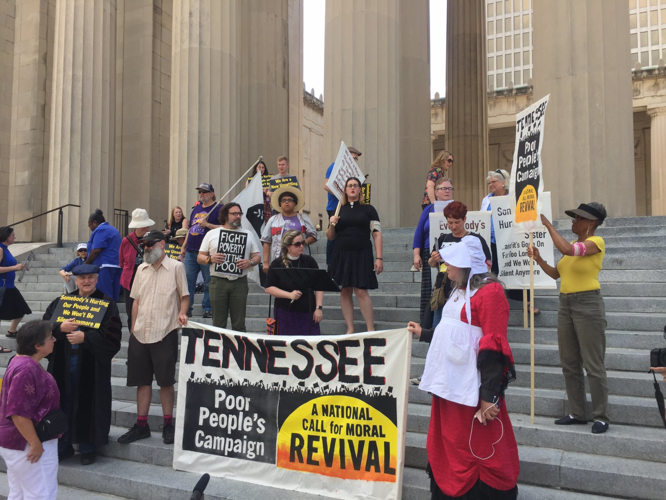
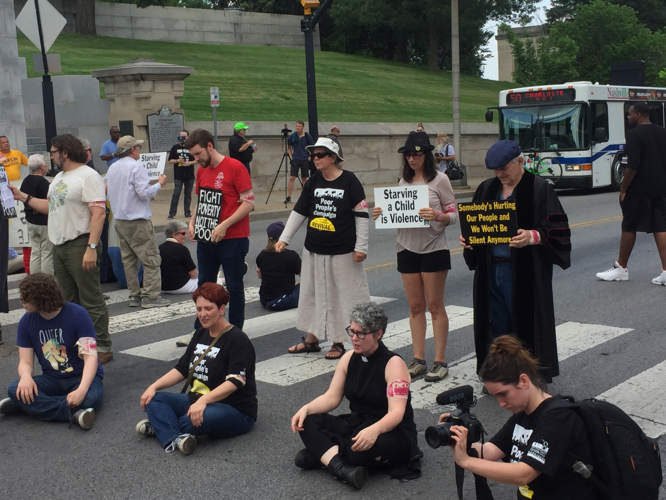
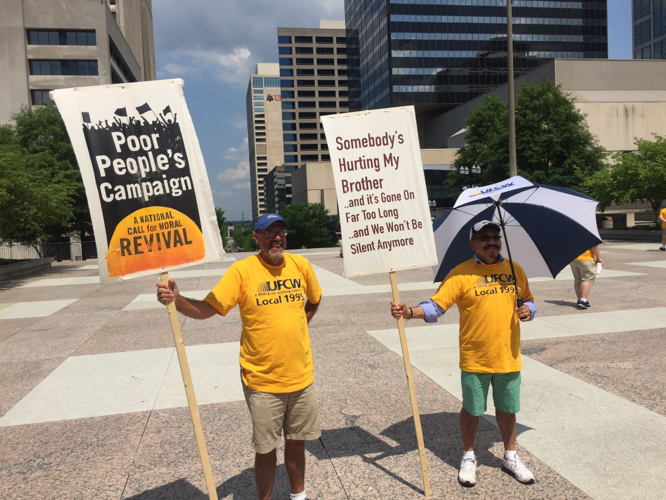


Calling for a "moral revival" in America that brings the suffering of poor and marginalized people to the forefront, a diverse group of local activists gathered on the plaza outside War Memorial Auditorium this afternoon to renew Martin Luther King Jr.'s Poor People's Campaign. After blocking downtown streets surrounding the state Capitol, they took to marching, singing the songs of the original movement, declaring that "before this campaign fails we'll all go down to jail."
"We are following in the legacy of Dr. King," state campaign co-chair Beth Foster told the Scene, explaining why she was willing to be arrested as she sat in the middle of the street on Charlotte Avenue near the Capitol. "We are lifting up the same issues that Dr. King was lifting up 50 years ago with civil disobedience, which is systemic racism, poverty, the war economy, and we've added ecological devastation. And we know that we have done all those things to be heard and none of them have worked."
Actions like this, she said, might finally break through what she called "a distorted moral narrative."
The movement, Foster said, seeks "to say these are the moral issues of our day, as they were in the days of our grandparents and great grandparents, and until these moral issues are addressed, we can't become the country we've never been before."
Although Metro police officers and state troopers had gathered around the demonstrators, diverting traffic, no arrests had been made as of this writing.
Activists around the country are taking part in similar demonstrations, kicking off 40 days of protest aimed at drawing attention to the same issues raised by the original movement, plus one or two. Protesters in Raleigh also blocked traffic Monday afternoon in front of the North Carolina Legislative Building.
Among the crowd in Nashville were clergy, Muslim activists, black and white union workers, red-clad members of local Democratic Socialists of America chapters and LGBTQ activists. Before taking to the street they spoke of local poverty, like neighbors bathing their children under another neighbor's water spigot or being forced to take dog antibiotics for a tooth infection because of the cost of dental care. They spoke of immigrant families facing ICE raids, women facing abuse in prison and transgender people facing violence while state legislators debate laws about bathroom use. And they frequently referenced the targets of the original movement, and refusing to rest on past victories.
"Fifty years ago, crowds gathered in our nation's capital to remind our leaders of their commitment to establish justice, ensure domestic tranquility, provide for the common defense, promote the general welfare and secure the blessings of liberty," said Metro Human Relations Commission member Marissa Richmond. "Those words were not a reality for many then, and they remain an elusive goal for many today. The promises of an end to poverty and discrimination ring hollow when many still go to bed hungry and are denied gainful employment or are ripped away from their families because of ignorance and discrimination."
They promised to be back on Monday "and the Monday after that, and the Monday after that."
In The Atlantic's recent special issue commemorating thew 50th anniversary of King's assassination, Rev. William Barber II wrote about the revived Poor People's Campaign, of which he is a national co-chair.
In 1968, the idea—a Poor People’s Campaign to unite activists from across the nation and bring them to Washington to shut down the government, to bring the issue of poverty compellingly to the fore—looked impossible. Except there was no other way. The tent city in Washington was snuffed out after six weeks by riot police and tear gas. Even so, the campaign had a lasting influence on national policies, as seen in the additional spending for Head Start, subsidized school lunches and food programs in poverty-stricken counties, and the creation of the Children’s Defense Fund, which has pushed legislation to help poor children and families for the past half century.Still, we have never completed the Reconstruction that our federal government admitted was necessary after the Civil War. Just as the Poor People’s Campaign proposed, the Reconstruction we need now must arise from the efforts of people harmed directly by racism, poverty, environmental degradation, and the war economy. That is the inspiration for the new Poor People’s Campaign: A National Call for Moral Revival, which is coordinating direct actions across the country that will begin in May. Activists in at least 32 states and Washington, D.C., will join in 40 days of civil disobedience, including an encampment in the nation’s capital, in hopes of building the power of the poor and the working class to reset the national agenda.
See some more photos and videos from today's demonstration below.


%{[ data-embed-type="oembed" data-embed-id="https://twitter.com/iamstevenhale/status/996118496273723398" data-embed-element="aside">



Post a comment as anonymous
Report
Watch this discussion.
(0) comments
Welcome to the discussion.
Log In
Welcome to the discussion.
Keep it clean. Please avoid obscene, vulgar, lewd, racist or otherwise abusive language. Comments featuring hate speech or threatening or violent content will not be tolerated.
PLEASE TURN OFF YOUR CAPS LOCK.
Be truthful. Don't knowingly lie or mislead.
Be proactive. Use the “report” link on any comment that violates our comment policy.
Share with us. We'd love to hear your feedback.