
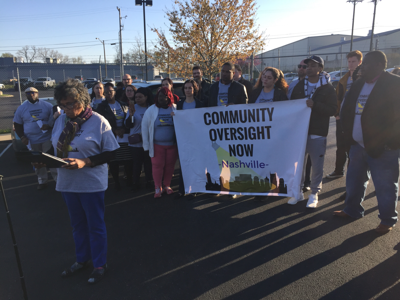


Community Oversight Now at MNPD's East Precinct
In the year since Metro police officer Josh Lippert shot and killed Jocques Clemmons, the Metro Nashville Police Department's East Precinct has been a frequent site of protest.
For months, Clemmons' mother Sheila Clemmons Lee has set up outside the precinct on Trinity Lane in East Nashville, surrounded by family members and supporters, demanding that Lippert be fired and calling for greater accountability for Nashville's police force.
Lippert remains on the force, assigned to desk duty in the records office. And Metro officials, including former Mayor Megan Barry and Metro Police Chief Steve Anderson, have resisted talk of a community oversight board from the start. A proposal to create such a board died at the Metro Council in January.
But undeterred, the coalition of activists that makes up the group Community Oversight Now gathered at the East Precinct Wednesday evening to launch a petition drive meant to force a Metro referendum on the idea. Fifty years to the hour after Martin Luther King Jr. was assassinated in Memphis, the group announced its plan to amend the Metro Charter to include an idea King himself endorsed on more than one occasion.
With several dozen people huddled in the precinct's parking lot — separated from scores of police cruisers by a barbed-wire fence — a series of speakers from the group made their case for civilian oversight of the police department.
At 6 p.m., around the time King was shot 50 years ago, the group paused to play a portion of the last speech he ever gave, the stirring address known as "I've Been to the Mountaintop."
Two experts of Martin Luther King's last speech. He delivered it on April 3, 1968, at the Mason Temple in Memphis, Tennessee. The next day, King was assassinated.
"Why do we need a community oversight board?" said activist Theeda Murphy, one of the group's leaders who used to work for the police department. "We need a community oversight board, in short, because the police cannot be trusted to police themselves."
"Over the past couple of weeks, I've been watching the news, I've been watching Stephon Clark's family," she added, referring to the unarmed black man who was shot multiple times in the back while standing in his grandmother's backyard in Sacramento. "I saw his brother in the city council meeting grieving, angry. And I remember last year at this time when we were in city council and [Jocques Clemmons' sister] Aja was calling out the hypocrisy of the 'It City.' The grief of black families is so dangerous. I was outside when the police were called, and they were lining up with their guns and their tasers and their zip ties to come in and arrest us. Because this family was grieving. This is why we need community oversight, and we need community oversight now."
Calls for a civilian oversight body are nothing new in Nashville and, in fact, activists have been calling for one for decades. Gicola Lane, an activist who has been a constant presence with the Community Oversight Now group and also runs the Nashville Community Bail Fund, spoke about her uncle, who was shot and killed by a Metro police officer in 2000. She recently tweeted clips from an old Tennessean article about the calls for a community oversight board that followed that shooting and four others that had happened that same year.
Wednesday's press conference also included comments from Monica Blake, a Metro police officer who says she filed numerous complaints about commanding officers — "including hostile work environment, racial and gender discrimination, social media misconduct, fairness and impartiality, failure to adhere to policy, and even potential criminal misconduct" — that were largely ignored. She says she was ultimately decommissioned for raising the concerns.
MNPD spokesperson Kris Mumford tells Pith that Blake's complaints have been referred to Metro HR and are being reviewed, but that she could not comment further on the specifics of open cases. Hearings in two open internal cases involving Blake have yet to be scheduled. Mumford also says Blake was decommissioned for "expressing fear of wearing her uniform and her gun" and clarifies that being decommissioned does not mean an officer is fired, only that they are stripped of police powers until the case is resolved.
In closing, Dr. Sekou Franklin, a Middle Tennessee State University professor and longtime North Nashville community activist, framed the movement as a continuation of the one led by King and others decades ago.
"We stand at a critical moment in Nashville's history," he said. "We celebrate the tradition of nonviolent resistance and the legacy of Dr. Martin Luther King Jr., who himself was a radical freedom fighter who was assassinated 50 years ago. We are the children and the grandchildren and the political kinfolk of Dr. King and belong to a tradition of freedom fighters and liberation activists such as Diane Nash, James Laws, Myles Horton, Ella Baker, Kwame Lillard, Rip Patton and a countless number of unrecognized voices that struggled with Dr. King and in the 50 years since his death."
Franklin highlighted the fact that women, and women of color in particular, have led the activist coalition over the past year.
"I want to make a special mention to the women, and particularly the black women and women of color, in Nashville and in this coalition who quite frankly have anchored this movement," he said. "In the words of Shirley Chisolm, they are unbought and unbossed. And their leadership is just as important to Nashville today as Diane Nash's leadership was 50 years ago."
In order to get the COB on the November ballot, the coalition will need to collect 4,300 signatures by August. They say they'll start collecting signatures on April 11.
In a statement through a spokesperson, Mayor David Briley says he is still working to bring the Policing Project to Nashville and will meet with Community Oversight Now.
"Policing issues are very important to me as I continue to work to bring the Policing Project to reality," he says. "I plan to meet with this group to talk about their charter amendment and will determine next steps after the meeting."
The board, as envisioned in the proposed charter amendment, would consist of 11 members serving three-year terms. Seven members would be nominated by the community, two members would be nominated by the Metro Council, and a final two would be nominated by the mayor.
As currently drafted, the board would have the following powers, including the power to compel testimony and recommend discipline:
1. The board shall have the power to investigate allegations that Metropolitan Nashville Police Department (MNPD) officers have committed misconduct against members of the public, as well as issue policy advisory and resolution reports assessing allegations of misconduct by MNPD, recommendations to agencies involved in public safety and the administration of justice, and have the option of establishing a monitoring program that provides an ongoing review or audit of the complaint process administered by the MNPD Office of Professional Accountability (“OPA”) or equivalent internal affairs program in MNPD.2. Where the board finds a basis to believe that an officer has committed misconduct in violation of MNPD policy, the board may refer such matter to the MNPD Office of Professional Accountability (“OPA”) and recommend that discipline be given within the parameters of civil service rules and regulations of article 12 of this Charter. MNPD shall be required to respond to the board’s disciplinary recommendations in writing.
3. The board has the option of forwarding resolution reports that produce factual findings of criminal misconduct and civil rights violations to District Attorney, the Grand Jury, or the United States Attorney.
4. The board shall have all powers, including the power to compel, afforded to other metropolitan government agencies, boards, and entities identified in Section 18.10 of the metropolitan government charter.
5. The board shall submit to the mayor, through the director of finance, an annual budget request of no less than $1,500,000.00 beginning and after the fiscal year 2019-2020, and it shall be the duty of the council to determine if this amount is sufficient for the operation of the board and staff.
This post has been updated to include MNPD's response to Monica Blake's comments and a statement from Mayor David Briley.


Post a comment as anonymous
Report
Watch this discussion.
(0) comments
Welcome to the discussion.
Log In
Welcome to the discussion.
Keep it clean. Please avoid obscene, vulgar, lewd, racist or otherwise abusive language. Comments featuring hate speech or threatening or violent content will not be tolerated.
PLEASE TURN OFF YOUR CAPS LOCK.
Be truthful. Don't knowingly lie or mislead.
Be proactive. Use the “report” link on any comment that violates our comment policy.
Share with us. We'd love to hear your feedback.