
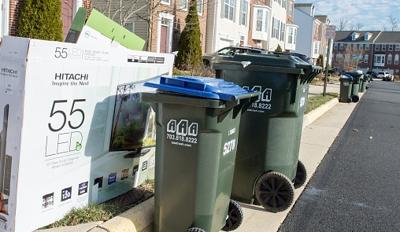

The U.S. Court of Appeals for the Sixth Circuit ruled last week that the discovery of some old joints and marijuana residue in your curbside trash can is not enough to allow police to search your home. The ruling, reversing a lower court decision upholding a search warrant obtained by Metro Nashville police detectives, caught the attention of legal observers because of its rarity, but also because it shines light on a little-known police tactic: sending officers disguised as garbage men to collect the trash of targeted homes and search it for evidence of drug activity.
The case heard by the Sixth Circuit offers a pretty good example of how it works. On April 26, 2013, three Metro Nashville Police detectives travelled together to a home in Antioch where Jimmy Abernathy lived with his girlfriend. They collected his trash and, upon rummaging through it, found the remains of several marijuana joints along with several baggies containing marijuana residue. Just what they were looking for. Based on that evidence, they applied for a warrant to search the home and three weeks later, with that warrant in hand, officers showed up to do just that. Inside they found, according to court documents, “large quantities of cash, marijuana, cocaine and firearms." Eight months later, a federal grand jury indicted Abernathy on four drug and weapons charges.
Abernathy eventually pleaded guilty, reserving his right to further appeals over the legitimacy of the warrant. In March 2016, after he was sentenced to 131 months in federal prison, he filed his appeal and when the Sixth Circuit ruled last Thursday, they vacated his conviction and sentence.
“It’s an irregular result,” says Kevin McGee, a Nashville criminal defense attorney. “You don’t see a lot of times where a search warrant is upheld at the district court level and the Sixth Circuit reverses it. Candidly, I’ve seen several times where [a district court] might suppress something but then it gets reversed in the government’s favor, on appeal, by the Sixth Circuit. So, they’re not exactly a bastion of liberal judges up there.”
What’s not rare is what’s known as a “trash pull.” When he has clients charged with drug offenses, McGee says, some 40 percent of the cases included the tactic. Asked about trash pulls earlier this year, Metro police officials said they didn’t have a record of how often they’re done, describing them as an “investigative tool” justified by the fact that once your trash is on the curb it’s basically public material. That’s essentially true. Trash pulls are used by police departments around the country on the basis that a person has no reasonable expectation of privacy regarding something they’ve decided to throw out.
So, if the police receive a complaint from neighbors about activity at a house or suspect it for some other reason, they will often send detectives to the home to pick up the trash. McGee says he long wondered how exactly they pulled it off, until he was in court one day when an officer was asked to explain.
“They literally dress up like [garbage men],” he says, “and they’ll go out and they’ll hit six, 10, a dozen or more target houses, load their trash up and then take it to a warehouse and sift through it.”
The affidavit used to obtain the warrant in the Abernathy case confirms as much with this comically blunt line from MNPD Detective Henry Particelli: “Within the last 72 hours your affiant posed as a garbage disposal employee.”
In district court, Abernathy had moved to suppress the warrant but also requested a hearing allowing him to challenge the accuracy of some statements in Particelli’s affidavit — in particular a line where the detective said that he had “received information that the occupants” of the house “have been and are currently engaging in illegal drug activity.” At the hearing, the detective would admit that he had not received any such information nor had he obtained any evidence prior to the trash pull suggesting there was drug activity at that address. In the Sixth Circuit’s ruling, the court notes that Abernathy had a long history of drug and weapons charges but that this information was not included in the detective’s affidavit or presented to the judge who granted the warrant.
The district court found that the detective’s statements had been misleading but upheld the warrant on the basis of the evidence found through the trash pull. The Sixth Circuit, however, determined that it was “insufficient to create a fair probability that drugs would be found” in the home.
“In essence they’re saying just because someone’s got some [evidence] that they at one point had weed and then it’s apparently gone because it’s in the trash doesn’t mean that there’s anything more in the house,” McGee says.
Asked for comment on the ruling, and whether it would lead to any changes on the part of the department, MNPD spokesman Don Aaron emailed Pith this statement.
“We respect the court’s decision in regard to the lack of articulation in this particular 2013 search warrant. We do not anticipate any procedural changes.”



