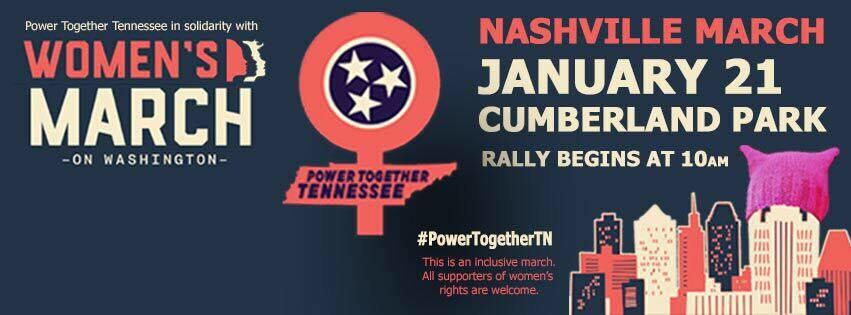
According to womensmarch.com, over 600 women's marches will take place in dozens of countries across seven continents tomorrow (yes, even Antarctica) — people will be taking to the streets in Rio de Janeiro, Stockholm, Seoul, Dublin, Mebourne, Paris and so many more. Here in Nashville, thousands are expected to come out for the 10 a.m. rally at Cumberland Park, marking Donald Trump's first full day as president of the United States with a one-mile march to Public Square Park. As of this writing, nearly 7,000 people have RSVPd via the Facebook event page.
While organizing Nashville's march, the four women leading the movement — Dee Clancy, Sarah Jane Murray, Jennifer Wilson and Darlene Neal — realized they didn't want to commit to just one day of action. In the midst of gathering permits (so many permits) and answering a constant stream of questions (so many questions), they also found time to start a new campaign to help people stay involved. They call it Power Together Tennessee, and the goal is to move past the exclusivity of the "Women's March" title and create a space for all Nashvillians to feel seen and heard beyond Jan. 21.
Just a few days before Trump's inauguration, I sat down with two of the organizers — Clancy and Wilson — to find out more about the march, hear about Power Together's goals and maybe get a little sign inspiration, too.
Tell me about Power Together. What is it and when did that start?
Dee Clancy: It's a new organization that was born out of some of the early angst and discomfort with the idea of Nashville women associating themselves with the Women's March, because there's been a lot of tension and a lot of different opinions. One of the things, when we first started organizing, was we wanted to address the name issue. And in order to do that we needed to differentiate ourselves from the actual Women's March. So Power Together was born. We realized through a lot of our meetings that there really is a need for a group that's not specific to any one issue, but a group that shows unity. We're not talking about uniting the groups — we're talking about uniting actual people from different groups, and people who have never even thought about any kind of civil rights or social justice before, who are really stepping outside of their comfort zones to be a part of this movement.
The Women's March specifically has gotten a lot of criticism because of the name.
Jennifer Wilson: A lot of criticism. That was a big part of why we changed the name in particular. We had a lot of conversations — deep, long, hard, difficult, challenging conversations — about how we are going to step outside of that and have conversations in a respectful way that actually brings people in. We're looking at between 5,000 and 6,000 people showing up on Saturday. Somewhere along the way that we've gone is the right thing to do, because Nashville's never seen anything like this before.
Tell me a little bit about the event.
DC: It starts with a rally at Cumberland Park [at 10 a.m.], and we have a lot of speakers lined up that fully encompass the Unity Principles that the National Women's March put out. I feel that they make one of the best bold and beautiful statements that any national organized group has ever made, because they're so far-reaching and all-encompassing. It's not just about women. It's not about any one group. Anybody falls under one of those unity principles. Everybody in Nashville falls under one of those. Either it's you directly or somebody you love.
JW: Then the goal is for the march to actually begin at 11 a.m. or 11:15 a.m.
DC: We should be at Public Square Park by noon.
Walk me through that planning process a little bit, because I know it turned into something so much bigger than originally planned.
JW: Oh my God. When we first started, we were small and we were doing the First Amendment March, and we did not ...
DC: It was a political march.
JW: We didn't feel like we needed permits. And then we grew, and then we grew some more, and then we grew some more. We met with our city permitting gentleman, city parks and Metro PD. Through that we got everything that we needed in order to obtain the permits. In order to get insurance you have to have security, in order to get security — it's just this long stream. I think I have 25 emails that are going back and forth between all of these organizations, because each one needs a different piece. I'm going to tell you, the city has been phenomenal.
Good. I was going to ask what kind of reception you're getting.
JW: They have bent over backwards to make this happen for us. Gone above and beyond.
When this is over is, what would you recommend for people who are inspired by this who want to keep doing something.
DC: That's what we're hoping [will happen] at the rally. People are going to be exposed to a lot of new organizations that they've never heard of. Our hope is that if one of those speakers or one of those organizations really touches them, and it's something that they're passionate about, they'll join. We're already encouraging them. People that aren't, maybe they're not moved by some of the speakers that are up there, that's OK. Some people maybe just want to go with their kids and take a seat. That's fine. What we're hoping to do is to have concerted efforts every month with different organizations around Nashville, around Tennessee that support those winning principles that we were mentioning earlier. There's more power in unity, and if we can come together and understand that, then I really think it's going to be beautiful.
JW: People get complacent.
DC: We're seeing that. That's why we're marching. Too many people got complacent.
JW: Between the people that are marching in Nashville and the people that are actually going to Washington, there's 10,000 people on our private Facebook page. These are the people that have said, "Hey, I want to be a part of this."
How do you feel about the response? Is it surprising or does this feel like Nashville to you?
JW: This really feels like Nashville to me, although between Dee and I, when we're going through and approving people to join our page, I am always surprised by those that are coming in from outside of Nashville. There's a lot of them coming from rural Tennessee, from Kentucky, from Alabama, from Georgia. I mean, there's people coming from everywhere.
Have you guys gotten any bad feedback as far as from people saying, "I don't want this to happen"? How do you respond to that?
JW: You delete it and ignore it and go on. It happens all the time.
And has there been some backlash for the name change, taking the focus away from the word "women"?
DC: Absolutely, because change is scary. Change is absolutely scary, and confronting prejudices that you may have that you may not even realize, that's terrifying. And we're asking women that are joining this movement to do that, to look deep inside themselves and acknowledge that there might be some not-so-pleasant things. That's OK. We can talk about it. We can bring them up. We can get the result as a group together. That's what we do, together. Getting them somewhere. A lot of women have been very eager to do it, but some have been resistant. There's always going to be people that are like, "I don't need to change. I'm good just the way I am," because change is scary, but you know what? They're still part of the group, because as much as I might not agree with their voice, they still have a right to be heard. As long as they stay respectful, we'll listen. We'll listen to your voice. We'll listen to your opinion. Even if I don't personally agree with it, we're going to listen. You have to be respectful and that's one of the things that we have continued to push from the very beginning. We are not going to affect change if we refuse to respect differences of opinions, and it's worked.
JW: It's worked really well.
It's amazing how people act when you respect them.
JW: It is!
About the march itself, what are some of the things people can bring, be prepared to have and be prepared for?
JW: Be prepared for the weather. Make sure you have water, although we will have water stations set up along the way. Stay hydrated, stay enthused.
DC: We're not putting a lot of restrictions [on it]. There's not a governing law about signs in Nashville, although we are asking people not to put their signs on metal poles or on wooden sticks.
Because of the possible weapon aspect?
DC: Yes.
JW: And we're marching a mile, so do you really want to carry that?
I'm trying to think of something really clever to put on my sign.
JW: We won't be able to march, obviously, but if I were carrying a sign, my whole message is, "This is day one. We have 1,460 to go. I'll see you tomorrow."
DC: I love that. It's so hopeful. "I'll see you tomorrow." We're doing this every single day together, empowered. Beautiful. I love that.