
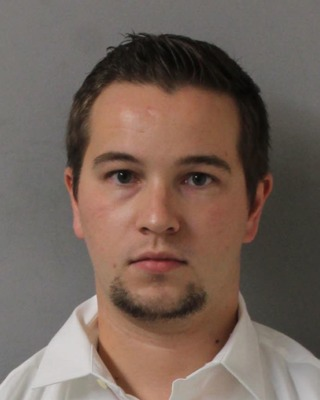

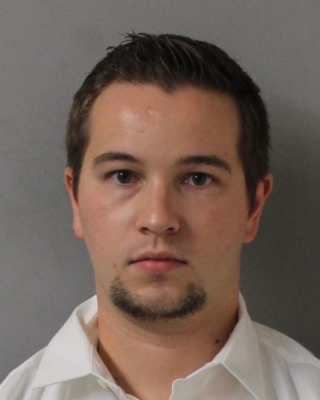
Officer Andrew Delke
Nearly all of the foot chase that ended with a white Nashville police officer shooting and killing a fleeing black man was captured by nearby surveillance cameras. But at a preliminary hearing on Friday, lawyers spent more time arguing about what happened in a moment that wasn’t shown in the footage.
In an interview with Tennessee Bureau of Investigation agents two days after the shooting — portions of which were made public for the first time Friday in court — Metro Officer Andrew Delke said that as he was chasing Daniel Hambrick on July 26, 2018, Hambrick turned and aimed a handgun at him. Hambrick, of course, can not give his side of the story, and the available footage of the incident doesn’t show him aiming the handgun he was allegedly carrying at Delke. But there is a blind spot, a 36-foot strip of grass at one corner of the John Henry Hale Apartment complex that was out of the cameras’ sight that evening. Prosecutors argue it’s not plausible that Hambrick turned and aimed at Delke in that short stretch; the officer’s attorneys say it is.
Delke was charged in September with criminal homicide over the fatal shooting, but Davidson County District Attorney Glenn Funk leveled those charges in a warrant as opposed to going first to a grand jury. Funk said he did so because it would allow a more open process, as opposed to a secret grand jury proceeding that would decide whether Delke should be indicted.
As a result, Friday’s preliminary hearing before General Sessions Judge Melissa Blackburn was only meant to allow the judge to decide whether there is probable cause to send the case to the grand jury for further review. But the hearing mostly felt more like a trial. One side of the courtroom, behind where Delke and his attorneys were seated, was packed with off-duty police officers, police union representatives and other supporters — a crowd that appeared almost completely white. On the other side of the courtroom, the Hambrick family and their supporters sat straight-faced. At times, some family members bowed their heads and quietly wept as the video of Hambrick’s death was played repeatedly in the courtroom.
Few cases receive such scrutiny at this stage, but this one is unprecedented in Metro Nashville history. Delke is the first Nashville officer to face criminal charges for an on-duty shooting. The hearing lasted nearly six hours on Friday and finished on Saturday morning. Delke’s attorneys told the court he followed his training and did not break the law. Prosecutors say a jury should get to make that determination. Blackburn says she’ll release her decision on Monday.
In his interview with TBI investigators, Delke said all the things an officer typically needs to say to justify shooting someone on the job. The officer said he “had absolutely no choice” but to shoot Hambrick and that he was “100 percent” certain that Hambrick would shoot him or others if he hadn’t been stopped. Delke said that he’d shouted at Hambrick multiple times to drop the gun and even yelled “drop the gun or I’m going to shoot you.”
"I said to myself, 'If I don't shoot him right now, I'm gonna die,'" Delke told investigators.
Moreover, Delke said the handgun Hambrick was allegedly carrying had already been pointed at him. He told the investigators that Hambrick turned to face him, and that the gun was pointed at him.
Prosecutors are not challenging the notion that Hambrick was armed — police said the handgun was taken from underneath Hambrick’s body after the shooting, and Hambrick’s DNA was later identified from blood on the gun. But they did make the case that Hambrick could not have turned to face Delke and aimed his gun at him during the short period of time he was in the blind spot — an area attorneys on Friday referred to as “the void.”
TBI Special Agent Steven Kennard testified that his investigation determined the portion of the chase not captured on camera lasted between 1.9 and 2.4 seconds. In that period of time, he said, “it would be very difficult” for Hambrick to have taken the action Delke alleges, given that Hambrick is seen sprinting into the blind spot and then, from a different camera, sprinting out of it. Assistant District Attorney Ronald Dowdy also focused on arguments that Hambrick was not in Delke’s line of sight during that portion of the chase.
But Delke’s attorneys, led by David Raybin, argue that Delke could have seen Hambrick and that Hambrick could have plausibly aimed his weapon at Delke as he ran through “the void.” They cited their own investigation and expert testimony in arguing that the unseen portion of the chase lasted three seconds, and they emphasized that when Hambrick and Delke emerge from “the void,” each appears to be holding a gun.
According to testimony on Friday, and the audio from his TBI interview, Delke had not seen the video footage of the incident when he made his statement. The TBI had declined his request to view it prior to his interview.
If Hambrick pointed his gun at Delke, it would seem to bolster the officer’s self-defense claim. But Delke’s attorneys also argued that the shooting was justified regardless of what took place in “the void.” They highlighted state law that says police can use deadly force if they have probable cause to believe that a suspect is a serious threat to the officer or others. Moreover, defense attorney John Brown said, "An officer is not under any obligation to let an armed suspect have the first shot.”
The arrest affidavit from September says that the chase and shooting occurred when Delke — who was patrolling the area looking for stolen vehicles as part of MNPD’s Juvenile Crimes Task Force — pulled into the parking lot after a car he mistook for a vehicle he’d attempted to stop nearby. When Delke parked, Hambrick took off running, and Delke gave chase. He ultimately shot Hambrick three times, striking him twice in the back and once in the back of the head. Both men were 25 years old at the time.



