
As some 20 kids ran around his backyard, storming a wooden playset that had yet to stand the test of time, Matt Pulle found himself a little nervous.
"There's a lot of lawyers here," he joked, nodding to the overrun apparatus behind a ring of parents who chuckled between sips of their morning coffee.
They weren't standing outside at 10 a.m. on a chilly early fall Saturday for a play date. They were seeking answers as to why Metro Nashville Public Schools Director Jesse Register wants to change where their children and neighbors' children will go to school, and why asking for their input feels like an afterthought.
"We want to defeat Dr. Register's plan," said Pulle, a parent of two and a lawyer in the attorney general's office as well as a longtime Nashville Scene contributor, clearing his throat as he addressed the 70-plus parents. "And we need your help."
As of last month, 15 Davidson County schools officially joined Tennessee's list of "priority schools," which is composed of the bottom 5 percent of schools in the state.
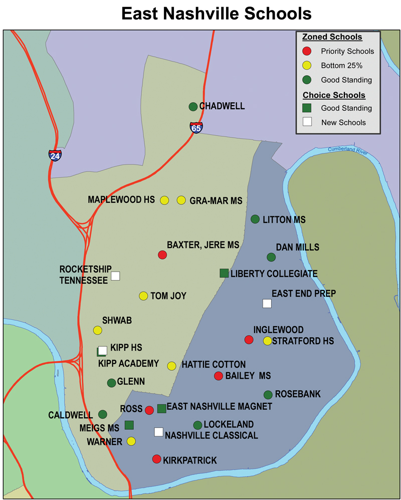
Four out of five kids at these Nashville schools can't read or do math at grade level, according to state tests. These schools dot the map: three in the Stratford cluster and one in Maplewood, three others in the Pearl Cohn cluster, two in Hunter's Lane, and a few spotted in the Glencliff, McGavock and Whites Creek areas.
District-wide, test scores leave something to be desired. While the city's schools have made gains — sometimes faster than the state — they still lag behind Tennessee averages. More than half the city's third- through eighth-graders are behind in reading, math and science. High-schoolers are a little better, with about half at grade level in math and biology. A little more than half show proficiency in English I and II.
Parents all over Nashville know this. That includes those in East Nashville, where many choose to ditch their local school and send their children somewhere else — typically to one of the area's higher-performing charter schools, magnets, or traditional schools with active parents.
The last time the state calculated "priority schools," it identified six in Nashville. This year, the number has ballooned to 15. Another seven of the 26 schools in East Nashville are in real danger of being added to its hit list of "priority schools" in the next few years.
That makes the East Side ground zero for MNPS' latest rebuilding efforts. Four of the state's highest-performing schools share a slice of East Nashville, with more charter schools opening their doors. Meanwhile, lackluster enrollment in traditional schools has left many zoned schools, like Stratford, nearly half-empty.
Register sees an opportunity to fold the low-performing schools into better ones, as a way to erase weak schools from the district map. Then, he says, he wants to give parents there a choice to go to the best school possible, instead of automatically enrolling students in a school struggling to get by.
He and his staff admit the plan is half-baked. But he announced it anyway, with plans to hand the school board a proposal for their approval by year's end.
Despite not having a plan, he has an outline of what he's seeking to do: visit with key stakeholders at each of the schools, decide whether there are principals who need to go, and figure out what the district can do to help. Then he'll decide which schools he'll hand over to charter schools, which to consolidate, and which to close.
At the center of these as-yet undefined plans is the creation of an East Nashville "choice zone" that would erase the current zone lines. There's no grand plan for the Pearl Cohn cluster, however, or other schools just outside the Maplewood and Stratford zones.
Register's had many high-profile fans rally support for his plan. Mayor Karl Dean and Achievement School District Superintendent Chris Barbic have applauded his message on the editorial pages of the daily paper, calling for a community conversation and support for turning around these schools.
The message isn't new. In 2012, Metro announced plans to "quickly transform" what were then the lowest-performing MNPS schools on its priority list. They included a proposal to "accelerate the transformation" of six schools — three of which are still on the list today.
The low-performing "priority" schools share lots of common denominators. All have high numbers of children from low-income families; all are populated primarily with minority students; all have principals with less than three years on the job.
East Nashville parents say they want a plan, but not one that is foisted on them.
"They're building the car as they're driving it," Pulle said. "That's not acceptable."
Dozens of people showed up to his house Saturday morning to listen, including mayoral candidates Megan Barry and Jeremy Kane plus area Councilman Anthony Davis. Several were moved to join Pulle and his wife Christine, currently secretary for the Davidson County Democratic Party, in forming the East Nashville United PAC. So far, the political action committee has raised more than $2,300 to defeat Register's plan.
"Influential people want to push this, but they won't start from scratch unless we mobilize," said Pulle, who added that the group isn't taking a stand for or against charter schools. What they want is for Register to start over and develop individual plans for each school after hearing community input, not the other way around.
Jai Sanders was one of the few parents there from Inglewood Elementary, a "priority school" squarely on the chopping block.
"The kids come there with a myriad of problems," he said, recalling children telling secretaries about the cops at their house the night before, or not having much to eat in the morning. What bothers him is that those third- and fourth-graders' test scores determine the fate of their school, despite the work the school's principal is doing.
There's a lack of trust with the district, parents echoed.
"It's been, 'Let's drop a bomb.' That's the MO," said Amy Phelan, vice president of the Dan Mills PTO, who is thinking of sending her daughter to her zoned school, Rosebank. "There's a plan, and they're not sharing it. We don't trust them. And that's disappointing. They make it hard for us to support them, and we want to."
The group, mostly white, largely middle class, admitted they're missing a few things in their fight. One is diversity in their voices if they want to be heard.
"I hear the frustration, and reasonable people who want the same thing will have different viewpoints of how to get there," says Elissa Kim, the area's school board member, who thrives on data and wants to hear more from parents at the priority schools. "Time, by itself, is not going to solve our problems."
In 2011, when the school system turned Cameron Middle School just south of downtown into charter school Cameron College Prep, parents were worried too. Now, the school is one of the best in state for improving student outcomes. "It's turned out to be a win, literally, for every child in the building," says Kim.
The key, she says, is to spread what works elsewhere into something that works everywhere — starting on the East Side.
Email editor@nashvillescene.com.



