

I begin each day in my mother’s home in North Nashville with a small list of tasks. I rise from my bed, still foggy, and bring the tea kettle to boil. I then unroll a yoga mat on our back porch, stretching out under a sky still freckled by fading stars, and watch the daylight spread — it first bathes the skyline to the east of us in gold and pink before it rises and touches me.
These small tasks have become a ritual over the course of my 10 years living in our home. They are performed with the goal of locating myself in time and space.
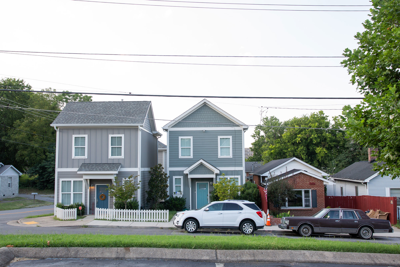
Over the past year, a new ritual has been added to the rest. Before I touch the tea kettle, I stand on our front porch and witness the construction of our street’s first tall-and-skinny. It began with the demolition of a 100-year-old bungalow. The wrecking crew performed the lion’s share of its work in the early hours of the morning, evading the full assault of the sun. It was an unceremonious sight.
The crew had a meticulousness honed by rote repetition. The wooden frame of the house was pulled to the ground with ease, like separating the bone of a chicken wing. Wood and cinder-block remnants were piled and gathered wholesale in the teeth of a sleepy bulldozer.
Entire blocks in North Nashville have been razed, their history erased and their inhabitants replaced with colonies of tall-and-skinnies that attest to the efficiency of these crews’ work.
The arrival of this new home and others like it — in new neighborhoods signifying “New Nashville” — did not occur in a vacuum. There had been signs pointing toward their arrival. The Starbucks on Charlotte Avenue; the appearance of a natural-foods section at the Kroger on Rosa Parks Boulevard where years ago I purchased my first chitterlings; the disappearance of chitterlings from the store; the arrival of white folks navigating the produce section alongside my mother and me, careful not to make eye contact.
The paving of our street was announced by my neighbor. Driving by our house, he called out over his lowered window with a sardonic grin, “The white folks are coming!” His vision held true. By summer’s end, that tall-and-skinny stood in perfect white completion where the bungalow had once been.
To exist while black and unpropertied in Nashville is to live in a state of suspense and wonder. Will my home be next? Where will I go? How much longer do I have a home? The widespread gentrification we are witnessing in North Nashville is but a snapshot in the history of colonization and displacement in America.
For years now, Nashville has been heralded as the new “It City” in both the local and international press. It has taken to this new title with all the gusto and greed one might expect when a city smells newfound admiration and the possibility of money to be made. There is a rapaciousness in the air, bordering on the obscene, as the city contorts, bends, shucks and jives to become whatever version of itself will bring about the largest turn of profit. Those positioned to make money do so, while all those standing outside the circle of profit are left on their front porch wondering when their lives will be razed and paved over.
There is a common thread linking our current situation to a larger American story. Since the arrival of the first slaves, blackness has stood as an impermanent commodity to be removed, replaced and uprooted, unremembered, at the whims of capitalism. Black folk have stood as a nameless, faceless presence to be extorted. While certain among us have managed to break through and make ourselves into individuals to be counted, this must be understood as an exception to the capitalistic American rule.
To the folks coming to claim their piece of “New Nashville,” the people who live on streets like mine do not lead singular lives. At most we are an anonymous bump on the road to greater prosperity. We are as human as a forest to be cleared, a mountain to be blasted through in order to manifest destiny. This is the cool, efficient work of capitalism and plunder.
Those who have been given the loudest platform from which to speak would glibly summarize my community’s displacement as progress. As always, we are collateral damage for the attainment of the “greatest good.” Our pain isn’t counted as pain — our presence is but a temporary placeholder for white permanence and profit.
As the city rolls further and further away from itself, I ask not for the halting of progress. I understand that Nashville is a city that has rightfully captured the imaginations of people the whole world over. Our ability to tell stories that get at the heart of universal truths stirs fascination in music fans from every corner of the earth.
I write this essay in hopes that we all take a pause and consider those of us standing on our mother’s front porch, trying to locate themselves within a city in the throes of rebranding. I sit writing this on my mother’s porch in a full August heat. The for-sale sign has been removed from the yard of the tall-and-skinny. I understand that my time here may not be long.
I write this essay to ask who and what “New Nashville” will stand for.
Adia Victoria is a poet, musician and longtime resident of historically black North Nashville.



Post a comment as anonymous
Report
Watch this discussion.
(0) comments
Welcome to the discussion.
Log In
Welcome to the discussion.
Keep it clean. Please avoid obscene, vulgar, lewd, racist or otherwise abusive language. Comments featuring hate speech or threatening or violent content will not be tolerated.
PLEASE TURN OFF YOUR CAPS LOCK.
Be truthful. Don't knowingly lie or mislead.
Be proactive. Use the “report” link on any comment that violates our comment policy.
Share with us. We'd love to hear your feedback.