
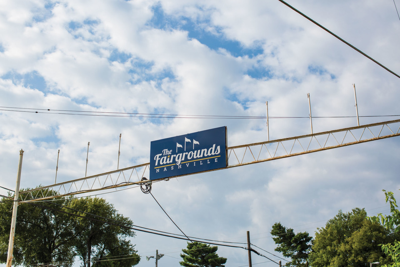


Temporary homeless shelters have been established at the Fairgrounds.
In early March, it became clear that the COVID-19 pandemic would soon hit Nashville. The service providers at LaunchPad, an organization that helps homeless youth ages 18 to 24, took a look at their shelter facilities and decided their guests would be safer somewhere else.
“We just looked around at our own space … we got mattresses on the floor and everybody’s sharing a couple of bathrooms,” says Ty Brown, executive director of the nonprofit. Rather than grouping 20 guests into a shared space as they usually do, LaunchPad organizers instead secured a few motel rooms for them, including one for on-site staff.
“We had decided we were going to take whoever showed up to our normal night of shelter and put them in an extended-stay hotel,” says Brown. “We did not have a plan for it. We didn’t know how long it was going to be. We didn’t know how long we were going to be able to pay for it. But what we did know is … that putting people in a setting with a lot of other people would be a really good way for them to catch the coronavirus.”
Some LaunchPad guests even found housing while staying in the motel, allowing newer guests to take their rooms. As of press time, LaunchPad’s motel stays are slated to end by May 15.
People experiencing homelessness are at high risk for exposure to the novel coronavirus. They may have to choose between staying outside or in a camp, or finding a bed in shelter without a space to self-isolate.
Nashville has opened up temporary homeless shelters to help alleviate shelter congestion, especially at the Nashville Rescue Mission. Currently, Metro operates a tiered shelter system at The Fairgrounds Nashville made up of three facilities: one for healthy guests, one for those awaiting COVID-19 test results, and one for people who test positive. In April, 19 guests at the fairgrounds tested positive for the novel coronavirus, as did 88 guests at the Nashville Rescue Mission. All were moved to the fairgrounds’ “sick shelter,” as it’s known.
After the first four fairgrounds guests tested positive for COVID-19, advocates at Open Table Nashville, a nonprofit that works with the homeless, criticized Metro’s shelter system.
“For over a month, Open Table Nashville and other advocates have been vocal about our concerns that the shelters at the Fairgrounds are not following CDC guidelines and FEMA recommendations,” said Open Table in a statement at the time. “These guidelines state that non-congregate facilities like motels, hotels, and dorms should be used for people who are symptomatic, awaiting testing, positive for COVID-19, and at high risk. Metro has continued to operate congregate shelters with little transparency about what protocols and procedures they are using to keep people safe.”
Dr. Sheryl B. Fleisch is the medical director of Vanderbilt University’s Homeless Health Services Program. Fleisch says that in an emergency like this, it’s important to ease the burden on shelter systems and follow guidelines from the Centers for Disease Control, but that officials should also aim to create permanent supportive housing solutions.
“We are currently meeting minimum CDC standards, and [those] CDC requirements also include pushing for other ways to protect and serve individuals who experience homelessness,” says Fleisch. “And I think there are other creative ways we can do this.”
For example, Fleisch points to gaps in recuperative care, which can provide temporary residence for homeless patients recovering from a hospital stay — she says these programs are currently unable to accept new individuals because they’re at capacity.
Other cities like Los Angeles have established shelter systems, but have also established hotel and motel voucher programs to help homeless individuals find spaces to self-isolate. Memphis also secured 60 hotel rooms for people experiencing homelessness.
In response to an email from the Scene asking whether Metro has considered vouchers, the Office of Emergency Management replied: “When the COVID19 task force started preparing for housing our homeless population we had a number of options on the table. One of those was possibly hotel rooms. However, as we looked at the best way to ensure we could provide a sustainable shelter with resources available the fairgrounds became the best option.
“The fairgrounds is Metro Nashville Property and the combined expo buildings are more than 100,000 square feet of space,” the response continued. “It allows for quarantining and providing a safe environment for our clients. The Fairgrounds will continue to be used as a shelter and we have other options to add more capacity if it is needed.”
Dr. Alex Jahangir, director of Metro’s Coronavirus Task Force, also said in a press conference that the fairgrounds shelter, which hosts roughly 200 guests, is not congregate sheltering.
People who are in the sick shelter are under an enforceable quarantine, which was highlighted when a fairgrounds guest who had tested positive for COVID-19 was arrested last week after escaping the quarantined shelter. The Tennessean reports that the man was the first person in the city arrested for leaving quarantine.



Post a comment as anonymous
Report
Watch this discussion.
(0) comments
Welcome to the discussion.
Log In
Welcome to the discussion.
Keep it clean. Please avoid obscene, vulgar, lewd, racist or otherwise abusive language. Comments featuring hate speech or threatening or violent content will not be tolerated.
PLEASE TURN OFF YOUR CAPS LOCK.
Be truthful. Don't knowingly lie or mislead.
Be proactive. Use the “report” link on any comment that violates our comment policy.
Share with us. We'd love to hear your feedback.