
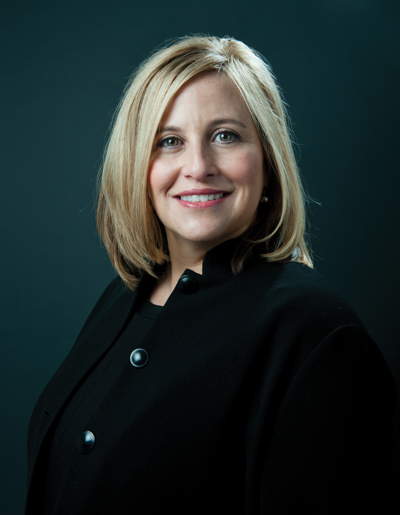

Editor's note: The coming mayoral election in August promises to be one of the most decisive in Metro Nashville's history, in determining the future health and managed growth of a city at a crossroads. In this seven-part series, we profile the people competing to maintain Music City's newfound success, to represent those in danger of being shoved aside, and to steer the city past the shoals of bubble and bust. Read the rest of our profiles: Charles Robert Bone, David Fox, Bill Freeman, Howard Gentry, Jeremy Kane and Linda Rebrovick.
Name: Megan Barry
Birthdate: Sept. 22, 1963
Birthplace: California
High School: Notre Dame de Sion
College: Baker University
Post-Grad: Vanderbilt University
Jobs: Council member at-Large, director of ethics and social responsibility at Nortel Networks, Ethics and compliance officer at Premier Inc.
Memberships: Board member at Center for Nonprofit Management, YWCA and Belcourt Theatre
Family: Husband Bruce, son Max
Rescue dogs: Hank and Boris
Website:
meganbarry.comOn a rainy November night, Megan Barry is working the crowd gathered in a stunning Forest Hills mansion, built in 1843, near Davidson County's southern border.
After nearly three years as a presumptive candidate, Barry, who is nearing the end of her second four-year term as an at-large member of the Metro Council, is officially, publicly, really running for mayor. It's been a year-and-a-half since she filed the necessary paperwork to set up a campaign — and more importantly, to begin raising money. But with the congressional midterms and state legislative elections now wrapped up, the political calendar is a wide-open straight shot to the Metro elections in August.
Barry is the only 2015 mayoral candidate who can boast having won a countywide election, and she's done it twice. After she was elected to one of the council's five at-large seats in 2007, she ran again in 2011 and received the most votes of the five incumbents who won re-election. If she wins in August, she will be the first woman elected mayor in the city's history. There is another woman, Linda Rebrovick, among her opponents, but the previous woman to try it — Betty Nixon, herself a former council member who ran in 1991 — is backing Barry.
This meet-and-greet — with lavish hors d'oeuvres provided and campaign contributions encouraged — is hosted by the home's enthusiastic owners, Dave Bichell, the chief of pediatric cardiac surgery at Vanderbilt University Medical Center, and his wife Terry Jo, a former nurse currently pursuing her Ph.D. in neuroscience at Vanderbilt.
The Bichells have a disabled son at JT Moore Middle School, Terry Jo tells the Scene, and public schools and public transportation are important to them. Terry Jo, who says she likes Karl Dean, met Barry at U.S. Sen. Kirsten Gillibrand's book event in Nashville in September.
"I said, 'What are you going to do better than Karl Dean?' " Bichell says. "She mentioned that what might differentiate her is focus on neighborhoods."
Soon the Bichells call the crowd to attention. They yield the floor to attorney Carolyn Schott, one of Barry's longtime confidants and a member of her kitchen cabinet, who introduces "the next mayor of Nashville."
Standing in a doorway between the kitchen and living room so she can reach the crowds that fill each room, Barry delivers her stump speech. She tells how she was born in California, where her father was stationed at a Marine Corps base, but raised in the suburbs of Kansas City, Kan. She came to Nashville in 1991 to get her MBA at Vanderbilt. She didn't plan on staying more than 18 months, she says, but she eventually fell in love with the city and her future husband, Vanderbilt professor Bruce Barry (who, full disclosure, is a longtime Scene contributor). They had a son and she spent nearly 20 years as a corporate executive, most recently as an ethics and compliance officer for a health care company.
"There is a lot of good talent in this mayor's race," she tells the crowd of affluent potential supporters. "But the one thing that I bring that's different than everybody else is that I've been part of government for seven-and-a-half years, and I've been in business for 20 years. And I get that government is not a business, and as much you would like to think that you can run it like a business, you can't.
"But what you can do is use all those efficiencies that businesses have to make government more effective. And that's why I'm running."
Barry's pitch is primarily focused on economic development, education and transit. On economic development, she cites the city's headquarters relocation deal with Bridgestone announced earlier in the day, which included a 100 percent property-tax abatement for 20 years for the tire-making goliath. She has defended this approach to economic development, arguing in an issue statement on her website that "the fact that cities sometimes overdo it" when it comes to tax breaks and incentives "doesn't mean the entire enterprise is misplaced or corrupt."
Her campaign will argue that this sort of aggressive approach to economic development must be, and can be, balanced with a focus on neighborhoods.
"We can't let the economic growth that we're experiencing also impact the way our neighborhoods are thriving," she says.
On education, Barry presents herself as the realist in the room.
"Guess what?" she says. "People who want to pretend that charter schools are going to go away are wrong. And people who think that charter schools are going to take over our entire schools are wrong too. There is a balance, and they both have a place in our public education system. They are both public schools."
Still, her personal experience, she later tells the Scene, has emphasized the importance of neighborhood public schools. Her son, who is now a sophomore in college, grew up attending public school — a goal for their family, Barry says. That lasted all the way through ninth grade, when she says they found that Martin Luther King Jr. Magnet High School's focus on science and math "was not a good fit for him." Faced with the same choice as many Nashville parents — between philosophical support for public education and their own child's future — the Barrys enrolled him in University School of Nashville, a private school.
Barry says the decision forced her "to eat a lot of crow" and has made her "kinder and gentler" when the issue of schools comes up.
"What it does is, it makes me even more committed to this idea that parents need to have really strong local schools that get their kid all the way through," she says. "Because the majority, 72 percent, of those kids are on free and reduced lunch. Where are they gonna go? They're not choosing to go to Father Ryan when it's not working out."
It's in that spirit she tells the full house that in her administration "we will have universal pre-K, and we will find a way to pay for universal pre-K across all of Nashville's kids." That leads to an issue fundamentally linked to public education, and one on which Barry is staking much of her run.
Transit is undoubtedly one of the biggest concerns facing Nashville's next mayor. The candidate has explicitly said that Nashvillians need to get out of their cars, and that her administration would pursue policies overtly designed with that purpose. She also says the entire vision for transit in Nashville — including all modes from bikes to buses — should reside in one place, and she plans to appoint a transit czar to oversee her vision from the mayor's office.
"But at the end of the day, all of this doesn't matter if you all don't help me get elected," she says, to laughter and applause. From the kitchen come shouts of "Go, Megan!"
Barry's reputation as a local progressive stems in part from the company she keeps. Her home, just blocks from Belmont University and Hillsboro Village, has long served as the site of semi-regular salons for a certain set of local progressives and Democratic insiders. Experienced Democratic party operative Sean Braisted serves as her campaign spokesman, and Claudia Huskey, also a veteran operative and former senior aide to Vice President Al Gore, is managing the effort. She counts people like Mary Mancini — who may well be the new Tennessee Democratic Party chair soon after you read this — and Lisa Quigley, Rep. Jim Cooper's chief of staff, as friends and supporters.
The label is also tied to her sponsorship of two pieces of council legislation in particular: one to add nondiscrimination protections for gay, lesbian and transgender Metro workers, and the other to enact a living wage for Metro employees. Both met with mixed results; the latter ended up raising the wages of only 14 workers who were being paid less than $10.77 an hour.
Since announcing her mayoral candidacy she has, not surprisingly, taken a more public stand on several issues. In September, she declined to participate in a candidates forum hosted by the Nashville Business Coalition because of its $250-per-ticket price tag, and in October, she opposed a council bill that would have raised the salaries of the next mayor and Metro Council by more than 30 percent, criticizing both as misguided in light of the struggles of average Nashvillians. She was also the only mayoral candidate to speak out about Amendment 1, opposing the constitutional amendment that eventually gave the state legislature more power to regulate abortion.
But in her time on the council she has also maintained high scores from the Nashville Area Chamber of Commerce and supported the Dean administration's agenda at every turn. She has backed his slew of economic incentives deals, laden as they are with tax breaks for massive corporations; supported financing for the half-billion-dollar Music City Center; and on and on. She was also the lead sponsor of a bill to demolish the Fairgrounds Speedway as part of Dean's failed plan to redevelop the property — an issue rendered moot by a referendum in 2011, but one that could still be the source of lingering resentment in some quarters.
Barry was not alone of course, as most of Dean's initiatives have passed with overwhelming majorities. But some progressives on the council have pushed back against them, and Barry's disinclination to do so — be it squishiness or shrewd political calculation — is a point of contention with critics on the left. According to one stream of conventional wisdom, her campaign may test whether she can continue to balance progressive cred and straight A's from the chamber — or if the balancing act will eventually turn off too many voters on both sides.
Then again, there are those, like Barry supporter Walker Mathews, president of R.C. Mathews Contractor, who tell the Scene that simplistic progressive-vs.-conservative divides are the wrong way to frame Barry's candidacy.
"Whether I agree with Megan on any of her social issues or not, I strongly agree with where she's going in terms of the vision she has for our city," says Mathews, a self-described conservative Republican who cites Barry's chamber rating as a reason for his support. "I support her for the same reasons that I supported Phil Bredesen and Karl Dean."
Barry avoids highlighting differences between her potential administration and Dean's — not surprising, given their alignment over the years. But in a conversation with the Scene at her living room table, they emerge.
Perhaps the biggest departure is in her plans for the city's transit system. She has distanced herself from The Amp, at least in its current form. And she wants to try out fully subsidized public transportation ridership, as a pilot program. She says she was in Edgehill recently talking with people about how they have to pay to get on, ride downtown, then pay to transfer — a real expense over time for people who rely on public transit.
"If you lived 10 blocks in from Edgehill to the Gulch, and you had a $400,000 apartment or a condo, your transit is free because you've got a connector that goes all around downtown that will take you where you need to go," she says. "That seems like a miss. So, in my administration we would pilot having an increase in ridership conversation by making transit accessible by making it free."
If that sounds a little optimistic, Barry points out that Metro taxpayers are already giving a significant subsidy to the Metro Transit Authority — more than $36 million in the current budget. The revenue generated by ridership is small by comparison, and it's taken largely from the low- and middle-income Nashvillians for whom transit is a necessity, not a lifestyle choice.
In any case, she says, dedicated funding for transit has to be on the table.
Also on her mind: increased representation for neighborhoods on the Planning Commission — a body often seen as slanted toward developers — and a proposal to offer a slight boost to the Barnes Affordable Housing Trust Fund, which she says she wants to bring up in council soon. She says she's been talking with the Dean administration about directing a small fraction of the taxes generated by short-term rental properties to the fund.
"It's not gonna give us $10 million tomorrow," she says, "But it's about trying to find the ways to have some dedicated funding."
Funding for her own campaign is something Barry the candidate will need to find, fast. Despite being the first candidate in the race — and despite lining up some prominent supporters, such as Martha Ingram — her fundraising efforts have not been impressive. The campaign has said a slow burn was all part of the plan. But as the race heats up, Barry won't be leading the field.
Her most recent campaign financial disclosure, filed in July more than a year into the effort, showed her campaign with just $321,967.36 on hand. Of that, $200,000 came from a personal loan by the candidate herself. By comparison, Charles Robert Bone posted $315,000 from supporters and loaned himself $200,000 on top of that. Barry will certainly not be able to match candidates like Bill Freeman, who has declined even to put a limit on the amount of money he might pour into his own campaign.
Even so, Barry, as you might expect, puts a positive spin on the fact that her schedule is now packed with events — like the one restaurateur Randy Rayburn is throwing for her Thursday night, as a fundraiser and last hurrah for recently closed Hillsboro Village mainstay Sunset Grill — where she'll be asking a lot of people for a lot of money.
"If you actually have to talk to people and convince them," she says, "that's a good thing, because then they're much more likely to push a button for you."



