

Read our interview with Megan Barry here.
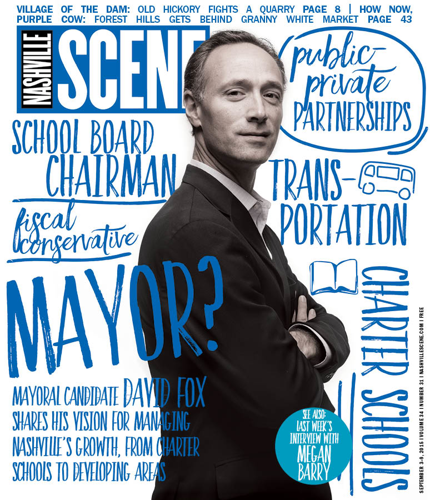
Now is David Fox's time to shine. It wasn't weeks ago when his opponent was on TV bragging about endorsements from other politicians. It wasn't in the first debate, when he stuttered and struggled to land a blow.
He's planned carefully for this moment, when he can seize the election from his opponent's grip. A year ago, Fox was one of six hopefuls racing against council at-large member Megan Barry, a clear front-runner after years of building an early base. His strategy of holding back until late in the game proved a masterstroke in a crowded field, edging him past his even better-funded rival Bill Freeman. His odds were slim, but here he is.
Typically, when someone — much less a political candidate — brands himself as "disarmingly honest," some stifling of the gag reflex is in order. But in person, that's exactly how Fox comes across. He spent much of this year's campaign speaking thoughtfully, and with admirable wonkiness, about solving the city's problems. His occasional stiffness as a candidate, in some ways, makes him more believable.
Yet it's Fox who has manufactured the election's largest controversy: making the race partisan and negative. Although both are centrists, Fox has spent the past month trying to push Barry to the fringes in an effort to distinguish the two. The tactic worked in the seven-person scrum — he made the runoff, then used his election-night platform to shove Barry to the "far left" of everyone else, including him.
In so doing, though, he's pushed himself more to the right. The former hedge fund manager and MNPS board chairman was the first of the two to open a crack in the election's traditionally steely nonpartisanship, framing Barry as a media-hungry liberal to his fiscal conservative. At the same time, he's tried to show her supporters — members of his own social circle — that he has essentially the same position on the social issues she espouses. He's just a lot quieter about it.
That balancing act has been increasingly difficult to manage. On general election night, Fox declared social issues have nothing to do with the mayor's race. To put speculation about his views to rest, he said he believes in a "live and let live" philosophy on abortion and gay marriage. End of story.
Yet as of this writing, he has run four negative ads in an election that has historically seen only one or two. One of his first attacks starred his wife, longtime Scene contributor Carrington Fox, who alleged Barry would "use Nashville as a platform to talk about extreme issues of the social left." Of the remaining ads, two cast doubt about Barry's belief in God, a strategy apparently aimed at black voters who rejected both candidates the first time around.
The ads have polarized the overlapping communities that contain both the Foxes and the Barrys — Barry's husband Bruce Barry, like Carrington Fox, is a longtime Scene contributor. The more both candidates have made religion an issue — from a whisper campaign meant to paint Barry as an atheist, to Barry's subsequent, very public show of faith at a North Nashville prayer breakfast, to Fox's blatant positioning as the more godly choice — the more people who know them want to roll their eyes heavenward.
"This is just outrageous. Enough. I know all these people and their spouses, and in the many meals and hours I've spent with them, not once did we say grace or talk about God," Liz Garrigan, a close friend and former Nashville Scene editor now based in France, posted on Facebook. She now finds herself caught between families she's worked and socialized with for years.
"That we've never spoken of God isn't an indictment or a judgment. It's a fact. Religion is personal, not political, and it's no one's place to judge another's faith," Garrigan tells the Scene. She used to spend time with the two families and was especially close to the Foxes, saying they would throw each other parties for big occasions like new jobs or babies. But now, watching the campaign from afar, she finds herself on the other side politically — and pushed to root for Barry. (It should be noted that some other longtime Scene contributors, such as E. Thomas Wood and Nicki Pendleton Wood, are supporting Fox.)
The flipside is that while gathering endorsements from former rivals such as Jeremy Kane, Fox has also tapped into a support base beyond Nashville Democrats — everyone from NASCAR drivers to Williamson County state legislators Sen. Jack Johnson and House Republican Caucus Chairman Glen Casada. Both GOP lawmakers have demonstrated a penchant for dismantling Nashville municipal policies at the state level, such as undoing the city's gun ban in parks.
Follow big money into the financial picture, and the race gets even murkier. Fox's brother George, a fellow hedge fund manager in Connecticut, cut a $500,000 check to Citizen Super PAC bankrolling support for Fox's campaign. George Fox didn't return calls from the Scene to illuminate the relationship between the "Fox Brothers," a term used by rivals trying to invoke the image of arch-conservative billionaire operatives the Koch brothers.
The brothers' closeness — born out of the tragic death of their mother in the bathtub when the boys were 4 and 6 years old — has only added to the scrutiny. Fox, who became independently wealthy while working with his brother, self-funded at least $1.5 million of his campaign. It's bought him well-produced advertising such as a clever ESPN-esque TV ad of him rehearsing in a bathroom and another spoofing Matthew McConaughey's Lincoln commercial — humorous, winningly self-effacing attempts to recast his occasional awkwardness as a plus.
And yet for all his avowed differences, Fox hasn't said he'd vote differently on many of the projects he's criticized. He hasn't said he wouldn't have voted for the Music City Center, or First Tennessee Park. Business incentives are a necessary part of business, even if he doesn't like them, he says. And in reality, his positions on issues such as affordable housing aren't that far from Barry's.
So who is David Fox? Well, he's not Megan Barry. —Andrea Zelinski
David Fox spoke with SouthComm staff Aug. 21. Present were Fox campaign spokesman Israel Ortega, Nashville Scene reporters Steven Hale and Andrea Zelinski, Scene editor Jim Ridley, and NashvillePost editor Geert de Lombaerde. The transcript has been edited for space and clarity. A full transcript of these remarks will appear on the Scene's blog Pith in the Wind.
You and Megan Barry have a lot of [overlapping] circles of people you know, many of them friends. Does that speak a little to [Nashville's] kind of small-town politics [and] small-town nature?
Yeah. I mean, I think it's a good thing, because you're right: Carrington and I are friendly with Megan and Bruce [Barry], and have been for many years. And I think that's a good thing. You know, I think it's nice that — I mean, getting down to two candidates, we're pretty different folks, like our careers have been different, and our priorities are a little bit different. I think that's a useful thing for Nashville voters. But yeah, that was true about the whole — I mean, we were all fairly friendly with one another.
I didn't know Bill Freeman, had met him before the race, and I'm not sure if I had [met] Linda [Eskind Rebrovick] before, but I knew Charles Robert [Bone], and he's a really nice guy. The thing that was interesting is, you find out people's bases of support. You know, we all have [supporters] — but for Charles Robert, he's got lots of friends — I mean, hundreds or thousands of friends. And it's nice. So it was a good experience. And Bill Freeman and I got to know each other a bit, which was nice. So yeah, I think we still have a little small-town feel going on here.
Does it make this race at all difficult that you guys compete and have this shared network of friends?
I think it's harder on our friends than it is for us — and that's true from the beginning, and it's true now — because a lot of people said, "I'm friends with two, three, four, five, six candidates," and they felt badly about it, because they couldn't support everybody. As a candidate in Round One, oftentimes people would say, "David, I just think there's a great bunch of people running, and we're going to be well served." And I think, well, there are some strong folks running, and I was thinking, boy, how to differentiate ourselves is going to be a challenge for Round One, and that's why I think our volume, you know, voting turnout was on the low end, just for that reason. So it's funny.
So you mentioned having different priorities. On election night, you addressed the social issues right off. You said something to the effect of, "Because of who my opponent is, I want to address these right now and maybe it's the last we should talk about it because it's not something for the mayor's office." Since then, there's been a lot of rhetoric from your campaign, including this latest ad, talking about [how] Megan Barry is on the "far left." When you say that, do you mean the social issues? And if so, why are you still talking about those if
— Well, because I think, what's the basis of people voting for you? You know, I can tell you my plan for affording housing and education and, you know, 50 other things. But in the course of four or eight years, there's going to be a lot of other issues that we don't talk about. And what I think voters are trying to find — what I as a voter try to find — is predictability. I want to know somebody well enough so I can say, "OK, well, if something happens, how are they going to react?" And so I think all that stuff sort of factors into how important one is to be able to discern differences between candidates. So I don't know if that's what —
Are those the reasons that you describe her as on the far left — those social issues, gay marriage, abortion? Those are the
— Well, it's a few things, and a lot of it is, as I said on election night, as you quoted, we share many of the same thoughts as far as on those issues. But I think one of the differences — and it's been coming back to me a lot in the last few weeks as I talk to people — [is] a specific conversation where people say, "Well, I agree with Megan on all these issues, [but] she always leads with those issues." And they'll say, "Well, these are federal issues and we're trying to find somebody who can run the city."
And that's really the ultimate point that I'm making. There are a lot of important social issues, and I don't mean to minimize them. A lot of those are just federal issues, and it depends [on] what you want in a mayor. And I mean that. I'm not being dismissive, because where Megan's passions lie will attract a significant percentage of Nashvillians that say, "Well, that's exactly what I want in a mayor."
But my belief is that a majority of Nashvillians will say — even if they might agree with her social agenda — they'll say, "Well, that's fine, but it's not really the relevant thing of what we want in a mayor; we want somebody who's had some demonstrated expertise in running organizations." And that's where the passion is, and that's sort of what my background is.
I do have social causes I care about. But my passion for running for mayor is mostly about making sure that our city is great now, making sure it's greater in 20 years. And that's sort of basic-management, organizational leadership stuff: what are our priorities and making sure we can get around the city in a reasonable amount of time, knowing what it takes to lead an organization, how to get buy-in. And I just think, as I've looked at it, the experiences I've had with organizations have put me in a reasonably good position to do that, to lead the city in a pretty collaborative way. And I just think our priorities are — we're just different people. And like I said, we'll each attract our own constituencies, and I'm not critical of her opinions; I'm just saying that's what she leads with, and that's my point.
So one of the things that's been coming back to you from the debate [is that she] described your vision as one of "austerity," and you pushed back on that a little. But you have talked about fiscal conservatism, watching spending. Do you envision making cuts to Metro government or the budget? What do you mean?
Right. Well, a little bit was my own fault as far as allowing myself to be painted that way, which is inaccurate, and it happened in our interview [gestures to Hale].
OK.
[laughter] And again, it was my fault. So in that interview early in the campaign — which I thought was excellent — frankly, we got into the conversation by [your] saying, "We've been to a number of these meetings, and people are saying things are going great and let's do this, but then you keep on saying we've got to address this issue and this issue." So we sat down and talked for an hour-and-a-half [about] the problems. And so you wrote a very accurate article, which I was delighted with, but I didn't frame the conversation. And so I have some responsibility for some of those perceptions, but in truth —
Good that we're back at it again now. [laughter] Take a whack at it.
OK. My attitude is, having lived here forever, it's been the growth of the city that has made it so much more of a fascinating place to live. You know, if Nashville were anything like it was 30, 40 years ago, I don't know that we'd be living here. I love the fact that people have moved here from all over the world. It's just a culturally far more interesting place to live and there's more prosperity, and I want us to continue to grow. And we are going to continue to grow.
Where I've talked about some caution is on the public spending — both in the quantity of, like, capital spending, and in where we spend it. There's a time and place for everything, and we invest an awful lot of money to make downtown a very vibrant, economically powerful place. And I think we'll be well served by it, and we'll be down here, I'm down here, a lot. But our needs of today are different from what they were, you know, eight or nine years ago. In my estimation, our urgent needs [now] are of the basic stuff: Our population is growing quickly, we all expect it to continue growing quickly, and we're all experiencing over the past 18 months a conspicuous increase in drive times, among other challenges. And so if we're to maintain our quality of life, we will change our focus from capital projects downtown.
Again, I'm talking about public spending; I'm not talking about the private market. The private market is doing fine. [But one way to] just keep on seeing things expand is to focus on these basics. You know, [Mayor] Karl [Dean] got started with $25 million on sidewalks, which I think is a good investment. We're going to have to sustain for a number of years to make up for what we didn't do in previous years. We've got to re-envision transit in Tennessee.
And the challenge is now that we have had about a billion dollars in debt — long-term debt over the last about six or seven years. It's just like a household: When you spend a lot of money, you take a little breath. You don't sustain it. You don't keep on doing it. And one thing that has concerned me in the process of the campaign is, I just felt like I was the only one who had talked about this. I got the distinct impression that most of the other candidates felt like the capital spending we've been doing is what we need to keep on doing and keep on adding to debt, and I think some believe that that amount of public spending is required to have a great economy. And my view is that if we keep that up and are not careful, that's sort of what ends up killing our economy, because we get overleveraged. So I think I'm just thinking longer term. I think that's the issue. It's not an issue of austerity versus prosperity. I'm thinking about how do we maximize long-term prosperity. And the way we do that is by being fiscally responsible in how we spend our money. And I'm afraid if we have somebody who is focused on immediate-term prosperity and we overspend, then we get ourselves in trouble.
How do you balance that thought with the idea that probably the project with the biggest cap, regional transit, is becoming more emergent by the day? There's a natural tension to everything, right? At the same time, here comes this big project.
That is the tension. That's it — and there's no hocus-pocus. There's no way to dance around it. So at a time when we spent quite a bit of capital to build up this area — I think in a very nice way — well, now we have these basic issues that we're going to have to address to protect our quality of life. And so our flexibility is a little bit less than it might have been. So I think we have to be creative in how we do it. To what extent can we engage the private sector to shoulder some of these infrastructure projects?
That happens around the world more so than it happens in the United States, but it happens. The virtue of doing that, of course, is the debt can stay off our books; the private sector could shoulder it. And also one thing that means — another thing I sort of brought an exception to — part of the conversation was, we'll spend any amount essentially to get the right transit or to get a transit system. And that just scares me, because, again, when you think of how we spend money in our own household, how often do you say, "Well, I'll spend any amount to get a car, or I'll spend any amount to get a house?" That's not how you do it. And so we need to apply the same discipline for other people's money — municipal spending — as we do for our own.
And so [as] we restart this conversation on transit, price has to be a very central part of the conversation. And I don't know what our appetite is right now. I don't know who will join us in the surrounding area, as far as including state or federal funding. But price matters here, and so we'll have to come up with various scenarios and price them out and find out what our appetite is, and then the price will matter.
And it's a few prices. It's the capital expense to do whatever you want to do — and virtually all mass transit in the United States is cash-flow negative. It almost always loses money. They all lose, but I'm not sure if any mass transit programs make money. And that amount of loss makes a difference, because that comes out of your operating budget. That's what funds schools and fire departments. You're right: That is going to be the challenge here — if money were no object, then this would be fairly easy. I mean, you say, "Well, let's just do the light rail kind of all over the place, and if it costs $8 billion, then we've got it." But the cost does matter, and if I'm elected, that's going to be I think the central challenge that I'll be thinking about: How do we pull off moving urgently to shore up infrastructure in a way that we can afford it?
Since money does matter, where is it going to come from? I mean, where is it going to be diverted from, or what revenue stream is going to get reported?
I think it's too early to know as far as how we choose to fund it. I mean, we just don't know yet as far as what — see, I don't think we even have any rough estimate for what we would want to spend on, like I say, a transit program. We don't know ... are we going to just improve by bus system, are we wanting to do light rail, are we going to — you know, people talk about doing, what is it they have at Disney World?
Monorail.
Where people always say can we do a monorail. And the difference between the price of these things is, you know, 20-fold or 30-fold. And the size of the project kind of drives how you end up funding it. Now, one thing about Tennessee that I've just recently learned — I did not know this — is that in the state level, and we're one of I think five states, that we don't use debt financing for transportation projects. It's a pay-as-you-go program. I still am getting my head around that. It's just hard to believe that all the money that we spend on roads and highways and bridges just comes out of — we fund every year. I just learned that last week. So I don't know that that would work for us. I think we would have to have a financing plan.
But again, as I mentioned earlier, you know, there could be parts of this that the private sector could do, which would relieve us of the fund. One reason I go to the domestic violence meetings is both because I think it's an important issue [and] also because I think they have created a very interesting template for how to effect change in Nashville. The mayor, you know, [and special counsel to the mayor's office] Diane Lance and [the late attorney] Jean Crowe and others who put that together — that's one reason I'm following it so closely, because we had a little trouble in Nashville sometimes coming together on these projects because we get kind of divided on this, and people are really on the same team.
And from my perspective, I believe that what they've done on domestic violence, the process is one we can use as a process for all these issues. For transit. For mental health, [which] is an issue I care about. I might do something very similar to that. The point being, the mayor helps identify a problem we have to address, and then pulls together a pretty large group of folks ... gives them a budget, gives them a time expectation for when can you arrive at such solution, has them meet publicly and tries to get the media there, so as they work through this process, people don't feel blindsided. I mean, there's buy-in and then the public engages, so that when that group finishes it's not the mayor saying, "I've got my plan"; it's this group saying to the mayor, "Well, we have a consensus view here, this is what we would like you the mayor to support."
So those are the two reasons why I'm following the domestic violence thing. [Just] the nature of the problem is one I have to take seriously. But also that's a template that I want to use over and over again as mayor, because I just think it's worked so well.
Talking about the problems with our public school system, as you have, how do you think you get public school parents to listen to you — or how do you have credibility with public school parents to talk about the problems facing their kids and the problems facing their schools — when you've taken your kids out of those schools? And some of those parents will of course not have the financial ability to do that.
Right. And that's the issue. And that's why — I mean, y'all have heard me speak a million times, and you know what I get most excited about when my temper starts rising, it's almost always about public education, because very few people in the city historically have treated the educational needs of other people's kids with the same urgency as they treat their own kids' education. And I'm — we're fortunate. We have options. If we don't like our options, we've been able to avail ourselves of other options. And so I think it's incumbent on somebody like myself who does have other options to treat it with more urgency, not less.
I mean, that's why I ran for the school board. It's perplexing to me why my school-board colleagues didn't know that we were in a crisis when we've had sustained years of such low academic performance, especially among those, you know, socio- — you know, free- and reduced-meal kids, and with the big racial gap. I mean, it was right there for a long time. Why be patient on something like that? I don't get that. Again, if you're thinking, "Oh, let's design a plan" in your academic universe or something, I get it. But those are real kids, and I know how much Carrington and I think about doing absolutely everything the best we can for our kids, lest they —you know, something happened to them, and we over-worry about stuff.
So I think you can earn trust by your actions and what you do, and I've spent four years of my life doing the best I could to urgently improve the quality of public schools here. And the first time I thought about running for mayor was when I was thinking — this was probably two years ago — thinking about, well, Karl Dean has been a big deal in education here. He has injected a sense of urgency that is critical to get improvement in the schools, because the elected school board too often is not real effective and doesn't act with urgency. So I started thinking then, well, if we have a mayor who doesn't get it, who thinks it's not on his or her org chart, then we're at great risk.
And that was the first reason I started thinking about, well, is there anything I can do about it? It didn't necessarily mean I wanted to run for mayor; it just means, what's going to happen when Karl's gone, who can fill those — who can play that role? You know, every mayor of every state calls themselves the education mayor. Well, Karl has been the education mayor — and if we don't have [another] one, then bad things will happen in public education. And that's one thing where Megan and I, I think, are on somewhat different pages in terms of understanding what the challenges are and what the role of the mayor is. I think it's important to collaborate as much as you can with the school board, but be a critical friend when necessary.
Let's clarify real quick on charters. You've talked about New Orleans as an example of something where it took a pretty dramatic step in charter schools. Do you envision a wide expansion of charters in Nashville or
— Yes. And that's another thing that routinely gets mischaracterized. I did refer to New Orleans, but it was in response to a specific question or a specific assertion. I think it was in the race when somebody else was asserting charter schools just don't grow to scale. I said, "Well, how can a city [like New Orleans] have almost all their kids in charter schools, yet somebody argues they don't grow to scale?" So that was my point. I mean, to have an entire metropolitan area with charter schools, how can you then say they just don't scale, when obviously they've scaled?
When I said that, then folks said, "OK, that's what he's advocating that we do." I said that's not what I was advocating we do. They were trying to make the argument we've kind of tapped out what we could do on charters, and they can't grow to scale so let's quit, you know, [messing] around with them. My point was, well, that's not true. I don't know what our capacity is. And I really don't care. I mean, I don't really care how many we have. I just think we have to be guided by what works and how quickly can we get there.
One of the things that will drive, I bet you, how many charter schools we wind up with is how effective of a superintendent do we wind up with. If we get a seriously great superintendent, and the quality of our traditional schools improves at a nice clip, well, I bet you the demand for charter schools and interest in starting them will be relatively less compared to if the school board is unsuccessful. And if we have unsuccessful schools that don't get attention and don't get repaired, we'll have more charter schools. But I don't know how many we should have; really, I don't care. I just want the schools to work. I mean, we've seen [the effect of strong principals] — we've seen like with Ron Woodard who ran Maplewood, he made a big difference; Robbin Wall at McGavock, he's made a big difference. And so, [I mean to do] anything I can as mayor to help recruit great principals. We know that's a huge variable in the quality of the school. The other part is, you've got to give them a lot of authority, though. And [former MNPS superintendent] Dr. [Jesse] Register was moving in that direction. I want to see that accelerate a lot. That would be my personal preference. My experience with the organizations is you can get only so much done when central office are making critical decisions.
Ultimately, you've got to hire great people, give them a lot of authority, and then track how they're doing and monitor it. So I tell you I don't understand the visceral response to that. I don't understand it on either side. I'm missing something, and y'all report it, and you see it — the big emotion of, you know, "Charters are awful," and other people who just think that charters are everything. I don't really get it. I guess I'm just pretty pragmatic. That's how I view myself, anyway. Let's do more of what's working and less of what's not. And if that means we have a great superintendent who can ramp up traditional schools, then that's awesome, because that's the easiest.
But if that doesn't happen, how can we morally say, well — some people, not elected officials but some people in the community, have been calling for a moratorium on charter schools. Seeing that most of our top-performing middle schools and year-over-year gains are our charter schools — and if they're predominantly serving at-risk kids, African-American [kids] — we have to be morally justified saying, "OK, well, should I do any more?" I don't get that. I mean, what's the moral basis for that? If we're seeing we've having an unusual level of success with charters ... the argument [for a moratorium] I don't even understand, and I don't understand the ideology.
I just don't think we should indulge ideology here. If we can take a school that's underperforming, we get a better principal, the superintendent does a great job, then that's our most desirable scenario. But where that's not going on, if a nonprofit can come in and start a school that does a better job, I just don't see how morally we could do anything other than that.
You say with charter schools, you look at them more as a pragmatic deal. Knowing that there's need for schools that can move that needle faster, do you see yourself recruiting charter schools here too?
Yeah, I would do that. Like I said, they want me to help them recruit a superintendent, I'll help them recruit a superintendent. If they want me to help recruit great principals, I'll do that. So I'll do anything I can. It's really, really is trying to improve schools by any means necessary. And that's the attitude parents will take about their own kids, and I think we need to have a mayor who takes that same attitude about everybody's kids. It's getting 100 percent successful schools by any means necessary, ASAP. That's kind of my philosophy and ideology. Again, it comes back to the basics: what are we focusing on as a city. You know, let's focus on basic services and make sure they actually work. And so that's kind of my view.
Another topic has been
— Can I get another water?
We're not going to let you out.
I'll sleep out in my car. [water arrives] Thanks, guys.
Another topic that's been a big one in this race is affordable housing. I'm not always sure we're all kind of talking about the same thing. How do you define the problem to the extent that you agree there's a problem of affordable housing. How do you define the problem, and then what is the solution of that problem? Help us define the contours of this.
First, it has emerged in the last two years as a big problem. It's always been a problem. That's why Rev. [Bill] Barnes has been working for as many decades as he has. But this is one of the results of a successful city. And people move here, you see population growth, people develop homes, and that's what we're seeing going on right now. And I don't know many Nashvillians who want Nashville to become an economically homogenous city. I don't — most of us don't want that on just a very human level. Employers don't want that on an employment level. They want to be able to have people in Davidson County they can hire, and it's gotten increasingly difficult in the last two years.
So first, I agree that it's a pressing issue, and it's kind of up there. It's part of my theme, really, of traffic and infrastructure of, OK, we're growing well, but let's not let our quality of life take a beating because we didn't react quickly enough to the growth and success we've had.
So there are three to four things that I would like for us to do. I'd like to see us get pretty bold in the use of incentives for developers. That happens routinely in other states, and the incentives are usually based on the density of something. And increase the density — let's set aside X percentage of them to be priced at below the market. I'm also in favor of putting more money in the Barnes Fund — Barnes Housing Trust [Fund] I guess is the full name — and I like that, because I think if we as a city feel like this is an important priority, then we as a city ought to fund it as a city.
I know we're running short on time, but there's a few things I definitely want to make sure we get to. One of them is a topic I know you haven't covered much, which is the Super PAC. [laughter] I understand that there's another TV ad I think that was reported yesterday is coming. What's that?
I want to say the Tennessean reported yesterday that there was another TV spot coming from the
— From the —
From the Super PAC.
From the one that was involved in my race?
Right.
OK. I was not aware of that.
I fully acknowledge — you commented on this before — that you say you didn't have any coordination with the PAC but also with your brother [George Fox]'s funding in that. But given that the PAC is located — I don't know if it's the same street, but it's pretty close, certainly pretty close to the firm you're working with on your campaign. I mean, even if you personally didn't know, can you see why it might be hard for people to believe that one didn't know about the other in some way or another? I mean, is that
— I can't really control what people believe. And —
You believe that, though?
Yeah. Yeah, I think it's — yeah, it's my understanding if you violate rules like this, it's a serious deal and it's a big deal, so why would anybody throw out their career by doing something improperly, in my view? So —
People do it all the time.
Yeah, but I know my campaign manager [Chris Turner]. I just don't believe he would do something like that. And I know my brother wouldn't do something intentionally that was wrong. So, yeah. So I don't have any reason to believe, and I don't believe, anything like that has happened. I think everything — everything that our campaign has done has been above board. So I didn't know that there was going to be another round of TV ads.
Another thing: The two candidates who performed best in largely African-American neighborhoods/precincts are not in this runoff. Why do you think you didn't do better in those areas?
That's a fair question. Well, [former mayoral candidate] Howard [Gentry] being African-American I think had an advantage first of all over the other candidates. And he's been elected many times. He's a very well-known person in the African-American community. His family has been a leading family here for generations. Bill Freeman made an unprecedented commitment to get involved. I mean, for a year-and-a-half before Bill got in the race, I would see an ad once or twice week, you know, with African-American clergy or civic leaders. And so I think those two factors were very unusual and kind of got ahead of all the rest of us actually.
I mentioned this the other night, [and I] have had the same conversation many other times since then, [but] there's a lot of appropriate cynicism and skepticism among African-Americans — this question of seeing the cycle of politicians troll through the neighborhood and make promises and be there, and then you never see them again. And I told everybody who kind of brought that up or seemed to come in to greet me with suspicion, I said, "Well, I don't blame you. I mean, why would you be anything other than skeptical or cynical of somebody you've never met before coming to you during election time?"
And I just said my commitment is, I want to just learn more about what are the needs of the community, where we can be helpful, I want to build relationships with people in the community, and let the actions when I'm mayor, not my words, earn your trust. And at that point, if I'm able to do that, we'll accomplish some huge things. And so I don't expect to have people's trusts, but I want people to know me and make an evaluation.
That's why we had that event where a fair number of African-Americans attended, and we've got an event at Mt. Zion. And since we don't have a history, I just want them to get a sense for who I am and see if I'm their cup of tea. I don't think anybody feels more passionate in this race about the educational needs and the need for economic revitalization especially among the African-American community than me. I mean, those are probably my two highest passions when it comes to civic life. I just think there's such upside in both of those areas, in both the gaps — in the economic gap and the academic achievement gap — that as a potential mayor of the city I just get very excited about. We can do something about this. We can really make a profound difference on this stuff. I've been thinking for years about what can we do in areas where they need economic revitalization. I mentioned earlier if we're going to do TIFs, let's use TIFs where people need it. And we talked — the entrepreneurs coming here are great. That's a very narrow sort of thing.
See, I grew up in a family of merchants. We've been merchants for hundreds of years. So when I've started businesses, my brother started his businesses, there wasn't any intimidation. I said, "Well, what else are we going to do?" Well, sure, we're going to start a business; that's kind of what we do. But if you grow up in a home where that doesn't happen, first of all you may not even think about, "Well, can I start a business?" And if you do, it's just pretty intimidating.
So let's start doing some things where we can kind of change that. Let's take the — you know, some of the resources of an entrepreneur center — and put it in areas that need it, like with the Entrepreneur Center. If they wanted to partner in, something like that, or we could do it separately, but let's harness the private sector to do it where you have ... first of all, a physical space where you can come in and start a business for a very inexpensive price. We have mentors, people who have started and created and led successful businesses, who are there to coach you along the way. We had access to funding. We had the private equity community, venture capital community. We'll make some capital available, and let's really jump-start it. Like TIF, I said, that's to accelerate the private market. Well, let's accelerate business formation, especially among African-Americans.
I just think there is just massive upside, in my view, both economically and in education for much of the African-American community here. And that's sort of my most passionate area, really, because I think I bring something to the table on both of those things. But again, I don't expect people who have been treated cynically to see me and trust me on day one. But I try to be disarmingly honest in my communications, and I do that to build trust so you don't have to figure out, "Was he saying what he means or means what he says?" And so I'm just excited about arriving at a point where there's real trust both on the school board issue and among the African-American community so we can get this — I think we can get an extraordinary amount done. That's why I'm running for office. I mean, I want to get something done. I'm not running for anything else. You know, I love being in business; I want to go back into business. But while I'm doing this, if I'm lucky enough, that could make a huge difference, and these are areas that I really care a lot about. So ... [stands up, puts on jacket]
I know you've got to go. Let me squeeze in one more thing here real quick.
Fox spokesman Israel Ortega interjects, "Let's make it short."
Let me put it this way: Taxes are going to have to go up in your time in office if you're elected; is that accurate to say?
No, I don't know that —
How would you avoid doing it?
Well, look around. I mean, property taxes are a very important part of our base here. And our property tax base is growing at a very nice clip. So I don't take it as a given at all that we'll have to raise taxes. In fact, my proclivity is to live within our means, not to raise taxes.
So no, I don't have any expectation that that will happen actually. I think our tax rates are ample. We get plenty of revenue from retail sales and from property taxes, and the way we're having such an increase in high-valued property, I think we should be able to live within our means.
Could you imagine cutting them?
Is that possible or is it -— It's possible. It's just not a promise, but it's possible.
If you get elected, do you have a transition routine in place?
[moving toward door] I'm still working on that. And that's one thing I wish we could change. I mean, I wish there were a two-month gap between the election, because I'm doing both now. I've been doing it for a while, but campaigning and I'm also working on who do I want in the senior leadership positions. And it's just — it's just difficult to balance both, and it's the most extremely important.
When I started [a] business in the past, I've had months to work through and figure out who's the right fit. I don't feel pressure about the campaign, I really don't. I feel good about it. When I think of pressure, it's thinking, "Man, I want to have the right leadership team as soon as close to day one." And it's just difficult to make it happen while we're doing these other things.



