

From the outside looking in, it might appear as though East Nashville's Maplewood High School struggles to provide its impoverished students with opportunities to succeed and thrive. The task is a tall one: Maplewood stands in the bottom 10 percent of Tennessee schools, and 86 percent of its students receive free or reduced meals.
But assistant principal Ryan Jackson, who oversees the school's Academy of Energy and Power, has strived to change any negative perceptions of Maplewood students in his eight years at the school.
Since the school's focus is on project-based learning, a teaching method in which students gain knowledge and skills through working on hands-on projects, Jackson says he has worked hard to ensure that each project will not only give his students the knowledge they need but also the power to shatter all negative assumptions about what they are capable of accomplishing.
"We serve the highest poverty in the city," Jackson says. "How can I create the awareness and access for kids while also implementing cutting-edge technology?"
In previous years, the school has worked on projects ranging from creating a mobile solar-powered smartphone-charging station to designing plans for terraforming Mars while working with Project Runway contestant and Nashville designer Amanda Valentine on designing Martian spacesuits. The projects have fared well in STEM competitions — that is, science, technology, engineering and math competitions — and Jackson decided he wanted to take this year's project further.
"I knew I wanted to use drones," he says. "I didn't know anything about drones, but I knew it was a piece of equipment that I wanted my students to get their hands on."
Jackson's initial idea was to have the students build and fly a drone from Maplewood to Hillsboro High School in Green Hills. But due to the scope of the project, it had to be scrapped and reworked. But Jackson didn't let the hurdle derail his mission. He invited a drone pilot from the Air National Guard to visit the school and speak, and what the pilot said — though it was comical to Jackson at the time — didn't sit right with him.
"[The pilot] said, 'We put warheads on foreheads,' " Jackson recalls.
Sure, drones can destroy, he thought, but maybe they can create. Maybe they can enhance life. After all, Jackson had attuned himself to changing the perception of the school, why not counter the common perception of drones? Jackson teamed with art teacher Mike Mitchell in hopes of bringing the students a way to alter that perception.
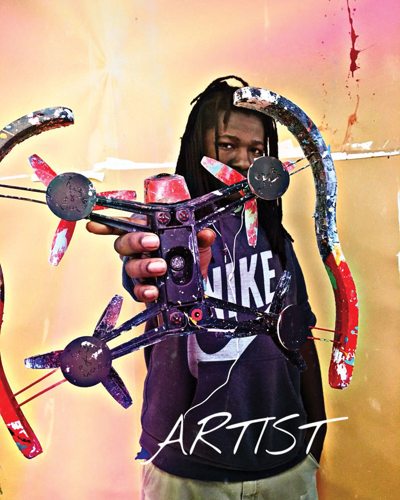
"Mike had won a STEM project outright on his own through the [Maplewood Martians project]," Jackson says. "He was like, 'Man, wouldn't it be cool if we could use the drones to create paintings?' He was thinking big."
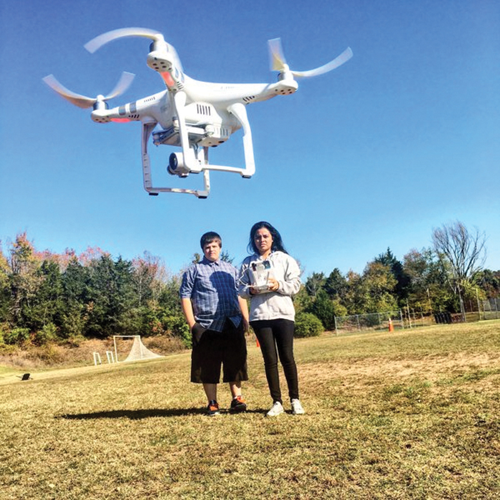
But Mitchell's idea wasn't the only project planned with the drones. The Nashville Electric Service, a flagship partner of the school, wanted the students to conduct tests on power lines.
Says NES operations manager Brad Heck, "We were just curious to see if using a drone could give us better information with a camera getting detailed pictures of the condition of cross arms, insulators and the condition of the pole at the top, that we couldn't even get using binoculars on the ground with the same level of clarity and definition."
Mitchell also began exploring how to build upon his painting idea, bringing in Vanderbilt University, the Smithsonian and Nashville's Red Arrow Gallery as partners in his project. A key moment came when renowned artist Mahwish Chishty, who uses drones as a focal point in her pieces, jumped on board. As partnerships started falling into place, it was time to acquire the drones and get them into the students' hands. With the help of donors, the school was able to buy a DJI Phantom 3 Advanced drone for the NES project, and a Parrot Bebop drone for the art project.
But learning to fly them had its challenges.
"We had NASCAR-style crashes," Mitchell says. "I mean, Dr. Jackson would come into class and flip, saying, 'Is this drone really going to make it?' "
But they did make it. In fact, in February and March, Red Arrow Gallery featured the students' artwork alongside Chishty's.
Competition-wise, the painting project placed silver both in the arts category of Metro Nashville Public Schools' Project-Based Learning Expo and at TSU's regional STEM competition, which in Jackson's eyes is a huge win, because the project literally puts the "A" for art in STEM, in what he calls the STEAM movement.
Though the students had yet to graph the data gathered from the study, the NES project placed bronze in the MNPS PBL Expo. But by the time of TSU's competition, the students had graphed and finalized the data, and the project placed gold.
In the end, for some students, the real win came in the knowledge and skills gained.
"With the art project, I learned innovative skills," says Maplewood senior and valedictorian Matthew Thompson, who worked on both projects. "We had to learn how to modify the drone without disrupting its equilibrium to make art. So, the art had a more innovative side than the PBL, but then, the PBL was more of an experience for me. It helped with my presentation skills. It helped with me understanding drones better. The PBL was more technical and engineering. The art was more innovating."
"Both Dr. Jackson and Mr. Mitchell took me under their wing," says freshman Olivia McCormack, who worked on the art project. "They explained to me how it was going to be. Everyone knows a true education is pretty hard to come by, especially if you're more of a quiet person. Having someone who's going to push you and help you open up to things and be more interactive — especially with art — is going to make you open up and be more creative, and that was extremely important to me."



