
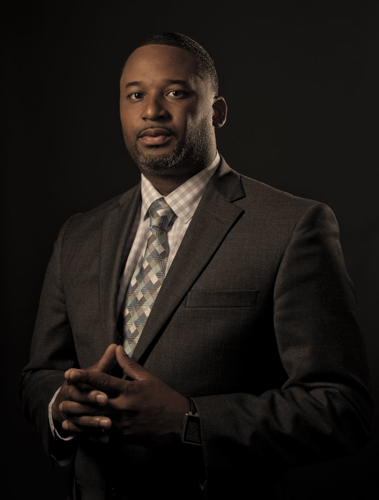
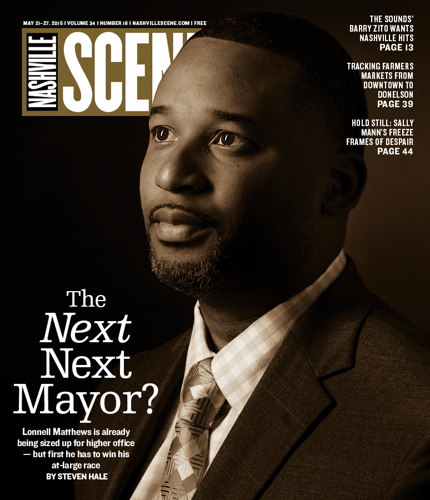
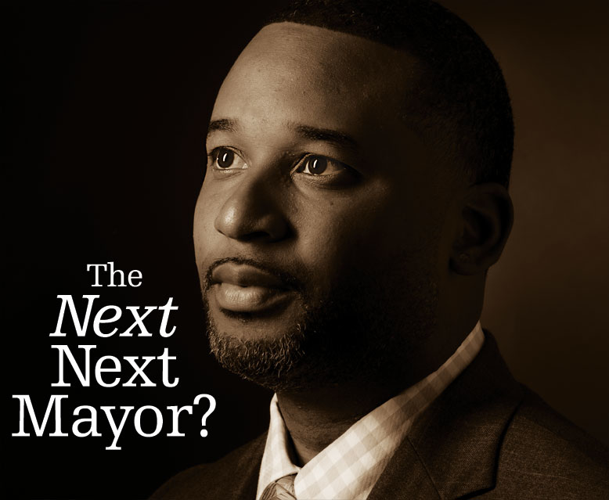


On a recent Wednesday evening, in the aging brick YMCA building on the corner of Russell and 11th streets in East Nashville, 10 men and women meet in an upstairs classroom. They have one goal in mind: that you remember the name Lonnell Matthews.
It's already familiar at the home of the YMCA's Community Action Project, or Y-CAP, a center dedicated to serving at-risk youth. Among other programs and services, the center gives kids a place to go in the vulnerable hours after school, when juvenile crime peaks. Matthews works here, as executive director of youth outreach.
But he is also a Metro councilman nearing the end of his second term representing District 1, which includes Joelton and Bordeaux. He's now one of 27 candidates vying for the council's five open at-large seats. Established leaders in African-American communities and political insiders around the city are throwing their support behind Matthews, an up-and-coming figure they believe has a bright political future.
Even so, only two district council members have successfully made the jump to a countywide seat. The core members of his campaign team have that history against them as they try to get Matthews elected. Toward that end, they have a guest tonight.
With rolled-up sleeves and a gray-flecked goatee that belies his youthful looks, Matthews, 35, introduces Jerry Maynard, the two-term at-large Metro councilman. Seated side by side in folding chairs, they make for an interesting contrast: Maynard boisterous and animated in a blazer and jeans, Matthews reserved in the slacks and dress shirt he wore just minutes before to a fundraiser for fellow at-large candidate John Cooper (see story here).
Matthews tells his staff that he asked Maynard how he might be able to support his campaign.
"Just get me in front of your team," Maynard replied. In 2007, Maynard became just the third African-American elected to one of the council's countywide seats. He's here tonight to explain how he did it, and how Matthews can do it too.
"I'm going to give you the hard, hard facts, and that is this: Most people are not coming to vote for at-large," Maynard says. "They're coming to vote for their mayor; they're coming to vote for their district. You happen to be on the ballot in between."
The at-large race is a popularity contest, Maynard says. A battle of name recognition. Matthews doesn't have to defeat an opponent, Maynard explains. He has to be one of the top five vote-getters. For the people in the room, who believe Matthews deserves one of those seats because of his merits as a candidate, that may be a hard message to hear — that election comes down to cold numbers and a relentless ground game.
But Maynard needs them to understand that electoral politics is not always a meritocracy. When people look at their ballot on Aug. 6, they will see the names of at least 27 at-large candidates, most of whom they will know very little about. The team's obsession, Maynard says, has to be with making sure that in that moment, the name "Matthews" sounds familiar.
By using as much data as they can get, he tells them, they must pick 30,000 households — preferably in districts with competitive races, where turnout will be higher — and structure their budget around hitting those voters eight different times. Mail pieces. Phone calls. Ads on African-American radio stations.
"And guess what," Maynard says. "They're not people under 30. I love social media, love y'all, y'all are beautiful folks, y'all are young. I wish I was young. Hell, I wish I could go back 20 years."
But the truth of the matter, he tells them: "That ain't who votes."
Maynard encourages them to deploy what he calls the Neighbor-to-Neighbor program, a strategy aimed at expanding Matthews' name recognition beyond his base.
"What we did is, we got an email and I contacted 75 of my closest white friends that live in West Nashville and East Nashville," he says. "Will you send this out to your universe of emails, all your email, your Twitter, your Facebook, everything: 'I know you may not know Jerry Maynard, but you know me. You trust me. You go to church with me. And I'm telling you Jerry's good. You need to make him one of your five.' "
It worked. Maynard recalls standing at the Green Hills library with his sign as white voters walked past him, telling him enthusiastically, "I voted for your guy!"
"They had no clue who I was," he says.
So even if you don't know who Lonnell Matthews is now, his biggest boosters believe, one day you will. Jerry Maynard believes it too. As Maynard gets into his black Cadillac after the campaign meeting, he calls across the street to a reporter, "He could be our next congressman, he's that strong."
Maynard's not the only one who thinks so. Outspoken Metro Councilwoman Emily Evans and well-connected lobbyist James Weaver aren't always exactly on the same page. But on this they agree: Lonnell Matthews is a contender.
"I think he has a real career in politics in Nashville," says Evans, who has been making phone calls on his behalf. "I think he has a great future, and we should all do what we can to give him the opportunity to show his talents and his skills to the city as a whole, and not just the First District."
As a wheeler-dealer whose many clients include Bridgestone Americas and Comcast, Weaver is hardly a neutral party when it comes to Nashville's future political makeup. But he's also the kind of guy who hears plenty of conversations about what that might be — and he says Matthews comes up in all of them.
"Lonnell is in every conversation about who could lead the city, who might someday be in Congress," Weaver tells the Scene. "All of those kinds of discussions, Lonnell's name is in every one of them.
"You don't get in that conversation just by breathing," he adds.
The list goes on and on. Last month, Matthews announced that Vice Mayor Diane Neighbors, County Clerk Brenda Wynn, and state Reps. Harold Love and Darren Jernigan would serve as co-chairs of his campaign.
Fellow council members and plugged-in politicos say his name arises in every discussion of who might be the next next mayor. But that election — the 2023 mayoral election, that is — is more than 3,000 days away. Early voting for this year's Metro elections begins in less than 60.
That gives his volunteers fewer than two months to drill the name Lonnell Matthews into voters' heads. If only there were a detail that would help him stand out from the pack ...
"Have you heard about the gold tooth?"
John Little sits at a table in Big Al's Deli, the no-longer-secret neighborhood spot on a leafy street in Salemtown. Little's is a name people learned in a hurry too — especially after last year's judicial elections. That night, candidate after candidate watched as box-busting vote totals in predominantly black North Nashville districts torpedoed their campaigns in those low-traffic races. As a consultant for multiple winning candidates, Little, along with Maynard and others, worked to generate that turnout, the major story of the night.
This cycle, Little is devoting most of his professional energy to Charles Robert Bone's mayoral campaign, which has hired him to consult on strategy and outreach. Personally, though, he's supporting Matthews — a guy he's known for more than a decade. Back then, Matthews was managing a local rapper and had a shiny decorative cap on a tooth he cracked while roughhousing with his brother as a child. That guy's friends knew him as Lo.
"He was this guy who, you could tell he was a good manager but he wasn't like your typical manager, like, gangster," Little says. "He was more, 'This dude is tight, I love his music, and this is an opportunity where we can all make it if he had someone who can guide him in the right way.' "
Little clearly loves to tell the uninformed about the gold tooth. But the story he keeps pressing Matthews to tell is a lot more personal, one that illustrates what's at stake for him in the race.
Lonnell Matthews Jr. grew up in North Nashville, first behind the Looby Center between 11th and 12th avenues north in a duplex his grandmother owned, then in Bordeaux after his family moved across the bridge when he was 12. He had one younger brother, also named Lonnell — after their father — but with a different middle name. The two were always a lot alike, Matthews remembers, the younger Lonnell always trying to best the older one.
Matthews graduated from Martin Luther King Jr. Magnet High School and enrolled at Tennessee State University. After two years living on campus, Matthews spent the rest of his time in school bouncing around the county, living in apartments in Bellevue, Madison, Donelson, Hermitage and Antioch — an experience he believes will help him legislate with a countywide perspective.
He was studying accounting and business law, but he found himself drawn to music. At first, he wanted to be a rapper himself. But Matthews, who says he "tends to be a realist," quickly realized he didn't have a future as an MC. He got on the other side of the business, starting a record label called Playerway Entertainment with Torrance Esmond, then a musical production student at Middle Tennessee State University.
"In college, I had this rivalry," Matthews says. "He didn't know about it, but I had this rivalry with Puff Daddy. That's what I told everybody. I said, 'I'm gonna be bigger than Puff Daddy one day, I'm gonna own my own record label, I'm gonna throw better parties.' He was doing the all-white-linen party every Labor Day, and I said, 'I'm gonna throw a better party than him one day.' "
Playerway signed some artists and put out some projects, but Matthews says he soon realized he had to give it up. The studio was distracting him from his studies. Esmond stuck with it and went on to hook up with the chart-topping Christian rapper Lecrae, who spent some time as a student at MTSU himself. The two have since won two Grammy Awards for their work together.
Matthews would find his way back to the business later, though. His brother had long been bugging him to check out his best friend, Jermaine Shute, who went by All $tar Cashville Prince and later Starlito. The older brother went on to manage the rapper for several years after college, eventually getting him signed to Cash Money Records (home of Lil Wayne and years and years of drama).
The event that changed Matthews' life came in March 2006. As he relates the memory today, sitting outside the chapel at the downtown YMCA, it still brings up emotions he struggles to contain. He remembers where he was that day, sitting in the Brentwood Y auditing account receivables when he got the phone call from his mother.
His brother had been shot, in what turned out to be a drug deal gone awry. They were rushing him to Vanderbilt hospital. By the time Matthews arrived, his father was already there and his mother was on the way.
"As soon as I walked in, I knew that he had passed away already," he says. "Some of his friends were there and just the look on their faces and the reaction — a lot of them were crying — and I knew. The first thought that I had was, 'I can't let my mother find out from a doctor or anyone else.' "
He ran to the front door of the hospital and stopped her there just as she was walking in. The pain is still fresh, though the memory is nearly 10 years old.
"Hardest thing I've had to say to my mother," Matthews says, in a lightly quavering voice.
What troubled him in the weeks and months after the shooting — and seems to stay with him now — is the way two lives that were in many ways so similar could turn out so differently. They even had the same name.
"Looking around our community and what has happening in our community and what we were exposed to, I could easily have gone his path," Matthews says. "Just as easily. It was just a choice not to. The opportunity was always there."
The extent of his own troubles with the law is a 2005 DUI reported four years ago in a local-media council overview — an experience he chalks up today to youth and "bad decisions," and which he says he learned from and hasn't repeated.
His brother left a baby girl, born just three weeks before the shooting. Matthews has helped raise her ever since. He and his wife had their first child, a baby boy, 10 months ago. They gave him the same middle name as Matthews' brother.
He dove into his work at the YMCA, where had been working since college, taking a deeper interest in his work with middle and high school youth. It was then that he decided to take it seriously as a career.
"The environment is there," he says, describing his thoughts at the time. "It's going to really take everybody in the community to try to change the environment. But if I can help kids understand how to navigate through the environment and expose them to what is possible beyond just their block that they live on ... we have this whole world. It's bigger than your corner."
But he wanted to change the environment too. The opportunity came in a way he didn't expect.
He was asked to dinner one night by Alfred Degrafinreid II, who would go on to be staff counsel for Congressman Jim Cooper and is now the chief administrative officer in the Criminal Court Clerk's office. At the time, Degrafinreid was working for Howard Gentry's first mayoral campaign. Matthews assumed he was about to hear a pitch about joining the campaign himself. Instead, Degrafinreid told him he should run for the open council seat in District 1.
Matthews says he didn't know the first thing about running a campaign or even how to get his name on the ballot. Moreover, he was just 27.
"It was almost an automatic no, because at that time in the African-American community, you didn't get elected to office unless you paid your dues," he says. "You were 45, 50 years old."
Yet he didn't say no. After walking up and down his parents' street, talking to neighbors and hearing mostly encouragement, he says he thought about his brother's death, and the chance to shape his community. He decided to go for it. When he made his decision to run for Metro council, he walked away from the rap game, and his goal of unseating Puff Daddy.
The gold tooth, though — well, not so fast. Though he roars with laughter when a reporter brings up the topic today, he still had the gleaming cap when he set out to become the youngest African-American ever elected to the Metro Council. The campaign manager for one of his three opponents had been a mentor to him in college. He came to Matthews one day during the campaign with some advice: Lose the bling. "People are not gonna vote for you with the gold tooth," Matthews remembers him saying.
"I was kind of stubborn then," Matthews says. "I was young. I was 27. I was like, 'Dude, you don't know me. I'm gonna prove you wrong.' I had always intended on taking it out, but I purposefully kept it in for the duration of the election and even a month after the election just to prove him wrong. To prove that it's not the gold tooth that's gonna keep me from winning this race. It's all about how can I connect with people in my community and let them know that I'm the best representative for them."
Matthews was the second-place vote-getter on election day, putting him into a run-off against Ken Jakes — now also an at-large candidate — who had initially bested him by 542 votes. But when the two faced off a month later, Matthews overtook Jakes, winning by 506 votes.
He'd hardly had time to find his seat in the council chambers, however, before he was met with the largest and most divisive private development plans in the city's history. The $4 billion May Town Center was to be a sort of second downtown, a mixed-use business park, retail and residential development spanning 550 acres in the rural Bells Bend area. That area was included in the sprawling district Matthews had just inherited.
"I got thrown into the deep end, and I wasn't a great swimmer at the time," he says.
At various points in a debate that spanned several years, Matthews frustrated players on both sides by seeming uncertain about his position. The project never came to pass, and in hindsight Matthews' boosters — a group that includes Evans, who opposed the behemoth development, and Weaver, who represented the developers — say he handled himself well, especially given his age and lack of experience. But for better or worse, the May Town debate might be the main reason people outside of District 1 know his name, and soreness from the fight may linger.
That said, over the rest of his two terms Matthews has grown in prominence. He has chaired the council's Education Committee, and in 2013 he served as its Budget and Finance Committee chairman, the latter giving him responsibility for overseeing the council's deliberations on the city's $1.8 billion operating budget that year.
He has consistently supported big-ticket Dean administration projects such as the Music City Center and the new Nashville Sounds ballpark, as well as the mayor's incentive-heavy economic development approach. But he has distinguished himself in other ways. Maynard credits him with spearheading the workforce development and diversity program they sponsored together in 2013. At times, he says, they've deployed a good cop/bad cop strategy to move the ball on issues such as contracts for minority businesses in public construction projects, or public investment in underserved and predominantly African-American areas.
"Sometimes you have to rattle the cage in order to get things done, and then you have to have someone who can be there after the cage has been rattled, to be the person who's a diplomat to say, 'How do we make sure we get the things done we need for all communities?' " Maynard says. "So many times, I would be the person rattling the cage, and then Lonnell would step in and say 'OK, here's the solution.' "
That's strategy, Maynard says, but also a reflection of their different personalities and skills.
"He has a gift that unfortunately I haven't mastered yet," he adds, laughing hard.
Matthews was also a vocal supporter of the legislation last year that allowed same-sex partners of Metro employees to receive benefits. At a recent fundraiser, asked for an example of his willingness to lead, he says that "several" supportive colleagues who wanted him to run for an at-large seat discouraged him from signing onto the bill as a sponsor. After he went ahead anyway, one even asked him to remove his name.
But he says that conversation was exactly why he had to do it. When it came to a vote, he stood on the council floor and delivered a forceful response to an effort to derail the bill. Have two terms in office made him a different person from the one who ran eight years ago? He pulls out his phone and shows a reporter a picture. It shows him and his brother, the two Lonnell Matthewses, and in the middle of his wide smile gleams that gold tooth.
Between now and August, Matthews will be working to make sure you know his name. He has plenty of support from people who have established names for themselves, but he knows endorsements — even gushing ones — can't replace face time with voters.
"I still need people that I don't know to get to know me," he tells a small group at his fundraiser downtown. "So if you want to host a meet-and-greet at your home and bring people in, I need people that I don't know. Don't invite all the people that I know over there in the community. I want to walk into a house full of strangers, and I want them to leave wearing one of my buttons."
His pitch hits on familiar themes, but (he hopes) with a unique perspective. He says education will be a primary focus of his campaign, noting that while Nashville's economy has grown, its schools have lagged. Over the past eight years, he says, the council has failed to adequately hold the school board accountable.
"We should have had something in place to really measure the effectiveness of different programs, different schools," he tells the Scene. "Unless we can really show what's working, then we're blindly funding a school system that has moved the needle some on the achievement gap and graduation rate. But we're definitely nowhere near where we need to be in terms of preparing our students for college and career."
On mass transit, he agrees with other candidates who have called for a Comprehensive Regional Plan and a dedicated funding source. Now a more seasoned politician, he declines an invitation to bounce a few of his funding ideas off a reporter, but he acknowledges that funding transit will mean redirecting some existing taxes and fees or creating new ones.
He agrees that Nashville has an affordable housing problem, but notes that the cost of living overall is rising too. A discussion about affordable housing, he says, has to be accompanied by a discussion about higher wages.
Among the many lessons of the May Town debate, he says, was the importance of patience and the need to resist rushing the approval of projects when more voices in the community need to be heard. It's a lesson he wants to apply to a proposal threatening to divide the North Nashville community where he grew up: the mayor's plan to relocate Metro police headquarters from downtown to Jefferson Street.
Matthews initially supported the idea. But after community opposition was strongly expressed at a rally and a town hall meeting earlier this month — both of which he attended — he thinks the plan should be delayed and taken up by the next council.
He still says it's a great idea that would ultimately "bring an element of safety to the corridor that hasn't been there, and that I think has stifled growth on the corridor for several years." But he adds that opponents in the neighborhood have raised important questions, many stemming from the fraught relationship between African-American communities and the police. It's an issue he says needs to be addressed head-on.
"There are real barriers to trust there," he says. "And to say I'm going to put the head of police right in the middle of a predominantly African-American community without addressing [the] issue of there's not a lot of trust there — just based on historic events during the Civil Rights movement and what's going on nationally now — yes, we need to slow it down, we need to have a conversation about that first."
He also acknowledges concerns that the project would exacerbate gentrification in the area and other negative effects on longtime residents. He plans to meet with Police Chief Steve Anderson about cultural sensitivity training and professional development for officers, as well as the possibility of the department releasing an annual internal-affairs report that can be reviewed, in part, by a citizen panel. Body cameras should be discussed too, he adds.
Eight years after Matthews had to call the election commission to find out how to get his name on the ballot, many are convinced he represents the rising leadership of a new Nashville. His strongest supporters agree about his future, even if they dispute which office he should seek next.
Asked what might come after two terms as an at-large councilman — if elected — he gives exactly the answer a future mayor or congressman is supposed to give.
"I've always said that as long as I don't have to compromise myself, compromise my morals and values, and as long as people keep asking me to do things, as long as they'll elect me to do something, then I'll stay involved in politics and public service," he says. "Could I see myself doing something beyond council at-large? Maybe. But I have to get to council at-large first."



