
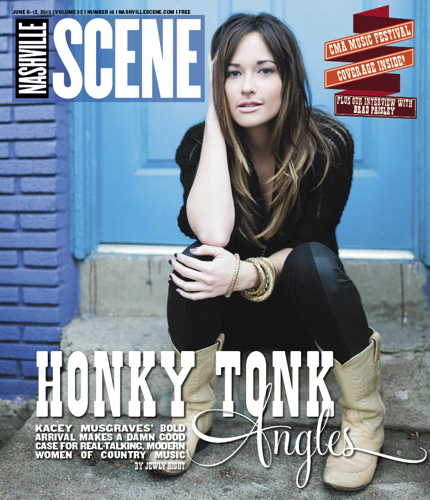
If ever there was a debut country single that didn't require a hard sell to critics, Kacey Musgraves' "Merry Go 'Round" was it. Last fall, Mercury Nashville mounted a promotional campaign to convince tastemakers to give it a listen, and the song did the rest. Ears calibrated to the fortress-like density of much contemporary country production were in for a surprise.
The track began with balmy banjo arpeggios, elegantly minimal piano and wisps of melancholic steel guitar, leading up to the moment that the quiet, canny authority of Musgraves' voice introduced itself. "If you ain't got two kids by 21, you're probably gonna die alone," she sang, "at least that's what tradition told you."
The video offered glimpses of a slender 20-something sporting BluBlockers, a dainty nose ring and an insouciant smile, interspersed with footage of idyllic, Caucasian 1950s American life; the cookie-cutter subdivisions and frolicking children, sure, but also the pharmaceutical cocktail that took the edge off the monotony. Behind those images, her turns of phrase deftly pulled back the curtain. "Just like dust we settle in this town," she sighed.
There was nothing in-your-face about any of it, but it certainly gave the impression that this singing and songwriting young woman would have something profoundly different to offer country music.
Plenty of country-savvy critics, like Brooklyn-based Jody Rosen, were sold on Musgraves in no time flat. Then a contributor at Slate, Rosen immediately anointed her the "future of country music" — and meant it.
"That's an incredible song," Rosen says on the phone, "and what blew me away was the fact that it's recognizably a pop-country song, and I saw [Music Row songwriter] Shane McAnally's name in the credits there. So she's not some alt-country person at all. ... It combined what I love most about Music Row, which is the wit, the pop savvy, you know, the hook, just great songcraft, with this message that was so dark and is so not what you hear on country radio."
When Musgraves' dozen-song album Same Trailer, Different Park came out in March, it made good on the promise of that first single, and the buzz about her spread even to the sort of outlets that self-consciously avoid giving commercial country music the time of day — one of the more striking examples being an admiring write-up on the blog of the pop-feminist magazine Bitch.
It was almost as though the music journalists of the world had been waiting for this 24-year-old Texas-to-East Nashville transplant to come along.
"Well, I mean, I was hoping people would have that kind of reaction," says Musgraves, relaxing at a sunny table outside Edgehill Cafe. "But I mean, I didn't expect it, you know? I mean, I do think [my music] is coming from a different perspective, so I would hope that people would say, 'Yes! We love this!' instead of, 'Where is this coming from? We need to go back to what we were doing.' So I'm thankful for that, that people recognize that."
Glowing reviews are a source of affirmation, but they're hardly the only, or even the most important, ingredient in a country performer's long-term success. Musgraves has also received some significant votes of confidence within her genre. Earlier this year, "Merry Go 'Round" made it into the Top 10 on Billboard's Country Airplay chart, was certified gold and earned her three ACM Award nominations, including in categories where she found herself the lone first-timer — then a month out from the release date of her debut album and going up against established superstars.
"To be included in that family feels really good," she says of the country music industry's embrace, "because I know how loyal the genre is."
Those are pretty miraculous feats for a new country artist — especially a new artist who's actually doing something new. They're downright unheard of for an act that was initially signed to a label aimed at the Americana market, Mercury Nashville imprint Lost Highway.
"I mean they definitely were all about the music," Musgraves says. "I was a fan of their roster, Ryan Adams and Lucinda [Williams] and everybody."
When Universal Music Group Nashville was reorganized last year, Lost Highway and its roster went away, but Musgraves didn't. Convinced she had what it took to make it in mainstream country, new chief Mike Dungan shifted her to Mercury proper. The instinct was a good one.
"I tried to sign Kacey to Capitol Records when I was still there," he writes in an email to the Scene. "I aggressively pursued her, and was honestly crushed when she informed me that she ultimately decided to sign with Universal. When I later discovered that she was signing officially to the Lost Highway imprint, I was puzzled, to say the least. It was clear to me from the moment I met her that this was not down-the-middle-of-the-road mainstream country music, but that was exactly what excited me the most. It was fresh, it was different ... and those qualities, along with what I perceived to be the obvious star power that exudes from her very core ... I just felt from the beginning that this is precisely what mainstream country music needed."
Just two summers ago, before anybody'd heard of "Merry Go 'Round," it was mighty slim pickings for solo women acts on the country chart; two whole weeks went by without a single one appearing in the Top 30. And lately, the contrast between the men and women of country has been not just quantitative but qualitative. A rising crop of female performers are giving voice to deep-seated desires and wrestling with constricting conventions and relational let-downs — real, hefty, on-the-ground stuff — while a good many male performers continue to mine the fine-in-moderation theme of weekend tailgating out in the sticks.
Says McAnally, a recording artist himself before his career as a pro songsmith caught fire, "What I've noticed in the last 10 years is that the girls are the ones saying everything. Back in the day — I don't even know specifically when — but guys would really lay it out there. ... We went through a phase of about 20 years when girls got real sweet and it was all slick, and they didn't say a whole lot. And I feel like that's coming around. ... I mean, they're talking about some real things. 'Merry Go 'Round,' a guy could say that, too. But right now, I don't know any guys that would."
Talking about real things is finally starting to bring commercial payoffs. Having made a long trek to the top of the country singles chart, Miranda Lambert put her oomph behind her all-girl trio Pistol Annies, who scored a surprise No. 1 with their debut album even though it was initially a digital-only release. (Not coincidentally, their label made this year's vital, unvarnished, fun-as-hell follow-up, Annie Up, available in all formats from the get-go.) And Ashley Monroe, aka Hippie Annie, is getting a much-deserved second chance at a stone-country solo career.
None of these developments says more about the possibility that country is once again making room for potent voices and interesting points of view — particularly from women — than Musgraves' right-out-of-the-gate success. She's harboring great hopes too for her frequent co-writer Brandy Clark, who's put in more than a decade chasing cuts on Music Row and is, at long last, preparing to release an album of her own, stocked with dark-humored doses of reality like "Get High" and "Take a Little Pill."
"What's going on right now is kind of naturally where I fall," Clark says. "But yeah, there were a lot of years where I didn't get a lot of cuts, didn't get any at some points. You know, I was told that my songs were too country."
[page]
What country looks, sounds and feels like has virtually always been a moving target. And since, like everyone else, the music's creators and fans have been living more suburban realities for a few generations now, the impulse to find meaning in reaching back to rural identities — usually in lyrics as opposed to sound — is understandably strong.
What's phenomenal about Musgraves is that she's fleshing out a new way to live that tension. She hails from unincorporated Golden, Texas, whose biggest claim to fame, besides her, is a sweet potato festival that's been spotlighted by Oprah. She owns and appreciates how her roots have shaped her.
Yet she does that, consciously and authentically, through the lens of an ever-widening worldview. In her latest single, "Blowin' Smoke," she plays the part of a straight-talking waitress working a dead-end diner gig and feeling utterly and completely hemmed-in. It's a companion piece to "Merry Go 'Round."
Musgraves says of the small-town experience that informs her writing, "I came from that, but I also moved away from it. So I see both sides and I can appreciate both. And I'm not dogging people that still feel that way. It's just time for somebody to be a realist about it."
She's not only a realist, but an important generational voice for country music. "There are some older people in there," she says of the fans she's earned so far. "But I think the majority is younger, and they're outspoken. I think they're open-minded. Whatever they're feeling when they hear my music, they're liking enough to be really loud about it."
Musgraves' recent Ryman performance would be a strong contender for the hippest mainstream country show ever to grace the stage of the Mother Church. She and her scruffy young band stood on Astroturf, flanked by lawn flamingoes, with a cute, kitschy image of a trailer park hanging behind them. (That particular night she was opening for Little Big Town; she's also toured with Lady Antebellum, and she's out with Kenny Chesney right now. Speaking of getting around, her scheduled appearance at Wednesday night's CMT Awards marked the first time she's taken part in CMA Music Fest, and she's also about to make her Bonnaroo debut.)
The matter-of-fact modernity of Musgraves' millennial-generation perspective also extends to all manner of personal freedoms. Take her song "It Is What It Is," about an ambivalent hookup. She's fond of noting that her grandmother calls it "the slut song," but she considers it "just honest." Her most-discussed composition, though, is "Follow Your Arrow." Depending on whether or not you count Garth Brooks' utopian anthem "We Shall Be Free" or Miranda Lambert's "All Kinds of Kinds" — which playfully embraces a couple that gets off on cross-dressing, among other things — Musgraves' tune may or may not be the first mainstream country song to take on heteronormativity.
"I wrote it with Shane McAnally and Brandy Clark," she says. "Shane is my producer — one of 'em [Luke Laird is the other] — and [Shane and Brandy are] both gay."
The song started with a note she wrote to a friend who was taking an overseas trip. "It said, 'Kiss lots of boys,' " Musgraves says. "Well, I took that, because I wanted to make a song called 'Follow Your Arrow,' encouraging people to do that. When we were writing it, that line came up, 'Kiss lots of boys,' and I was like, 'I wish we could say something like "Or kiss lots of girls." ' And Shane was like, 'Why can't we?' So, boom."
She later elaborates, "I do think it's time. I mean, we're now in a time period where we should all be equal. What gets me is that whether or not you agree with the political stance on that, it's like we're all driven by the same emotions, you know? So people want to hear that in their music. They shouldn't have to go find gay music."
"Follow Your Arrow" is a whimsical, twangy shuffle with an insinuatingly hooky chorus. And it's not by accident that the well-crafted song strikes a quintessentially country balance between familiarity and novelty.
"If you're going to have a really in-your-face lyric," Musgraves says, "the music can't be that too, or it's gonna wear people out. So I feel like there's gotta be a balance."
She also has a pretty good handle on how to juggle art and commerce. Here and there critics have floated theories about whether the youthful sound of her voice or her physical attractiveness helps her songs go over. But it's worth considering that she's in step with the intimate-scale songs and performances that have proven so popular on ABC's Nashville — she co-wrote one of those songs — and that she's figured out her strengths and limitations.
"A lot of times what I feel like people might appreciate about my music or about my voice is that I don't try to do anything that I know I can't do," she says. "I just don't have a very acrobatic, you know, technical, Martina McBride kind of voice, or Carrie [Underwood] kind of voice. ... I fell in love with John Prine's music. I just love conversational music, when it feels like you're sitting there and it's coming at you very easy.
"As far as the appearance thing, I mean, I'm girly. I love makeup and big hair and big lashes. To me, that doesn't matter. I mean, if I listen to a record, I'm not seeing the person. So it doesn't really matter to me what they look like. I mean, I guess it does to other people. But the physical part of that is fun to me, getting dolled up. ... I think there's important sides to all of it. But overall I think that I'm not here just to look pretty. Or I don't wanna be. I want the other side of it to come first, and then if people think I'm hot, then awesome."
McAnally says, "She has more a sense of herself than any artist I've ever met, hands down. ... With that, you kinda don't give anyone the option of changing things, because it's this or nothing. That can be a really scary place to go, because you don't know if it's gonna end up being nothing. There is no middle.
"We got real lucky where it fell. But it's not luck."
Email editor@nashvillescene.com.



