
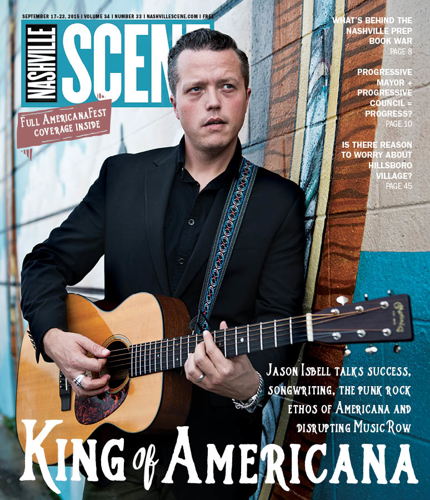


Also part of our AmericanaFest coverage, see our list of 34 can't-miss performers and events, and play along with Americana Artist or Baseball Player?
If Jason Isbell had won the top prize — Artist of the Year — for the second year in a row at the 2015 Americana Honors and Awards ceremony this week, he certainly would have deserved it. He didn’t win it —it went to his former opening act Sturgill Simpson — but it would be hard to pick a more emblematic Americana artist.
In July, the defiantly independent singer-songwriter’s self-released five-star fifth solo album, Something More Than Free, simultaneously debuted at No. 1 on Billboard’s Top Rock Albums, Folk Albums and, to the befuddlement of many on Music Row, Top Country Albums charts, selling 46,000 copies in its first week and beating out legacy country unit-mover Alan Jackson’s latest release. Could there be a better champion than Isbell for the Americana Music Association, an organization that prides itself on advocating and creating opportunities, and perhaps most importantly, a brand, for earnest country, rock, folk, bluegrass, R&B and roots-informed artists’ artists of all ages on the fringes of Music Row and the outskirts of Top 40?
Isbell deserved the Artist of the Year title when he won it at the AMA awards show last year, just as he deserved the Album of the Year trophy he got for his 2013 Dave Cobb-produced post-sobriety breakout LP Southeastern (which also deserved a Grammy nomination, but that’s another matter), and just as he deserved the Song of the Year prize for Southeastern’s devastating show-stopper “Cover Me Up,” a song about sobering up, finding yourself and finding love in the arms of the one who knows and loves you for who you are after years spent stumbling down life’s battlefields.
When Isbell first graced the cover of the Scene three years ago this week (“Alabama Shaker: How Jason Isbell won over the whole wide world of Americana,” Sept. 13, 2012), he was at a turning point. The native Alabaman had just dried out and moved to Nashville with then-fiancée-now-wife, singer-songwriter Amanda Shires. His career was on a slow-and-steady upward trajectory as well. He was packing out the 500-capacity Mercy Lounge on the heels of 2011’s well-received Here We Rest, his third solo album since leaving contemporary Southern rock cult heroes Drive-By Truckers, a band he joined in 2001 at age 22 and stuck with for six years.
“Jason, since he’s quit drinking, his focus has gotten even more intense,” Shires told Scene contributor Jewly Hight in the 2012 piece.
Three years later, it shows.
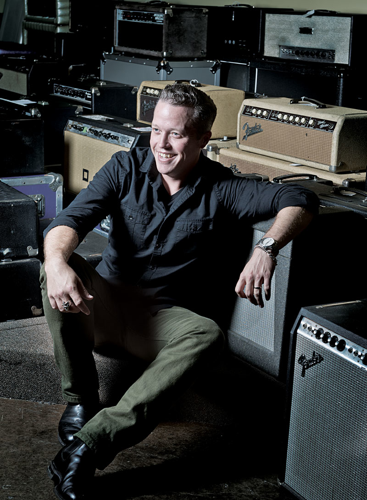
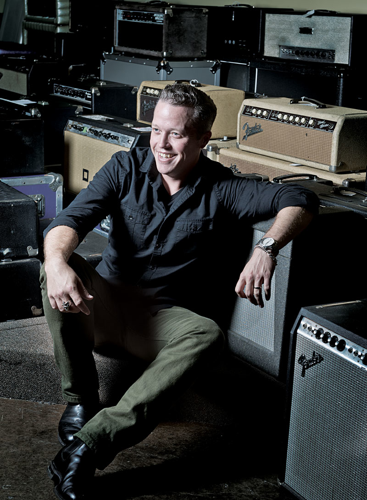
Cut to late August 2015 at Carter’s Vintage Guitars on Eighth Avenue. Nashville’s self-proclaimed “friendliest guitar store” is Isbell’s pick for this Scene cover shoot, and we weren’t the only ones snapping away. Over the course of the hour-or-so-long shoot, more than a dozen iPhone-in-hand fans approach the singer. No problem, as today Isbell is Nashville’s friendliest rock star, or country star, or star folkie — Americana star — perhaps because he’s only a celebrity when he comes to places like Carter’s. Most anyone in a town like Nashville or Muscle Shoals or Austin who knows how to install a Bigsby bridge on a B5 Telecaster knows who Jason Isbell is, while most people at your local Kroger haven’t a clue. And the 36-year-old singer is more than OK with that.
You would be too if you had a long-in-advance-sold-out four-night stand coming up at the Ryman, as Isbell does Oct. 23-26. That’s 9,448 tickets. Sold. Last year, during the very same week, the singer sold out a three-night stand at the Mother Church, a feat the opener from one of those shows — 2014 Americana Emerging Artist of the Year winner and fellow Music Row-machine antidote Sturgill Simpson — accomplishes himself Oct. 30-Nov. 1. Three nights. Another 7,086 tickets sold. Add in a pair of acoustic underplays Isbell pulled at the 300-plus-capacity City Winery in December and a Grimey’s in-store he played for an estimated crowd of 750 celebrating the release of Something, and the singer’s Nashville draw over the course of a year is enough to sell out Bridgestone Arena.
On Oct. 1, Isbell hits the road with a one-off opening for fellow Americana stars The Avett Brothers at Lexington, Ky.’s Rupp Arena, a venue that (to put things into perspective) Mötley Crüe and Alice Cooper play 10 days later. “We’re getting to a place in some markets now where we can headline [arenas],” Isbell tells the Scene. But that’s more out of necessity than it is desire. “I don’t love playing those places. It’s more of a practical goal than anything else. I’d rather do multiple nights at a theater than do one night at an arena, but that’s not always possible. ... The goal is to be big enough to play the arenas, the goal isn’t necessarily to play the actual arenas.” He says he hopes to play New York’s Radio City Music Hall, and — seeing as how he sells enough tickets in Nashville, a secondary market, to fill Madison Square Garden — he probably will.
Those dreams — or rather realities that just haven’t happened yet — seem far from the singer’s mind on a balmy Tuesday afternoon in August as he trudges up three flights of stairs. He starts his climb feet away from the door of hole-in-the-wall rock haunt The Basement, ascending up the next flight past Grimey’s and ending up at the offices of his management company, Thirty Tigers. Or rather, former offices, as the local indie music marketing, distribution, management and publishing Swiss-army-knife powerhouse that’s helped guided the career of many of Americana’s biggest names has just squared away swanky new digs in burgeoning Wedgewood-Houston. On the day of the Scene’s sit-down with Isbell, the move is imminent, and Thirty Tigers HQ is in boxes. Isbell’s eyes light up when he spots a lonely Crowded House poster still thumb-tacked to the wall. With excitement he declares that if no one if the office wants it, he’ll totally take it. And he totally hopes no one wants it. The singer is in good spirits, even though he’s also bracing for change, a week away from the due date for his and Shires’ first child (a baby girl born Sept. 1).
Speaking with a melodic Alabama drawl similar to the one he sings with, Isbell is contemplative as he talks about the craft of songwriting, at ease as he speaks about success and totally unfiltered as he talks about the Music Row machine he has no interest in ever being a part of. He also shares the secret to success for aspiring songwriter-songwriters out there hoping to be the next Jason Isbell. And the answer is — be Jason Isbell. That’s how he did it.
The level of success you’re at now, is it satisfying? Certain artists, they reach one goal while they’re already looking at the next one. Looking back at the last time you were on the cover of the Scene, your goals were fairly modest at the time, but you’ve well surpassed those. You said then that the dream is “just to not go back to having a day job, be able to do this and hang out with people I hang out with and play music for a living.”
That’s pretty much still it. Creatively my goals change, because making the last two records, I feel like I did what I set out to do with both of those albums. So I’m looking for ways to challenge myself creatively, but as far as, like, commercial success, career success; anytime anything really great happens — like the chart position for this record or playing bigger venues — it really just makes me think, “That’s a few more years I won’t have to get back [to touring] in a van, or I won’t have to worry about paying the bills, I can just focus on doing the work.” I don’t really have a desire to be more famous. I might have 10 years ago, but at this point I’ve kind of seen what that does to folks and I’d really rather just be able to play and take care of my family and have a career for the rest of my life. I think that’s more important to me now than being a big star. I’d like to just be smart about it and try to alleviate the pressure and the worries that go along with the business side of things, enough to where I can spend most of my time creating or being with people that I care about.
But being a star in today’s music world doesn’t necessarily mean being a household name. But the kind of appreciation there is for you on the cult level, you have a lot of very serious die-hard fans who really connect with you. You’ll tweet something — a political statement or something like that — and people will really seize on it ...
Yeah.
Does that ever freak you out at all, having that kind of platform? Do you enjoy it?
I like it, yeah. And I like it because I’ve been lucky enough and sometimes smart enough — it took some good decisions, but for the most part it’s luck — [that] I’ve wound up with a large [cult following]. You know, a cult following can be a really big following now. It’s not like it was 20 or 30 years ago. There are so many people with access to whatever kind of music they want, that a lot of people can find [out about] your records and your shows without having a big machine behind you. But as far as the way people affiliate with me, sometimes it’s as much about my story as it is the music I’m making, and I don’t mind that. That doesn’t bother me, because like I say, the audience that we’ve built, we’ve taken our time with it, and they really know what I believe for the most part. Some of that is [from] social media, some of it is due to the songs, some of it’s due to interviews, but I don’t feel like those people are ever going to all of the sudden decide to burn my records and boycott my music. As long as I’m being myself, whatever I say, [my fans] are going to be pretty open to. And I don’t need folks to agree with me, I just don’t want to be selling records to people I don’t have anything in common with, because that’s when you get in trouble; you say something and it becomes this big, overblown drama, and I think the best way to avoid that is to just give people pieces of who you are and go along.
Well, in today’s music world there’s so much moving so fast, and so much for audiences to be exposed to, and so much music competing for listeners’ attention, are you saying that the goal now is not just to get the exposure and find an audience, but to cultivate an audience that’s going stick with you?
Yeah, I mean, that’s more important to me, and I think it is to a lot of people who make the same kind of music that I do. I go see [John] Prine play — we’ve got some shows coming up with him, and we’ve done a lot in the past — and I see how his audience reacts, and it’s a beautiful thing. They know who he is. And they understand his wit, they understand his humor, what he says between songs, he doesn’t have to feel pressured to get to the next song. He can take his time and really possess the room with his own personality, and people are ready for that. He doesn’t have to have a drummer up there with him. He can play with three or four guys and really work people up into a frenzy just over the strength of his songs, and I think that’s a beautiful thing. That’s so much better than every time you make a record you’re feeling pressure of what’s popular then, and you’re trying to keep up. I think if you just be honest and try to make quality music for as long as possible, then you’ll wind up with [fans] who expect you to be yourself more than anything else.
Now that you have a sense of who that audience is, do you have them in mind at all when you’re writing? Or do you even need to do that?
I think that would be getting the cart before the horse, you know? I think what they expect of me is for me to not really give a shit. They want me to write about my life and about the things that are on my mind and to be honest, and I don’t think they want to be catered to. From what I understand about the audience I have, they like to be challenged and they like songs that open themselves up into different levels. Really, I think all they’re looking for is good songs and good stories, and I can judge that fairly well on my own as I’m writing. I do have sort of, I guess that traditional intelligent stranger in mind — somebody I’m writing for who might not exist. My wife helps me edit a lot when I finish songs and I get towards the end of songs — and I’ll do that for her, too. But there is always this sort of imaginary single audience member that you’re writing for that I think helps you keep your taste at a certain level, helps you keep your work at a certain level.
Without a face?
Really, yeah, without a personality of his or her own — would a person who likes my music, would they get what I’m saying here? Am I being open enough? Or is this phrase too cute? Is this rhyme too easy? Am I working hard enough? Basically, that person is probably part of me, part of my own musical tastes, really.
Do you have a take on what it is about you that attracts the listeners you attract?
I think they can hear that I care about every word in every song. And I think they probably know that I’m putting the work in every time I put a record out and I’m not pandering. And I think that goes a long way with folks. I’m not trying to write a John Grisham novel, you know, or a Nicholas Sparks novel. I’m trying to write something that makes people put the book down and think, and take a minute and try and process what they just heard or just read. That is what they want. They want multiple levels of understanding from those stories. They like allegory, and they like metaphors that work from all angles, rather than just the one [that’s] most obvious.
Do you think sometimes it’s about the songs giving a language or a sound to things people have thought or felt but maybe aren’t articulating themselves, but they hear it in a song and relate to it that way?
Yeah, that’s a big part of the job. I think when I’m at my best, that’s what I’m doing. That’s the goal, anyway. I won’t go so far as to say I do that all the time, but it is what I’m trying to do. And songs do that for me, too. I hear a lot of songs and think, “Man, why couldn’t I have said that that way? That’s exactly what I meant!”
Is there one that comes to mind? Not to put you on the spot ...
We were talking about Prine earlier. “Hello in There” is an amazing example of person who was his age when he wrote that — he was probably 28 or 30, maybe even younger than that [actually, he was 25 when it was released]. He’s writing this song about vacancy — the way old people withdraw, retreat into themselves — and what it takes to go the extra mile to connect with somebody who might be a stranger to you, the kind of courage it takes to reach in and pull them out of that private place that they’ve retreated to. I can’t hear that song without crooking up, and I’ve probably listened to it a thousand times, and it gets me every single time, because it’s just a perfect way, for somebody who was John’s age then, to address an elderly person who probably [has] become a little bit afraid of the outside world because they don’t understand it anymore, that [song] just hit that perfectly.
You had a pretty impressive sweep at the Americana awards last year — Artist of the Year, Album of the Year and Song of the Year — and now you’re nominated for Artist of the Year again, I guess that makes you the reigning heavyweight champion of Americana. Is that a title you’re comfortable with?
[laughs.] Yeah. If it’s gotta be one particular genre, I think I’d rather it be that one than anything else, because more [artists] that I respect fall into that category nowadays than any other genre. When we were at the [Americana] awards show last year and I won all the awards, you know, that night was crazy just because of who was there. Spending time with Lucinda [Williams], Patty Griffin, Carlene Carter. Loretta Lynn was up there singing. Tom T. Hall was there. All these people — Buddy Miller leading the house band, Ry Cooder playing in the house band. I was just a fan of so many people in that room, and I was running around trying to work up the courage to take pictures with them and talk to those folks. So to receive awards from people like that — in rooms that are populated by people like that — is a very, very big deal to me. It’s more fulfilling to me than it would be to win an award in a room full of pop stars. So yeah, I’m happy to be in that category — if that’s where they want to put us, that’s fine with me. That seems more appropriate to me than just to be called a “country” artist at this point, because country music has such an identity struggle right now, and I think that’s going to get worse. I think that’s going to get really, really intense before we figure out what country music is again.
Why do you think it’s going to get worse?
Well, because people like me are becoming more popular.
That doesn’t make it better?
I don’t know if it makes it better or worse for country music in general, I don’t know if that matters. I don’t think that matters. I just think it’s going to cause more of an identity crisis, which will probably be a good thing in the long run for the genre. But when I’m sitting around writing songs, I don’t give a shit about the genre of country music, or the genre of rock ‘n’ roll or anything else, I just want to get the best songs I can write. But it’s going to bring about some changes. I mean, rock ‘n’ roll in 1990 was very different than rock ‘n’ roll in 1993 — it sounded like two completely different kinds of music. And I think we’re reaching that point with country music right now. And I’m for it. If it changes what’s on the radio, I’m all for it.
Were you surprised when Something More Than Free topped the Billboard Country chart? And the Rock and Folk charts as well.
Yeah, I was surprised by that. Because I spent so much time thinking it was a bad thing that they couldn’t figure out what category to put me in. When that happened if occurred to me, maybe it was great that they didn’t know what to call it because it wound up being No. 1 in all three of those categories. But yeah, it was surprising because I never felt like I’d be part of the mainstream, even on a small level, which is where we are as far as mainstream acts go.
You’re outselling Alan Jackson!
We’re not selling half-a-million records, but we are outselling Alan Jackson, which is pretty crazy.
Did you listen to Alan Jackson growing up?
Oh yeah, yeah, I did! At the time, a lot of people thought he was really modern for country music and cosmopolitan, countrypolitan in a lot of ways. A lot of people thought Alan Jackson wasn’t country enough, but what would you give now to have him on the radio all the time. To go back to ‘90s country, it would sound like just the most genuine, authentic thing in the world compared to what’s on pop [country] radio right now. But that guy writes great songs, you know? He started out just writing songs here, and I think he wrote seven of the songs on that new album of his, so man, I’m for it, [but] I definitely didn’t expect to do better than Alan Jackson that week at all, numbers wise. I think it’s great. I’d much rather be battling it out with him than Luke Bryan or somebody like that.
Did it feel like a victory in a sense — as an independent artist, outside Music Row, who doesn’t plan these things necessarily — to have that chart position in country music?
Yeah, I think so. I’m a little leery of things that feel like victories because it’s not a competition, really, the way that I’m trying to do it. I’m not trying to compete with anybody. Sometimes I do get those instincts, I feel that way because I’m a human person and I am competitive, my nature is competitive. But honestly, what I notice more than anything else, from a business standpoint, is it caused so many people to discuss the record, that I ended up selling a lot more copies of it after that, because that had happened. I own the label, so I think about these things. All the think pieces about, you know, what direction country music was going in; even the people who were coming back saying, “It’s not a big deal, it only sold X amount of copies, it’s not like he’s a huge star now” — those people were fueling the fire, too, and the record kept spreading farther and farther because of all that commentary behind it. So it turned out to be a great thing for me.
Did it lead to anyone in mainstream country reaching across the aisle? Did Music Row try to ingratiate you at all?
Not really, I don’t think so. If that did happen, it never got all the way to me. … I don’t think they’re interested in artists like us. I don’t think that they — and by “they,” I mean music executives in the pop-country world, who are at big labels trying to figure out how to sell large numbers of records, or radio programmers, or radio consultants, whatever in the hell that is, I don’t know why we need that — but I don’t think they pay any attention to us. I think that’s a big part of the reason why their towers are crumbling at this point, because they don’t look outside their bottom line and they’ve spent so many years ignoring what we were doing on the fringes, and now the fringes are becoming the material in the middle. We’re getting popular enough where we’re taking some of those sales away from those folks. Not a lot of ‘em yet, but it’ll get bigger. It’ll change more in the next few years.
Do you ever meet fans who are also fans of mainstream country radio that discovered you somehow? Do you share an audience with some of it?
Yeah. I think with some of it I do. I think that what I’m doing is not all that different from what Miranda Lambert is doing. I feel probably more kinship with the women on that side of the aisle than I do with the men.
Is that because of the themes of the songs?
Yeah, man, they just write better songs! They record better songs right now. When I’m listening to popular country radio, the only [artists] that I will not change the station on are women, because they have something interesting to say — they’re reacting to the way they’ve been portrayed in country songs recently, or they’re trying to undo this kind of stigma that country music has fallen into, you know, the bro-country situation — they’re sort of railing against that, and it’s become commercially viable for them to do that, so their labels are allowing them to do that. You have to understand, that whole program is really, really screwed up, the way they do that. I mean, if you hear a popular country artist singing about something real, it’s because their label has allowed them to do it, because their label feels like that will make them money. And I’m just glad I don’t have to deal with any of that shit and I can just write a song about whatever I feel like writing a song about and put it on a record.
Do you feel like, on the creative side of country, whether it’s with the songwriters or even some of the artists like Zac Brown Band ...
Zac Brown did cover a song of mine [“Dress Blues”] on his most recent album [Jekyll + Hyde] and I thought he did a good job with it. I was glad that story got out a little bit more, and I have found some [fans] who’ve come to our music through that.
But have you seen people on the creative side of country taking cues from you from you at all?
Sometimes I can notice that. Maybe it’s not coming from me, maybe it’s just coming from the fact that more honest, independent music is becoming popular in general, so they may be writing more to that style right now. I’m not going to say that I’m influencing anybody on that side of the fence, because I don’t know, I don’t know, it’s probably not me. It’s probably a group of all of us — me, and Sturgill [Simpson], Kacey Musgraves, and all these people who are making music that’s not what country music is now, you know? But yeah, sometimes I’ll hear something and I’ll go, “Ahh, I bet they’ve been listening to my records,” you know. Every once in a while that will happen.
Do you see Americana as a genre or a marketing platform, or the Americana Music Association as an advocacy organization for more independent, roots-based songwriters, as having helped your success?
Probably. Yeah, probably so. I mean, that was always what I was going to do. I would never be satisfied just doing one part of that job. I love to play the guitar, I love to write songs, I love to sing the songs that I’ve written, I love touring, I love being in the studio — if any of that was taken away from, I would be unsatisfied. So I was going to do that whether it worked or not. So yeah, it’s good that the Americana community supports that. I think that speaks a lot more to artistry than it does craftsmanship. I think when somebody’s actually delivering a song, and this is not in every situation, because there are some singers who, their voice is really a beautiful instrument, and you don’t get that good at singing if you focus on anything else — playing an instrument, writing a song, whatever — and I understand that and I have respect for that, but there’s an art to writing a song that’s very personal, and performing that song yourself and captivating an audience with that [song] that I think sometimes transcends the craftsmanship of dividing that up into a few different jobs. So yeah, I’m happy [for] anything that’s given me more of a home to do what I like to do.
Now that you’ve been here for three or four years, how’s Nashville been for you as a place to live and work?
I love it, man. I love it. You know, I didn’t come here to work. I came here because Amanda lived here and she had been for a few years, and when I quit drinking I needed to go somewhere where there were more things to do to keep me occupied. … I feel very welcomed here. I’ve made a lot of new friends since I moved to town. There are venues that I can go see shows at or I can go play at. I’ve got a long relationship with Grimey’s record store, you know, The Basement, with the Cannery [Ballroom], the Mercy Lounge and now with the Ryman, which is invaluable to me that I can go in and play that place four nights in a row — it doesn’t get better than that, really.
So I have no complaints about this city the way it is now. Had I grown up here I might be whining about gentrification or about some of the high-rises that are going up, but I grew up in the middle of nowhere and there’s plenty of that land left. If you’re mad about the high-rise condos going up next to your favorite shit-hole bar in East Nashville, they’ll take you in Alabama, and [you can] drink your dollar beer out in the woods all you want to. Or move to Detroit if you want to see what happens when they don’t build those high-rises. Move to Detroit and check it out.
In singing about the South, do you have a different perspective having lived in Nashville — a fairly cosmopolitan Southern city — versus small-town Alabama?
It’s not much different, really, to tell you the truth. No, Nashville still has the same problems I think that North Alabama had as far as issues of a race, gender, you know, sexuality, women’s rights — we’re pretty much at the same place. I grew up two hours away from here, so it’s not a whole lot different. There are just more people [in Nashville], so there’s more people who believe like I do here. But there were pockets of people in Florence and Muscle Shoals who were really strange and liberal for that part of the country.
When you talk about identifying with females in country music, I gather that’s in regards to singing about some of those progressive ideals, whereas so much male-driven mainstream country has been about embracing anything that’s small-town or anything that’s generally part of Southern culture. Do you feel like, as time’s gone on and the audience for what you do has grown, it’s reflecting a change in ideas or that it’s a safer time, a safer place to sing about those ideas than it was in the post-9/11 era 10 years ago?
Oh yeah, it definitely is a safer place to sing about [that]. I mean, if the Dixie Chicks said now what they said back then, nobody would give a damn, you know? Everybody would agree with them probably. I think most of us agreed with [Natalie Maines] when [she] said it!…Yeah, I think it’s a much safer place, you know, somebody like [openly gay Music Row hit writer] Shane McAnally can be writing those kind of songs and slipping in his own agenda, which I completely agree with, I think it’s part of his job and I’m glad he’s doing that. He probably wouldn’t have found the same success years ago. And I feel for people like [openly gay singer] Chely Wright, who came up at a time when Nashville wasn’t ready for her, and they treated her like shit. I think some of us are ahead of our time. She probably was just one of those people, is one of those people.
Do you think that’s something else in your writing that people are connecting with — singing about a Southern progressive culture?
Oh yeah, yeah! That’s a very interesting juxtaposition there. To watch anybody grow and evolve in that way, it’s fun to see, you know? It really is. I think a lot of people are drawn to the contradiction. My wife says I’m a walking contradiction, like the Kristofferson song [“The Pilgrim, Chapter 33”].
A walking contradiction — how so?
Well, because I’m a redneck guy, you know? [But] I read books and consume culture that probably most big redneck guys don’t consume.
Maybe that’s the audience you’re tapping into.
Yeah, yeah, and I think that’s more me being honest and me being myself. Yeah, it’s certainly a better atmosphere for that now. It’s not where it should be, by any stretch. I sometimes feel like it’s that push at the end, you know, where you get that second wind and things are almost the way they should be. They’re not quite right yet, but in a lot of the issues things are getting really close to being OK, and so everybody’s pushing extra hard to get over the finish line.
Has there been a downside to success for you?
No. Not that I can see, not at this stage in my life.
Does that have to do with reaching this level at the age you are, versus 10 years ago?
It’s a lot easier now. When I was with the Truckers and we were having some success, I didn’t deal with it exactly right. I drank too much and just didn’t really behave myself; I didn’t have my priorities in the right order, that’s what it comes down to. And now I don’t have any issues with it at all, at this level. If I was super-duper famous and I couldn’t go to Target, I might be upset. I think it’s really important that if somebody’s going to get famous they need to also get rich, because if you get one without the other you’re screwed. ... If somebody has to go to Target and they can’t go to Target because [they’re] too famous, then your life is screwed big time. But for me, the success, I’m not wealthy but I’m also not a celebrity, so I can go to Kroger and buy groceries and I can go to the movies with my wife, and that’s fine, that’s great! I’m not going to get to this level and then bitch about it. ...
I like having the freedom to not worry about maintaining a certain level of popularity. It’s very liberating for me to not want to be a celebrity, to not care anything about that. I can write songs about cancer that aren’t by-the-book cliché pandering kind of songs. I can write songs about America that don’t pander and aren’t bullshit Lee Greenwood that we’re all used to hearing. So that’s a nice thing, and I’ll probably always write that way. The purpose for writing these songs, it’ll always stay the same.
Would you ever sign to a major label if they were hands-off, there were no strings attached on the creative end, and you had the same autonomy you have now?
That’s like saying, “If a bicycle could fly, would I go buy a bicycle right now?” Yes. Yes. If the major labels did not behave like major labels I would sign up in a heartbeat. Or if I needed them, you know? If somebody came to me and said, “Here’s our plan for selling a half-a-million copies of your record,” and I read that plan and thought it looked like it would work, and it didn’t require me selling out in the ways that I consider selling out, if I could still make the records how I wanted and turn them in without any A&R [interference] and they could sell half-a-million of them and I believed them, hell yeah I’d sign with them in a heartbeat. I don’t have any kind of ethical problem with signing with a major label. If somebody comes up with a good way to do it, I’m all for it. But so far they haven’t, and until that happens I’ll be content with my $4 or $5 a copy, and keeping my masters, and choosing my own track lists and not giving a shit whether I’m a country artist or an Americana artist or a rock ‘n’ roll singer.
Well, Americana has definitely claimed you as its own. So what is Americana? Is it a genre? Is it a sound? Is it an indie business model on the fringes of Music Row? Is it an advocacy group for artists who are in a broad sense connected to American roots music?
It’s punk, but it doesn’t sound like punk. It’s punk with different instruments and different songs. It’s people who are trying to do the right thing. When it’s at it’s best, it’s people trying to make music because they love music, and they’re not trying to swindle anybody, they’re not trying to get rich and famous immediately, they’re trying to make music that goes back to their roots, they’re trying to have some credibility, they’re trying to be authentic.
Now that it’s become a little bit more popular, there’s a lot of people hanging on the coattails and trying to be the next big Americana band, and they sound like shit, because they’re just ripping off people who are making honest music a year ago or two years ago.
There are definitely Americana tropes.
There are. And that’s always going to happen. It’s always going to be that way. Anytime a genre gets popular, there are going to be people who say, “Hey, I might be able to make some money makin’ this kind of music, and they start stompin’ and clappin’ and buy one of those stupid banjos that’s actually just a guitar that looks like a banjo with six strings on it." I hate those stupid things. But no, I am proud to affiliate with the Americana world because I feel like it’s doing, in a lot of ways, what punk rock was doing in ‘77 or ‘78. I think people are trying to say, “To hell with the system. To hell with what’s on the radio. To hell with what the big labels are doing. We’re going to try and make the music that we love because we love making music.”



Post a comment as anonymous
Report
Watch this discussion.
(0) comments
Welcome to the discussion.
Log In
Welcome to the discussion.
Keep it clean. Please avoid obscene, vulgar, lewd, racist or otherwise abusive language. Comments featuring hate speech or threatening or violent content will not be tolerated.
PLEASE TURN OFF YOUR CAPS LOCK.
Be truthful. Don't knowingly lie or mislead.
Be proactive. Use the “report” link on any comment that violates our comment policy.
Share with us. We'd love to hear your feedback.