
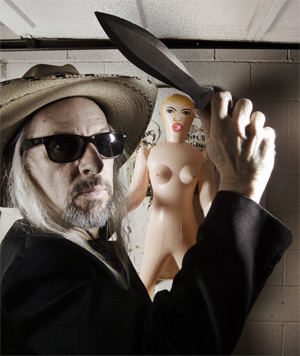

About three years ago, Phil Lee's wife said he needed a hobby. He was now in his 50s, she reminded him, and a man that age needs something to occupy his time—an activity to fill those spare, quiet moments as he contemplates the dimming sunset.
By God, you're right, Phil Lee thought. He started throwing knives.
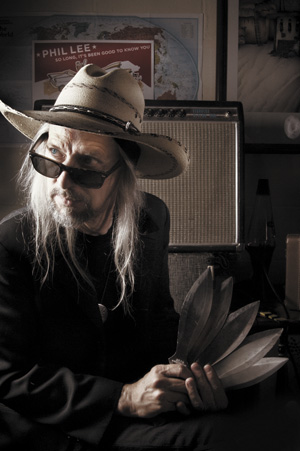
"Go ahead, try it," he says. He gingerly unwraps a set of badass blades with screaming red handles. They've got more heft than you might expect—lighter than a machete, heavier than a hatchet. He fans them out, like petals of a killer daisy, then extends a couple handle-first toward his visitor.
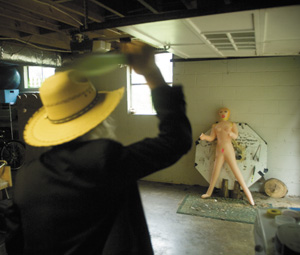
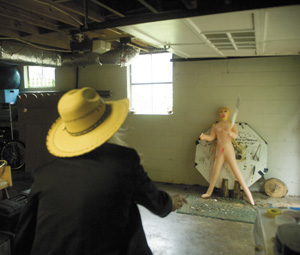
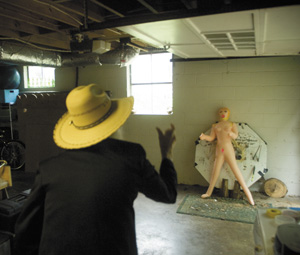
At one end of Phil Lee's garage, in the basement of his East Nashville home, is a makeshift knife-throwing range. Against a scarred back wall stands the target: a large, chipped cork pig missing fist-sized chunks of its tenderloin. Lee ushers his guest to the throwing line about 15 feet away, then sizes him up a moment. He must not like what he sees. He moves a big sheet of plywood to protect his washing machine, which already looks like somebody kicked it a few dozen times.
Lee takes a knife by the handle. "Like this," he says. His chest-length gray-blond hair pulled back by a black skullcap, he cocks his arm back until the knife is poised about level with his head, then releases it like a coiled spring. The blade chunks into the pig's shoulder. Lee smooths his T-shirt, emblazoned with the Volt Records lightning-strike logo. He looks over at his guest, who is raising and lowering his own knife like a pool boy waving a palm frond.
The resulting heave sends the knife pinging off the pig. Cork crumbs litter the floor. The blade ricochets off into the dark corners of Lee's workshop, sending stuff clattering. The guest turns to find Lee crouching for safety behind his water heater.
"Let's have some coffee," he suggests.
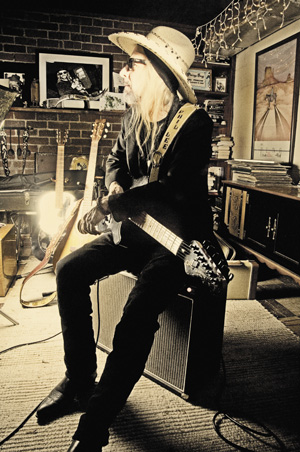
Long before he ever threw his first knife—inspired by the website of an acknowledged master, the Great Throwzini—Phil Lee was no stranger to sharp points and edges. He writes songs full of them: character studies that sidle up to folks we'd normally shy away from, pretty ballads that turn staggeringly bleak, ambiguous odes to rough living too laugh-out-loud funny to be considered cautionary tales.
He's also been on the receiving end of some hard throws, literally as well as figuratively. Although he'd been making music off and on for three decades—almost none of it released—his first album The Mighty King of Love didn't come out until 1999. By then he was a 47-year-old man in a kids' game, and if his songs were better for it, his commercial prospects weren't.
His second record, You Should Have Known Me Then, should have done the trick. In the two years since the first album, Lee had won a sizable following in the fledgling Americana genre. He'd formed a fruitful creative partnership with producer/guitarist Richard Bennett, whose credits range from Neil Diamond and Mark Knopfler to Steve Earle's star-making album Guitar Town. The record had a set of songs strong enough to conquer the world; it even had Gillian Welch and David Rawlings on board as good-luck charms. How could it miss?
The record-release party fell on Sept. 11, 2001.
Days later, Lee found himself in a van creeping across New York's George Washington Bridge, en route to hawk his magnum opus in the emotional black hole of the world. The gig had been booked months earlier. On top of that, he hadn't been able to convince his band why maybe now was not the time to bring guns and dope into Manhattan. "We're the worst-lookin' sons-of-bitches ever to come to this town," Lee recalls, "and our drummer looks like Ali Baba."
Ultimately, the band left its stash with a willing but wary music journalist. But the trip and the gig brought Lee to a conclusion: A radical new direction was overdue. "I need to be a folk-singing guy," he decided.
It's taken him eight years, but he finally has his wish. Barring global catastrophe, this weekend belongs to Phil Lee. He performs Thursday night with Richard Ferreira, Dave Olney and Gwil Owen at Douglas Corner, then moves to Norm's River Roadhouse Saturday night for the main event: the release party for what he calls "my third album in 57 years."
So Long, It's Been Good to Know You is a more sober set of songs, ironically enough, than the one he released on Sept. 11. Borrowing (and embellishing) the title song from the O.G. folksinger, Woody Guthrie, Lee offers few of the raunchy roadhouse rockers that initially made his reputation—songs like the sex-in-a-trailer come-hither "Night in the Box" and the hilarious lament "Karl's Got Louise."
Instead, he ventures into sea chanteys, slow-jam near-recitation and pre-World War II pop, with lyrics that give off a more pronounced sense of loss than anything he's ever written. There is still considerable humor, as in the pirate-ship sing-along "Where a Rat's Lips Have Touched." But the record bristles with Lee's newfound versatility on guitar and his immersion in folk music—its bawdiness, its timelessness, its Sears catalog of sorrows.
That shows in the opening song, "25 Mexicans." Its matter-of-fact sing-songiness sets up a character study of a guy who notes with a seeming shrug that 25 Mexicans now live in his childhood home. "That's fine, don't worry me none," he adds, "I got nothing against them Mexicans." "Across the borderline they stream," he says, "to a better life, so it would seem."
The music, with its faint mariachi lilt, could come from the same songbook as Guthrie's classic "Deportee (Plane Wreck at Los Gatos)," whose elegiac take on racist attitudes toward immigrants resonates more than 50 years later. But Guthrie never asked us to share the same skin as, say, the pilot scattering those dashed American dreamers like dry leaves.
Lee does. With a chill, the song shifts to the perspective of someone else contemplating 25 Mexicans: a truck driver who's been paid to haul this human cargo across the border. When the going gets tough, having taken their money, he abandons them to die a breath away from freedom. "You drive the truck, boy, that's the deal," Lee sings. "You're just the guy behind the wheel." It's the kind of lyric sucker-punch Lee excels in—the sort that undercuts a listener's complacency, stirring a more complicated response than knee-jerk sympathy.
"It's by far his best record," says longtime friend Larry Johnson, an Oscar-nominated sound technician (for Woodstock) who's better known as Neil Young's right-hand man on almost all of his film projects since the early 1970s. "It's one of my two or three favorite albums of the past year, and it may be No. 1. I played it for Neil, and he had the same reaction. He loves Phil Lee, and he thinks it's his best effort to date."
Richard Bennett agrees, and so does Lee. The reason, he says, is that after years of doubts, false starts, and at least one retirement, he's started to love music again.
"You hit 50, and it takes everybody that long to figure out they're not going to make it in the music business," Lee says, sipping paint-peeling coffee in the cluttered basement room that doubles as his practice space and studio. "With me, it was like being...let off the hook. Like, great God almighty, free at last."
The man who says these sensible words is a contented husband, a peaceable homeowner, a proud grandfather who admits he's grateful for early showtimes. But he's also, by his own admission, a one-time dead ringer for the antihero of one of his most mordantly funny songs, "You Should Have Known Me Then." That guy recounts a litany of murderous misdeeds and bad behavior: as innocuous as stripper-stoked threesomes, as indefensible as drug-dealing, gun-running and much, much worse.
There is an implicit apology in the song. Right: He's sorry he turned into such a domesticated dullard. "I loved my life of crime / I'd've slit your throat for a fuckin' dime," Lee sighs over an incongruously pretty, burbling acoustic melody, before anticipating your disappointment: "You should've known me then."
The basement room where Phil Lee hones his material is filled with mementos of people who did indeed know him then. On a shelf near his desk sits a photo of a square-jawed lawman. His badge rests nearby. Lee picks it up, humming the "dum-da-DUM-dum" Dragnet theme, and hands it to his guest.
This belonged to Capt. Jimmie Lee Pearson, the long arm of the law in Durham, N.C., circa 1965. He is the man immortalized in Lee's "Daddy's Jail," a song that only sounds like a tall tale about a scofflaw begging his arresting officers to put him anywhere besides you-know-where. In life, Lee spent his teenage years getting in minor scrapes, only to have his jailer dad give him a cursory reading of the riot act each time and send him on his way.
Perhaps that was because his father harbored a love of music—he played the banjo until Lee's mother yelled at him and he threw it in the trash—and his son was already showing promise as a professional drummer. But that career nearly derailed in 1970, when Lee almost got drafted to Vietnam.
He made his way to New York, where he played briefly in a band called Amazing Grace with actress Beverly D'Angelo and Rob Stoner, later a member of Bob Dylan's Rolling Thunder Revue. After a few years, he decided to switch coasts. He arrived in Los Angeles on the cusp of the punk years, when the city was a swirl of depravity and unreasonable hopes. He plunged without an exit strategy into its vampire lifestyle.
Those years inform one of Lee's best songs, "Babylon," first recorded with co-producer Howie Epstein more than two decades ago for a movie soundtrack that never happened. It's a brutally clear-eyed portrait of a feckless rocker scratching out a living in some unnamed metropolis, a "ghost town where the hollow creatures lurk." He's calling home, or what used to be home, to explain why he's not coming back.
You've heard a thousand self-pitying variations on this theme, with Kiss' "Beth" as only the most nauseating example. "Babylon" is "Beth" with a working bullshit filter. Lee's wannabe rock god finds his well-practiced excuses don't work anymore: "Forgive me for not writing in so long / I've been sick in my room...I guess you know that's not quite true...."
By this time, Lee's first marriage had broken up, and he was playing clubs billed as "Phil Lee, the Heartless Wretch." He got a job, he recalls, as "the world's worst cab driver," cruising around half-lit in a taxi emblazoned with the number 666. One night he responded to a call, only to find a scrawny guy with a foot-high Afro bearing down on his cab with a TV.
"I was looking at him and thinking, 'This little motherfucker just stole a TV, and he called a cab to make his getaway,' " Lee recalls. "So I get out and start helping him load the TV—what do I care, I'm half loaded anyway. And I look at him and say, 'You're Sly Stone!' " Indeed it was. Until dawn Lee tried to help the funk legend sell his TV for a high, eventually ending up at a business associate's house. Stone thanked Lee falettin' him be himself again by cutting him a bad check.
Sitting today at his desk downstairs, Lee opens a thick envelope full of yellowed snapshots from this period. He empties them onto his desk with explanations that only prompt more questions. "That's me with the Hell's Angels rockin' at the clubhouse," he says, handing over a glimpse of faded debauchery.
A smaller photo stops him short. In it, a sunny blonde with an extraordinarily disarming smile cuddles cheek to cheek with the Phil Lee of three decades ago. He grins.
"Cheryl," he says. "I had hair back then."
Seventies drive-in cultists remember Cheryl Rainbeaux Smith as the gold standard for Roger Corman starlets: a fresh-faced cutie who radiated innocent sexiness in exploitation favorites such as Jonathan Demme's Caged Heat. Lee remembers her most gratefully as a bad shot.
During Lee's bleakest days in L.A., the two began a tempestuous relationship that went from bad to worse once she creased Lee's skull with a Coke bottle. Another time she tried to shoot him, and he took her gun away. That only made her mad. Their amour fou reached its climax during a hellacious argument.
"We were all taking drugs, we were all drinking—we were the beautiful people," Lee deadpans. "None of us had any clothes on." The fight turned physical, and Lee bolted for the stairs—only to see the slight Smith, powered by hate and adrenaline, heave an enormous TV set at him. Like the boulder chasing Indiana Jones, it tumbled down the steps after Lee, and he tried to time its crash so he could jump over it. Instead it mangled his ankle. He hobbled away and ducked into a cab.
"Not long after that," Lee says, "I quit drinking."
No doubt this saga was incredibly painful. But Phil Lee is the kind of raconteur who spins his hardships into uproarious epic yarns, both in person and in song. "He never complains," says Richard Bennett, who's heard every musician's gripe in the book, especially about the industry. "He never cared about any of that shit."
Yet at age 40, Lee was disillusioned enough with music to give it up. He went to a truck-driving institute, graduated with full honors ("meaning I showed up and I didn't kill anybody"), and got a job hauling sides of meat for the Tennessee Dressed Beef Company.
"It's like riding an elephant," Lee says. "It's big, it's manly—it's the only time I feel safe when I'm in a vehicle."
But when the late steel guitarist "Sneaky Pete" Kleinow asked him to join a reconstituted version of the seminal country-rock act the Flying Burrito Brothers, he took the bait. The gig lasted "about 40 minutes," he remembers, but the itch remained. He began playing again in the mid-1990s, subsidizing his music habit with meat runs to Tampa.
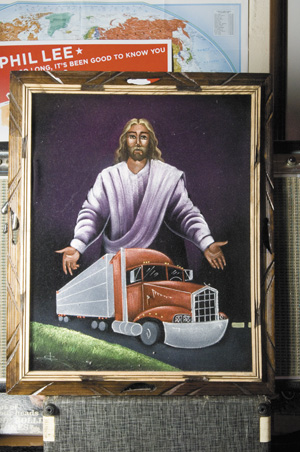
His life has changed dramatically since 2001—meaning it bears scarcely any relation to a Phil Lee song. A friend calls him "the world's most cautious thrill seeker." He settled down in East Nashville with his wife Maggie, an indulgent German-born woman who turned his head at a long-ago Sutler gig. Thanks, perhaps, to a black-velvet painting in his basement—of Jesus bestowing His grace upon an 18-wheeler—he hasn't driven a truck in two years. Nor does he miss it. "Having said that," he adds with a conspiratorial leer, "what've you got and when's it gotta be there?"
To broaden his repertoire, he took lessons in finger-picking and reinvented himself as a "folk-rock icon" (trademark pending). He now typically performs with only one other musician—sometimes Chicago-based Jan King, whom Lee knew from her days in the L.A. new wave band The Orchids; usually Nashville guitarist Tom Mason, himself a noted singer-songwriter.
Lee calls Mason "a great player" while disparaging his album nightly as part of the act. Mason, in turn, retorts that Lee has abandoned his habit of inviting musicians to lunch at places that mysteriously fail to take credit cards, leaving his guests to pay.
Kidding aside, Mason thinks Lee has his best chance in a decade to connect with a larger audience, paradoxically, by thinking small.
"It's a strange time in a strange business," Mason says. "These days, live entertainment is having—I know this sounds ridiculous, but...a resurgence. You can get everything on the Internet now except a moment in someone's company. That's what Phil is great at. He's an entertainer."
That cannot be easy. Since 2001, people from his past have disappeared with crushing regularity. His friend Howie Epstein, longtime bassist for Tom Petty & the Heartbreakers, died in 2003 after years of drug abuse. Cheryl Rainbeaux Smith met a similar sad end in 2002 after a couple of prison stints and a stretch as a homeless addict. "She was full of life," he says, "and just, goddamn, so good looking."
A year and a half ago, Lee lost his father, Capt. J.L. Pearson. Not long before his father's death, Lee got his stepmother to bring his dad to a gig. If nothing else, he'd get to hear "Daddy's Jail," which he loved. By that time, Alzheimer's had eroded his dad's memory.
"He was sittin' down on the front row, little ol' peanut down there," Lee recalls. After the show, Lee couldn't wait to ask his stepmother what his dad thought. Betraying no hint of recognition, his father enthused, "That guy's pretty good!"
His guest can't help but laugh, because there's almost no topic somber enough to survive Lee's comic timing. Lee himself even laughs—what else are you gonna do? When asked if he considers himself lucky, Lee looks incredulous.
"Yeah—whaddaya think?" he says. "One, I ain't dead. Everybody I know is dead. I've never been to prison. I'm married to a beautiful, sweet, hard-working, patient, smart woman. I've got Richard Bennett producing my record, George Bradfute as my engineer. And I've got [an interviewer] down here in my basement listening to me talk about myself.
"I'm a serious student of everything. Life is short, I'm finding out. There's so much beautiful music I've ignored over the years. I'm 57. I'm trying to do cool things until I'm dead."
And if the music doesn't work out—there's always knife throwing, right? Phil Lee won't get his hopes up. As he points out, "After 50, as a knife thrower, you got your good days, you got your bad days." But for anyone who thinks he doesn't have a bead drawn on today's generation, he's got news.
"I gotta tell you"—and here he leans forward, with a wonder-struck whisper—"I don't think The Ed Sullivan Show's out of the question."
Email jridley@nashvillescene.com, or call 615-844-9402.



