
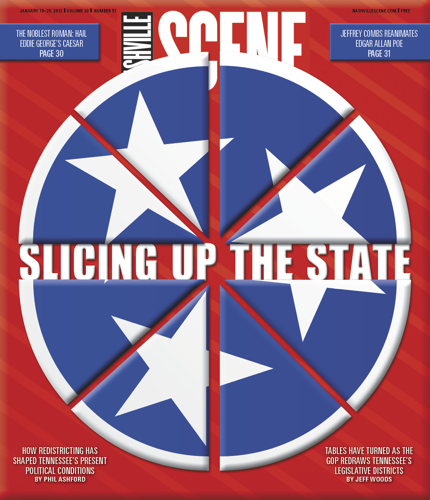
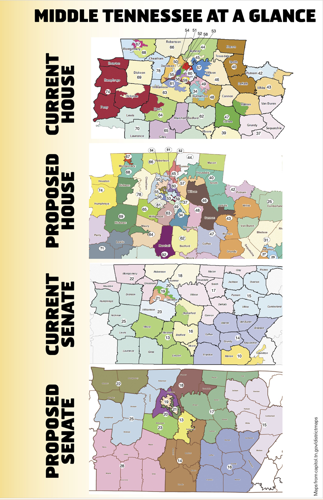

When Lyndon Johnson signed the Civil Rights Act into law in 1964, he lamented that Democrats might have lost the South for 30 years. In a sense he was wrong — the loss of the South was a slow-motion process that took more than 30 years to really get into the bones of the body politic. But Tennessee may now be seeing the final act of that transformation with the completion of the congressional and legislative redistricting processes. With this year's process, Republicans can now fully say that they own the state.
Politicians have long regarded redistricting as a kind of reverse election in which they vote out the constituents deemed to have been insufficiently enthusiastic in their support for the incumbents. Democrats exile pockets of Republican voters to the districts of adjacent Republican lawmakers, who accept them with the same glee that they expel their noisome Democratic constituents. It tends to be more about the "ins" declaring war on the "outs" in defense of the status quo, in a malodorous general conspiracy against the public that sometimes obscures the subtle ways in which power is balanced for or against the various elements of society.
Tennessee has always been ground zero in that struggle. In 1962, Charles Baker, a Shelby County Republican, was the named plaintiff in the Supreme Court's landmark Baker v. Carr decision, which opened the redistricting process — or lack thereof — to judicial review. At that time, the Tennessee constitution required state legislative districts to be redrawn with each decennial census. No action had been taken to update Tennessee's district lines, however, since 1901, when the population distribution reflected the state's agricultural nature.
In the intervening years, agricultural mechanization and the growth of industry (particularly driven by the wars) had pulled much of the population away from the land. Any rudimentary sense of justice would have suggested that political power should be adjusted accordingly, but for some reason the rural interests could never quite bring themselves to vote away their own power. When Baker filed, districts representing about a third of the population controlled about two-thirds of the legislative seats.
In 1964's follow-on Reynolds v. Sims decision, the high court established the "one-man, one-vote" principle — the notion that the vote any citizen casts should have the same political influence as any other citizen. State legislatures across the nation were ordered to reapportion along population lines. The decision was a triumph in the progress of democracy — and a trigger for all sorts of shenanigans ever since.
Of course, Baker himself was more of a cat's paw than a hero. The suit grew out of a 10-year legal campaign by urban interests primarily in Nashville, and the lion's share of funding for the legal fees was actually appropriated by the Nashville city council. Memphis, long the state's largest city, had for many years resisted urban-rural rebalancing in the state legislature as a cost of local boss Ed Crump's various alliances with rural interests and East Tennessee Republicans — which made him the dominant force in Tennessee politics up until the 1950s.
But even after the decision, the battle had more to do with urban and rural interests than partisan interests in a state where two-party competition was only beginning to emerge. The one-man, one-vote upheaval was greater in a number of other states, which had systems designed to mimic the federal constitution by giving each county one senator, regardless of population.
Prior to the Baker ruling, the high court had been unwilling to get into the redistricting issue as too much of a "political thicket" for the courts, but had cracked the door two years earlier when confronted with something too outrageous to ignore. The Alabama state legislature, responding to the rising prospect of black electoral power, had redrawn the municipal boundaries of Tuskegee to remove virtually all black voters from the city limits. An entity that had previously looked something like a square on the map now looked something like a spider.
Justice Felix Frankfurter led the court in opposing judicial interference in redistricting issues, but the Alabama action showed that even he could be pushed too far. In the high court's opinion in Gomillion v. Lightfoot, he wrote that political boundaries could not be determined on the basis of race. That element was underscored in 1965 by the passage of the Voting Rights Act. Not only did it clear a number of obstacles to voter registration, it provided for long-term Justice Department oversight of jurisdictions — mostly Southern — with a history of racially discriminatory practices.
The 1950s and 1960s represented a high-water mark in the Supreme Court's commitment to "equal justice under law." The high court promulgated landmark human-rights decisions on school desegregation, poll taxes, rights of criminal defendants and privacy rights. Though hotly controversial at the time, these have mostly attained at least superficial public acceptance away from the far shores of paranoid politics and 20 years of Law and Order episodes. Since then, the courts have done little consistent to protect citizens from all the other clever kinds of chicanery that go into the process of controlling the rules of the game.
"To the extent that a citizen's right to vote is debased, he is that much less of a citizen. The weight of a citizen's vote cannot be made to depend on where he lives," wrote Chief Justice Earl Warren in the one-man, one-vote decision. Of course, that's exactly what legislators have in mind when they start drawing up legislative lines.
[page]
Tennessee's first important redistricting struggle came after the 1970 census with the redrawing of the Shelby County district. The conflict provoked a clash between representatives of two key emerging forces in Tennessee politics — African-Americans and Republicans. Tennessee lost one of its congressional districts (going from nine to eight after the census), triggering some reshaping of the Memphis-based district.
The incumbent, Dan Kuykendall, was the first Republican congressman elected from Tennessee in the 20th century outside the GOP's mountain strongholds in East Tennessee. He was first elected in 1966, when the Shelby County Republican Party emerged from the tumult of the civil rights years as a hardline conservative alternative to the mountain moderation of the party's East Tennessee wing. The General Assembly moved some important Republican areas to a neighboring district — probably more with an eye to troubling the incumbent there — opening the door to a black challenge in the inner-city district.
Kuykendall survived the 1972 race but fell to State Rep. Harold Ford Sr. in a disputed election in 1974. Ford subsequently held the seat for 20 years, and the 9th District (Tennessee got its ninth seat back with the 1980 census) has been drawn as a minority district ever since. Indeed, each side achieved a durable result. Republicans got a reliable seat based on the East Memphis and Shelby County suburbs, while a safe inner-city district was created within the core of Memphis. The inner-city district met a need within the Democratic Party to expand the sharing of power to African-American voters.
But the bigger challenge was less obvious. Over the approximately 30 years after the mid-1970s, the Democrats would be facing a protracted rear-guard action to slow the Republican advance in the state. The nature of that advance wasn't necessarily obvious in the 1980s — the GOP looked hopelessly lost after the defeat of Winfield Dunn in the 1986 gubernatorial election. But the undercurrents were all flowing rightward.
The 1980 census hardly looked like an easy time for Democrats, who controlled two-thirds of both houses of the General Assembly. Most of the redistricting energy was devoted to intra-party feuding in Nashville and contention among white and black Democrats in Shelby County.
In Nashville, Democratic Sen. Joe Crockett had run afoul of various East Nashville power brokers and faced a potent primary challenge from the well-connected Joe Haynes. With the connivance of the party caucus, Crockett was able to redraw his district in advance of the 1984 election to exclude Haynes' residence. Haynes got an apartment in his erstwhile district and went to court to get himself back on the ballot. Ultimately, Haynes was able to get back on the ballot and defeated Crockett, who had taken a serious press beating over the matter.
After his election, Haynes got the General Assembly to pass legislation to put his house back in the district and allow him to drop the fiction that he was living in the apartment he rented. Haynes, who is still in the Senate, ended up aggrieved with the process once again this year — feeling the 2012 lines loaded his district with too many Republicans and had been drawn for his defeat.
The Shelby conflicts were strategic — some of the white Democrats felt they could pick up a couple more seats if the black Democrats would be a little more flexible on district lines. The blacks, who had fought a century-long battle to get representation in the legislature, wanted to be cautious and make sure minority votes were not so diluted that black representation suffered. House Speaker Ned McWherter sided with the blacks.
After the Kuykendall debacle, the congressional incumbents learned a lesson of their own. District lines are all about dividing up a fixed pie, and one man's poison is another man's treasure. In those circumstances, it's easier to be reasonable. The incumbent members made their own deals privately, then sent their directions to the General Assembly.
"We used to get a letter signed by all nine congressmen," recalled long-time state Sen. Jim Kyle (D-Memphis), who has undergone his own shuffle in the current redrawing, endng up in the same district as Sen. Beverly Marrero. "And it was never touched."
The 1990 census added one other wrinkle: computer technology. Redistricting software became commonly available, allowing more politically artistic versions of district maps without going through complex calculations as a result of each small change. House Majority leader Bill Purcell used the new technology to draw eight Republican incumbents into four districts in a peak moment for Democrats.
After 1980, Tennessee senators never really feuded about partisan redistricting. When Lt. Gov. John Wilder fended off an attempt by the Democratic Caucus to dump him as the party leader by making an alliance of rump Democrats and Republicans, he managed to hold onto his job while blurring partisan lines on just about everything.
"Wilder didn't care if you were a Republican or a Democrat — so long as you were for Wilder," said Kyle.
The peculiar balance ended up minimizing partisan redistricting fights for 20 years. But politics was changing. Tennessee had always had more Republicans than the other states of the Solid South — the block of segregationist states that had voted together for Democrats since the Civil War. But the GOP's false dawn of 1970, when Republicans held the state Senate, the governor's office and both U.S. Senate seats (which were gradually all lost to the Democrats by 1986), may have obscured the long-term trend of Republican dominance in the South.
Although Republicans had managed to win individual elections at the top of the ticket, Tennesseans still held some emotional grip to the Democratic Party — particularly the more moderate/populist lawmakers who came out of the various rural counties. At the top of Democratic tickets, leaders such as Jim Sasser and Al Gore were able to fashion themselves as something more in tune with people of the state than the national party that had placed Walter Mondale and Michael Dukakis atop the ticket. By focusing on economic issues and speaking softly on cultural ones, Sasser and Gore both scored big statewide sweeps against a seemingly feeble Republican party in 1988 and 1990 respectively.
But the ability for Tennessee Democrats to distinguish themselves from national Democrats died, largely in the growth of talk radio, Fox News, the Internet, and the declining respect accorded to an evenhanded press. Big national-wave elections in 1994 and 2010 completed the purging process. By 2011, Republicans in Tennessee held both Senate seats, the governor's office, seven of nine congressional seats, and strong majorities in both houses of the General Assembly.
The Democrats may remain enfeebled for years to come, but it's probably not the redistricting process that's going to do it. The Republicans took a few nicks out of the Democrats this year, but the fundamental tension in the Republican Party is the same as it was when the Democrats were in control: The effort to draw new Republican-leaning seats will always come at the expense of reducing safe Republican seats.
The current cleavage in Tennessee politics — and in national politics as well — is between those who believe that the world is fundamentally just and fair and people get what they have coming to them, and those who see people suffering from injustice, inequality or plain bad luck and think, "There, but for the grace of God, go I." The first group sees America as a giant mooch-ocracy larded with special interests and entitlements; the second sees a country with a social safety net under attack. When the economy becomes firmer again, that cleavage may change.
But until then, expect the politics of the state to look mostly like scrapping oversupplies on the life raft. Tempted as Republicans may have been to use the redistricting process to sweeping advantage, in charge at long last after all these years, they may have found there wasn't really all that much they could do. They already have everything.
Democracy in Pieces:
The tables have turned as the GOP redraws Tennessee's legislative districts


Post a comment as anonymous
Report
Watch this discussion.
(0) comments
Welcome to the discussion.
Log In
Welcome to the discussion.
Keep it clean. Please avoid obscene, vulgar, lewd, racist or otherwise abusive language. Comments featuring hate speech or threatening or violent content will not be tolerated.
PLEASE TURN OFF YOUR CAPS LOCK.
Be truthful. Don't knowingly lie or mislead.
Be proactive. Use the “report” link on any comment that violates our comment policy.
Share with us. We'd love to hear your feedback.