
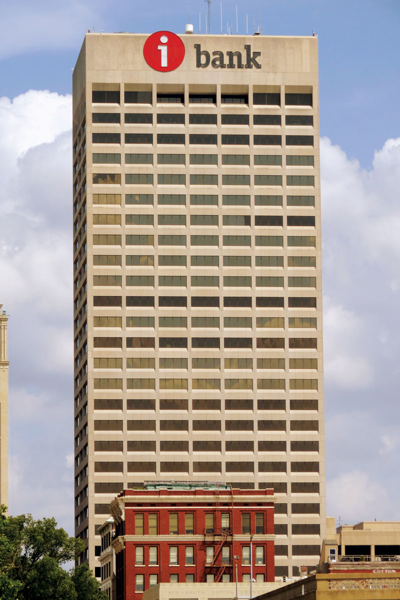
One Commerce Plaza in Memphis (Creative Commons 2.0 License)Brent MooreThe owners of One Commerce Square had a problem.
The investment group bought the troubled downtown Memphis skyscraper in 2010 for $7.6 million, and they spent another $22 million fixing the place up. The city of Memphis had also spent $3 million on a parking garage next door. All of the effort had been to land prime tenant Pinnacle Airlines, whose offices would take up 12 floors, one-third of the building. But in 2012, less than a year after they moved in, the airline was filing for bankruptcy, and despite the tax incentives that landed them in the building, despite the long-term lease, the company was pulling out and moving to Minnesota.
But then, in 2013, salvation appeared in the form of Jones Lang LaSalle — and the state of Tennessee.
The revitalization of downtown Memphis has lagged behind that of Nashville, but city leaders have pushed for redevelopment for decades. The first major business to buy into that redevelopment was AutoZone, which moved its corporate headquarters downtown in 1995. The company’s founder, billionaire J.R. “Pitt” Hyde III, wanted to help with the rebirth of the city he grew up in and loved.
Over the years, Hyde has done a lot for Memphis — sponsoring the minor league ballpark downtown, helping bring the Grizzlies to town, getting the National Civil Rights Museum construction finally underway. Hyde is also a major Republican donor. He and his wife Barbara donated $10,000 in total to Gov. Bill Haslam’s 2010 race, and $15,200 to Haslam’s 2014 race. AutoZone’s bipartisan corporate PAC also donated $5,000 to Haslam in each race. And both Hyde and his wife have contributed hundreds of thousands of dollars over the past decade to the Tennessee Legislative Campaign Committee PAC, the Tennessee Republican Party’s campaign account.
A decade ago, the recession hit Memphis hard. One of the most prominent downtown buildings, One Commerce Square, was close to empty and in foreclosure after its two largest tenants — SunTrust and the law firm Glankler Brown — had left in 2007 and 2008, respectively. Sensing an opportunity, Hyde, under his real estate investment arm Worthington Hyde, partnered with several Memphis developers (Karl and Gail Schledwitz, Terry Lynch and Gary Prosterman) to buy the building. But there was one catch: A new tenant had to be part of the deal.
So the developers, in partnership with the city, lobbied hard to bring Pinnacle Airlines to the building. Hyde personally pitched to the board, describing his own experience moving in a few blocks away, how people thought he was crazy at the time and how much downtown had improved since.
Although the company was also courted by Nashville and Mississippi, Memphis came up with around $10 million worth of incentives, including the parking deck and a 15-year tax freeze, and that was enough to convince Pinnacle to bite. The deal was announced in October 2010, and reporting at the time called it “the biggest corporate relocation for downtown Memphis since AutoZone.”
Not only would the headquarters’ 600 employees occupy 155,000 square feet of the building, the company’s other 9,000 employees were likely to visit for training, providing a boost for nearby hotels and restaurants.
The developers set to work renovating the building, and about a year later, Pinnacle moved in. And then on April 1, 2012, the company filed for bankruptcy. It was subsumed by Delta and renamed Endeavor Airlines, and in 2013 the Memphis offices were relocated to Minneapolis-St.Paul International Airport — leaving One Commerce Square with 12 empty floors.
In January 2010, the state of Tennessee entered into a $1 million “statewide master planning” contract with Chicago-based Jones Lang LaSalle, as part of Gov. Bill Haslam’s attempts to streamline government operations and maximize efficiency. According to the minutes of the Tennessee State Building Commission meeting at which the deal was approved, the vendor was to “assess the condition and management of current State properties, including capital maintenance and renovation, the need for additional or expanded facilities to accommodate State programs and service delivery, efficiencies that may be achieved by consolidation of spaces and the potential disposition of any property surplus.”
The choice of Jones Lang LaSalle was criticized at the time, as Haslam at one point had significant holdings in the publicly traded company, which manages $48 billion in real estate assets. Haslam’s investments are now in a blind trust, but as he has refused to disclose all the details of his holdings since taking office, it’s unknown whether he still owns stock in the company.
Over the course of the now-expired contract, JLL recommended the sale of some buildings and the demolition of others (including, notoriously, the Cordell Hull building in Nashville, which was spared from the wrecking ball and will soon contain all legislative offices after renovations are complete later this year). Also over the course of the contract, JLL got the commission to approve several amendments to its contract, which took it from a $1 million deal to a $7.65 million deal — and also allowed the company to collect commissions on the leases it procured, which a state audit would later call an “organizational conflict of interest.”
One of the buildings JLL recommended closing was the Donnelly J. Hill State Office Building in Memphis — another downtown building. In its report on the 44-year-old building’s condition, JLL called it “obsolete” and reported that it would cost more than $9.2 million to renovate. These numbers were questioned at the time. A report by the Downtown Memphis Commission estimated a renovation would cost half that amount. But the state decided to go ahead with plans to sell the building. A request for proposals was issued to find new office space. The developers of One Commerce Square were the winning bidders. Newspaper reports at the time had them as the clear favorite before the bids were opened, based solely on the amount of empty space in the building available for the state to use.
On Sept. 6, 2013, the State Building Commission’s executive subcommittee signed off on a proposal to move the 479 state employees from the Donnelly J. Hill Building to One Commerce Square under a 15-year, almost $29 million lease, an increase of $5.10 per square foot in rent and associated costs — quite a windfall for Hyde’s firm. One Commerce Square’s tenancy rate increased by 30 percent overnight. And JLL walked away with an $805,315 commission.
Meanwhile, in May 2015, the city of Memphis purchased the Hill Building from the state for $1.5 million. Renovations on the building remain underway.
Haslam’s office says nothing underhanded occurred — the RFP process was followed as usual, and the coincidence that the winning bidder happened to be a campaign donor is just that. Developers are more likely to donate to Republican causes, anyway (although Gail Schledwitz’s campaign donations lean Democratic).
But here’s where the Haslam-JLL connection will again come under scrutiny: JLL is reportedly one of the three companies seeking a massive statewide outsourcing contract, bidding on an RFP that the company itself (and the other two companies bidding, Aramark and Compass Group North America) helped write. An audit ostensibly proving the alleged cost savings of the outsourced maintenance and custodial jobs was completed by Kraft CPA, another firm with financial and donor ties to Haslam — although Kraft was chosen for the audit via an open RFP process too.
“The consistent lack of transparency and vast scope of the governor’s outsourcing efforts throughout his tenure should raise every taxpayer’s eyebrows,” says Nashville Rep. John Ray Clemmons, a Democrat and ardent critic of Haslam’s outsourcing attempts. “In this instance, given the facts, it is both fair and appropriate to question the governor’s motives. Additionally, I would argue that comprehensive oversight is needed to evaluate the actual motives behind all of his outsourcing efforts at our state parks, colleges, prisons and elsewhere. Without reliable proof of cost savings and improved government efficiency, we’re left scratching our heads about what the real motivation could be.”
The winning bidder of the new RFP will be unveiled at the end of March.



