
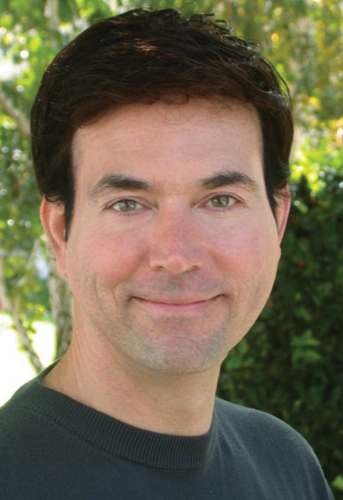
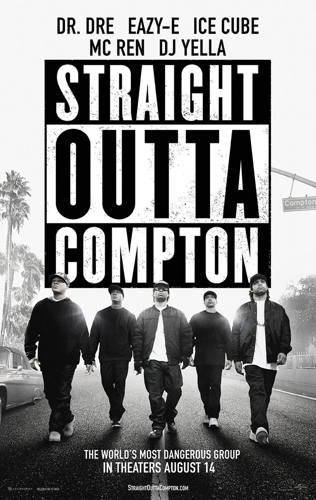

The journey of the N.W.A. biography Straight Outta Compton from long-gestating production to the most successful musical biopic in history — $160 million and counting — has taken more than a decade. One man who's been involved since the project's early days is Alan Wenkus, a former programming executive with Premier Radio and Clear Channel Communications.
Along with co-writer Leigh Savidge, Wenkus not only did the bulk of the research used to create the film's script, he spent nine months with the group's former business manager, Jerry Heller, compiling extensive interviews on his history with the group. These interviews detailed Heller's personal and business relationship with N.W.A. co-founder Eazy-E, something that was key to the group's success — as well as a major factor in its demise.
"My writing partner, Leigh Savidge, and I were the only people who had access to Jerry Heller," Wenkus tells the Scene in a phone conversation. "We spent more than nine months talking with him, but one thing some people don't understand is this film represents a 10-year journey through multiple studios and different scripts."
Wenkus will discuss that convoluted process — which involved sorting through the rap legends' past controversies, contentious histories and well-documented conflicts — 5 p.m. Saturday at Meharry's Cal Turner Family Center as part of the 2015 International Black Film Festival of Nashville. He's one of four credited writers on Straight Outta Compton as well as an executive producer, and he says it might not have happened at all if he hadn't won the support of Tomika Woods-Wright, widow of the late Eric Wright, aka Eazy-E, who died of complications from AIDS in 1995.
"It really took shape when we got the blessing of Eazy-E's widow," Wenkus says. "She helped us with other relationships, and eventually we were able to get Ice Cube, then [Dr.] Dre and [Dre's Death Row Records co-founder] Suge Knight.
"She controlled the publishing on some of his songs, and also was very concerned about the story. Once she was convinced of the project's worth, things started to come together. But Ice Cube didn't get involved until Universal really committed to doing it. When he saw that they were serious, then he committed, and from there we began adding everyone else."
After a protracted period that involved negotiations with two other studios, the script and music rights for what became Straight Outta Compton were sold to Universal Studios. Wenkus adds that Ice Cube was thoroughly involved despite simultaneously making another film.
"Ice Cube was always involved through Skype, on satellite, looking at the rushes and offering suggestions and making comments," he says. "He was very much concerned that the story accurately reflect their lives. There would be days where he would be shooting scenes all day, then check in with us after he finished shooting."
Others were reportedly not as pleased with the final result. Along with the movie's blockbuster opening came reports that Jerry Heller (played in the film by Paul Giamatti) balked at the way he was depicted. Wenkus disputes the contention Heller is unhappy with how he's portrayed.
"Well, I haven't had any interaction with him since our conversations, but I don't think it's true he's not happy with his portrayal," Wenkus says. "We went into great detail in terms of portraying the relationship between Eazy-E and Jerry. They were extremely close, and they had a business relationship that was critical to the film. I don't think we did anything in the script that is inaccurate in terms of showing his role and his connection to the group."
Another criticism concerns the absence of any material that deals with either the ugly physical confrontation between Dr. Dre and writer Dee Barnes in 1991, or his volatile relationship with vocalist and former wife Michel'le.
"We did have scenes in the original production that depicted that exchange between Dre and Dee Barnes, but it's among material that later [got] cut out," Wenkus says. "You can't have a four-hour movie. We're talking about a prolific period in these people's lives, and there is no way we could get absolutely everything that happened or everything that they did in one film.
"Dre has acknowledged that he was young and did some awful things back in that period. He has apologized for them, and I don't know what more can be said about that. To be blunt, I wasn't there when those things happened, and I don't know exactly what went down. But that is public information and it is a matter of record, so we expected that there would be criticism when that material wasn't included.
"Another thing that has to be factored in when you're talking about the final film is at a certain point, F. Gary Gray's input became a central factor. Ultimately, it reflects his vision as the director, as well as the desire to make a film that would resonate with a general audience." (Ironically, Barnes says Gray was the cameraman on Barnes' show Pump It Up! who shot the footage that led to the altercation.)
Wenkus is now working on two equally compelling new projects. One is No Show Jones, the recently announced George Jones biopic on which he's writer and executive producer.
"People talk a lot about Johnny Cash and he was a great individual and had a wonderful TV show, but when you talk about the man who's influenced so many country singers, George Jones is the person everyone admires," Wenkus said. "He did everything connected with country in a special way, whether you're talking about ballads, uptempo songs, novelty tunes, rockabilly. Anything connected with country, he was spectacular, and he definitely had a cinematic life in many ways.
"I've visited the George Jones Museum, and it is amazing. His widow Nancy is such a wonderful person, and they're really providing me with so much material. This is going to be a very special project for anyone who really loves country music."
He's also penning the screenplay for Code Name: Johnny Walker, which he calls "the opposite end of the story depicted in American Sniper."
"The Code Name: Johnny Walker project is about an amazing person and also shows the development in Iraq of what evolved into ISIS," he explains. "This man was an Iraqi citizen who saved a lot of American lives. He worked with Seals in Iraq, identified where the danger zones were, and what areas to avoid. When his identity was discovered, the government got him out of the country. He is now living in San Diego, really part of the American Dream."
The opportunity to tell such stories is part of what brought Wenkus to the IBFFN this weekend.
"I remain a huge supporter of diversity in film," Wenkus says. "I think that the response to Straight Outta Compton shows that people are interested in all kinds of stories, and are appreciative of various cultures and history."



