
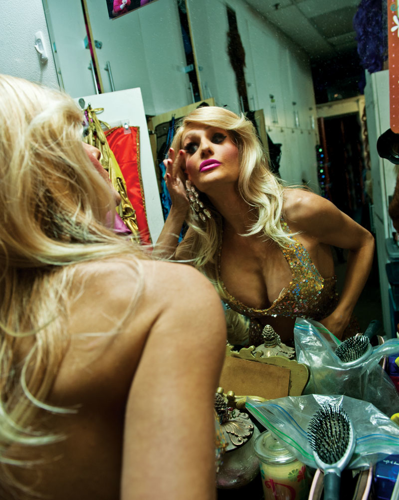

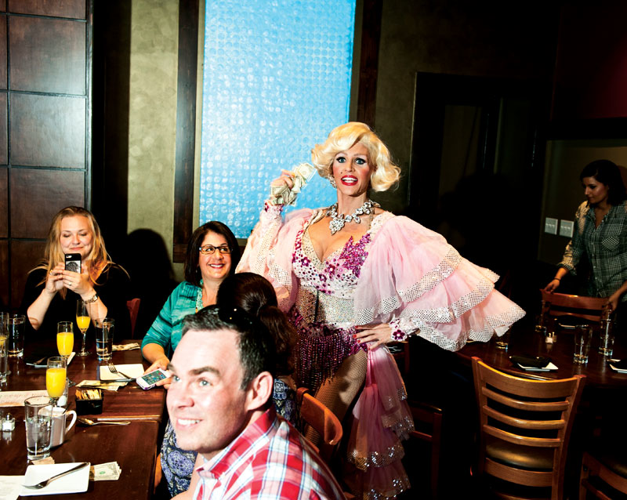
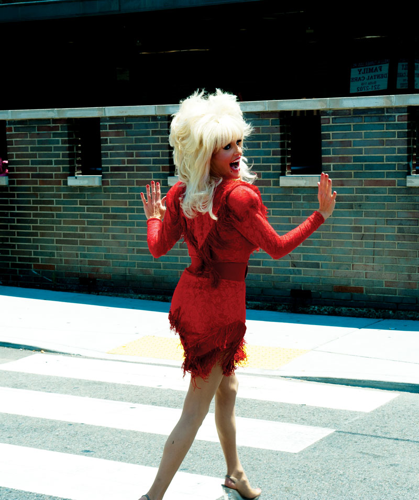
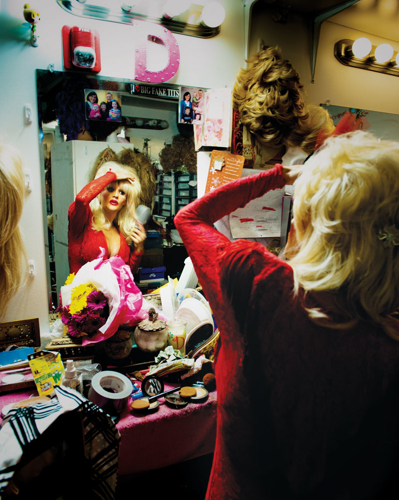
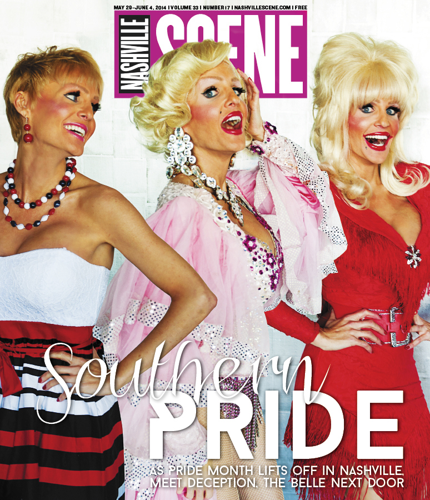
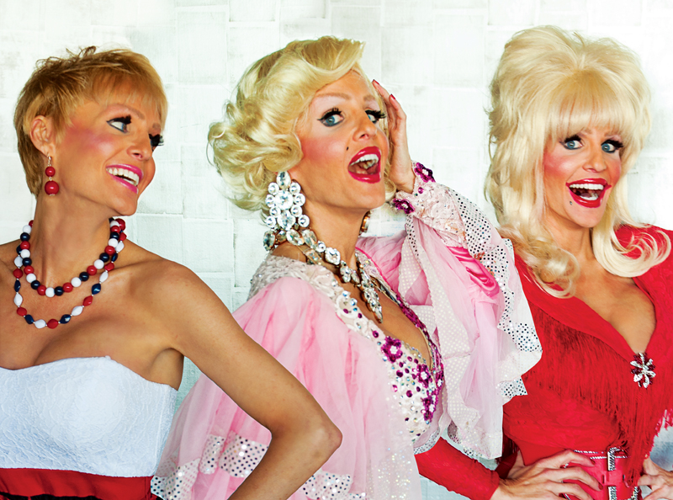


DeeDee Renner (left) and her Deception alter egos, Marilyn Monroe and Dolly Parton.
"I am the most boring person, so this is going to be a challenge for you," DeeDee Renner says, laughing as she settles on a couch in Tribe Nashville, demurely tucking her skirt around her slender legs.
Anyone meeting her for the first time would likely disagree. With ample fake lashes glued to her heavily lined eyelids — and even more ample breasts peeking out over the top of her strapless dress — Renner is striking yet diminutive. Especially compared to some of the other performers at Tribe, Play Dance Bar or Suzy Wong's House of Yum, where Renner is about to star in the weekly "Drag'n Brunch" (hence the stage makeup).
Tribe looks very different in the daylight, with the Sunday morning sun streaming through the windows. A faint chemical smell permeates the air, as every inch of the club has been scrubbed clean in the few hours since closing time from the previous night. Nearby, a dressing room has somehow escaped this cleaning frenzy — glitter coats various surfaces in the cramped room, and wigs of all shapes, colors and sizes drape the walls. Renner finds a space among the sparkles and feathers to prepare for the show.
"I hate to subject y'all to that dressing room," she says, laughing. "It's disgusting."
Renner, who regularly entertains at these adjacent Church Street venues in downtown Nashville, has been living as a woman since she turned 18. Once she was a legal adult, she started the physical transition, a six-year journey that started with hormones and ended with full gender reassignment surgery.
But for Renner — a Nashville stage artist and showgirl who performs as "Deception" — the surgery and the subsequent legal name and gender change didn't make her a woman. They only made official what she'd known practically since birth.
"I have always felt like I was a girl," Renner says. "My earliest memory is probably when I was around 3 years old, and I remember thinking that I was a little girl. I only had girls for friends, I loved everything pink, and I wanted every Barbie doll and every My Little Pony. Probably when I was about 5 or 6, I realized, 'I'm not a girl, I'm a boy.' It was really confusing for me, just realizing that, physically."
The confusion continued throughout her childhood. As a boy growing up in a Southern Baptist household in Cleveland, Tenn., she said prayers every night before bed. Every night, she begged God to turn her into a girl while she slept.
"Every morning I woke up, just to check, did it happen overnight?" she laughs, her East Tennessee drawl deepening as her pitch rises. "But finally I realized that's not going to happen. And there were hard times. I got depressed, but I just knew there's got to be some way."
A light appeared as a teenager, when she learned about gender reassignment surgery. When she was growing up, in the 1990s, the term she heard was "transsexual" — a word that signified a physical transformation. Today, she explains, many prefer the word "transgender," which includes people like the pre-surgery Renner who understand early on that they belong to a different gender than the body they were born with.
"My vision was, I'm just going to turn into a girl and get married and have kids, all of that," Renner says. "When I was in high school, my first boyfriend and I were going to move away after graduation, and I was going to fully transition."
Renner and her boyfriend broke up, but she still started her physical transformation from man to woman at age 18, beginning with hormone therapy. During this time, she moved to Chattanooga, where she launched her drag career. As she began her transition, she says, she never imagined a career as a showgirl.
But after living and performing in Chattanooga for about three years, she began to compete in regional pageants — and she won them. She started traveling and performing in other markets. This led to a move to Florida, where she continued her transition. She got breast implants, began the process of body sculpting, and eventually underwent the full sex reassignment surgery.
"It took a good six years, I would say, to get the whole female shape," Renner says. "But back in the '90s, plastic surgeons would tell you, 'We don't give men breasts.' So a lot of transgendered people, we did silicon injections. But now transgendered people will never have to do that because they can go to a plastic surgeon and get implants, buttocks, all these wonderful fillers. And that's society making that change, that acceptance."
For the next 10 years, Florida remained Renner's home base as she traveled the country, performing in larger clubs and competing in national pageants. On the circuit, she met Joey Brown, one of the owners of the popular Church Street nightlife complex that includes Play, Tribe and Suzy Wong's, and he started booking her in Nashville. Brown repeatedly asked Renner to move to Music City to join his cast full time, and in 2009, she finally accepted. Even though Renner grew up in Tennessee, she hadn't spent much time here and was apprehensive about the move.
"I was very nervous about leaving Florida; I was doing really good down there," Renner admits. "At 20, you can pick up and move on a dime, you don't have much, and if it doesn't work out, you just fly by the seat of your pants. But by the time you're 28, 29, you've established yourself, you have a home, you have things, and you think, 'Oh my gosh, can I uproot my life? What if it doesn't work out?' But I took the leap of faith."
The deciding factor, she says, was the way Brown and his partners Todd Roman, Keith Blaydes and David Taylor run their business. For drag performers, the package that's prized above all others is a benefits package. Not only is Play a solidly managed corporation, she explains, it's one of the only showbars in the country that offers its performers a major perk: health insurance.
She had no idea how important that benefit would be until June 16, 2013.
After a busy weekend performing at Nashville Pride, she wasn't feeling well. When it was obvious that it was something more than fatigue, Renner was rushed to the hospital. Brown and Roman sat with her as she awaited test results.
"The doctors came in and said, 'Miss Renner, we have some bad news for you. You have cancer,' " Renner remembers. "I was like, 'Excuse me? Cancer? Are you serious?' And they kept talking, and I interrupted them about three or four minutes in and said, 'Wait a minute — are you telling me that I'm going to have to go on chemo and lose my hair?' And they said yes, and I busted out hysterically crying. I mean, I just fell apart.
"When the doctors left and I had composed myself, Joey and Todd said, 'Do you realize that you did not shed one tear when they told you that you had cancer — but the minute you found out you were going to lose your hair, you became hysterical?' And we busted out laughing in that hospital room. I am so ridiculous!"
But for someone who had waited so long and worked so hard to make everything on the outside — the body, the hair — match who she was on the inside, is that really so ridiculous? The laughter quiets.
"I think, as a woman, hair is our femininity," she says. "I always had long blond hair, it was kind of my signature, and I thought, 'What am I going to do without that long blond hair?' "
As it turns out, once she began chemotherapy for her chronic myeloid leukemia, she did lose her long blond hair. But Renner describes herself as "a glass-half-full person." The region breeds steel magnolias, and if there's one thing they know, it's how to endure.
"I come from a long line of strong Southern women who are bred to be feminine but tough as nails," Renner says. Not only that, the diagnosis immediately brought her parents to Nashville. They stayed for three months as she recovered. "I'm one lucky girl," she says. "My parents, they never left my side."
She documented her experience through a Facebook page and a series of videos, providing updates on her progress and giving friends and fans a forum to write words of encouragement. After spending 35 days in the hospital, Renner returned home. By early September, she was back onstage at Play.
"I have not missed one shift since," Renner says. "I feel good. I'm actually still on the chemo, but luckily in October they switched my chemo to where your hair will start growing. So my hair is growing back, thank God.
"But it's still chemo, and it still makes you nauseous and a little dizzy. But it's mind over matter — even on days when you don't feel good, you trick yourself into thinking that you do. There's never a day that I don't do something — I always put on my makeup and go to the grocery store, or go shopping or something. I feel like, if you ever stop, then you let the cancer win. And that's just not an option."
After one year of living with cancer, Renner says she's realized that she already was a survivor, long before her diagnosis.
"Every transsexual is a survivor by nature — you have to be a survivor to be a brave, tough person who is true to yourself and to live life honestly and authentically," she says. "I already knew I was a survivor by making it through my whole life battling all the struggles and discrimination us transsexuals face. And now I am a survivor, twice!"
Renner says she's noticed a shift in Nashville and beyond regarding how the LGBT community is perceived, but that transsexuals are still misunderstood.
"Speaking as a transsexual, I feel like we're still probably 10, 20 years behind gay people in acceptance," she says. "It's so funny how people can wrap their minds around the concept of being gay, but people can't wrap their minds around the idea that someone could be born a boy but have a female mind, or vice versa. I think, in time, people will finally get that it's not a choice."
Renner's cancer diagnosis also taught her that she can't take a single day for granted. True to her Southern Baptist roots, she says she's seen that God has a plan for her.
"I never in a million years thought I would leave Florida, but God saw fit to give me this job that has health insurance," Renner says. "And after I took this job, I got diagnosed with the cancer, and Vanderbilt hospital is one of the best in the country for oncology. So I look back at different patterns in my life, and God's always got me exactly where I need to be at the right time."
Right now, that's in Nashville, a city she says she's fallen in love with. And the city has clearly fallen in love with Drag'n Brunch. On this particular Sunday, Suzy Wong's is packed, and with a diverse mix of patrons. One table hosts a book club; others host five different people celebrating birthdays — Deception included, though she charmingly declines to say her age. At a large table near the front, a 9-year-old girl sits at the head of the table with her family. After talking with the family, Deception learns that the girl came to Drag'n Brunch the previous week with her parents, and wanted to come back again.
"She wanted to see a drag show for her birthday!" Deception announces to the restaurant crowd, which erupts in cheers and applause. "How cool is that? And how cool are her parents for bringing her?"
Of course, there are plenty of double entendres and bawdy jokes — it's a drag show, after all. But the scene is remarkably family-friendly, and chef-slash-performer Arnold Myint's brunch fare is delicious. Besides, there are few social inhibitions that cannot be overcome by two-for-one mimosas.
On Nashville Pride weekend, Deception's June 15 performance at Suzy Wong's will serve as a fundraiser for the Leukemia and Lymphoma Society. Two of her most popular characters are Dolly Parton and Marilyn Monroe, but she usually just performs as herself. It's a role she's very comfortable with.
"That's where I'm so different from a lot of other entertainers — there's really no difference between Deception and DeeDee," she explains. "The other girls in the show, they do this over the top, makeup and hair and all that, and here I come out onstage, just this little girl."
If it seems contradictory that a transsexual would perform in a "drag" show, Renner says she considers drag queens and female impersonators to be individuals who, though they perform in female personas on stage, live as men off stage.
"I am in a female illusion review show, which is commonly referred to as a drag show, but I do not consider myself a female impersonator or a drag queen," Renner explains. "Not only do I feel like I am a woman on the inside — which I have identified with, felt, and thought of myself as a girl since my earliest memory — but I live my life as a woman full time, every day, all day."
Ultimately, Renner still has the same vision for her future that she had when she was a teenager.
"You know, I've had so many people come up to me and say, 'You just look like you'd be a housewife, it's so funny that you're on stage,' " she says, laughing. "Hopefully, one day, I will get married. Other than me doing shows, in my day-to-day life, I am like a housewife."



