
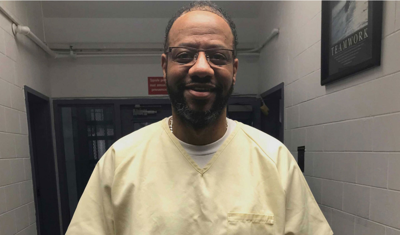


Pervis Payne
Pervis Payne is less than three months away from being executed for a crime he has always insisted he did not commit. After more than 30 years on death row, his life may depend on whether a judge grants his request for DNA testing, which his attorneys say could prove his innocence.
Shelby County District Attorney Amy Weirich is opposing that testing, while Payne is now backed by a growing coalition of criminal justice and civil rights organizations, including the Innocence Project. Both sides made their case at a lengthy court hearing in Memphis last week. A decision is expected later this month.
Payne was convicted and sentenced to death for the 1987 murder of a white woman named Charisse Christopher and her 2-year-old daughter Lacie Jo. But he has always maintained that he was an innocent bystander who came upon the horrific scene while checking to see if his girlfriend was at her apartment across the hall. He says he tried to help and then panicked. The prosecution’s case against him relied heavily on racist stereotypes about Black men, portraying him as a drug-using sexual predator who attacked Christopher, a stranger, when she rejected his advances.
The evidence against Payne was largely circumstantial, and he had no prior criminal record. He also has an intellectual disability. His current attorneys argue that made it difficult for him to assist with his defense and easier for the prosecution to make him look guilty.
What’s more, there was an array of holes in the case, forensically, that remain unfilled.
“Though painted as a drug abuser by prosecutors, no drug testing was performed on Mr. Payne, even at the insistence of Mr. Payne and his family,” said Asia Diggs-Meador, a board member with the Ben F. Jones chapter of the National Bar Association, at an event in support of Payne ahead of the recent court hearing. “Though the prosecution argued that the victim had been sexually assaulted, despite being found fully clothed, no testing was done to support such a claim at trial. Though arguing that the victim fought and scratched Mr. Payne as she tried to get him off of her, no analysis had been performed on her fingernail clippings taken from the crime scene. Mr. Payne has been ignored and marginalized for three decades. And the only way to somewhat undo the damage done by the prosecution’s use of racist tropes to circumstantially convict him is to ensure that the more than a dozen items of crime scene evidence are submitted to DNA analysis.”
Joia Erin, a program manager at the Memphis-based criminal justice advocacy organization Just City, was also at the event. Erin said that Payne’s case — that of a Black man accused of a sexually motivated attack on a white woman — “evokes haunting memories of countless Black men who were lynched in the Deep South.” Shelby County, where Payne was convicted, has the most known lynchings in Tennessee’s history.
The case also highlights the arbitrary nature of the death penalty and the way such cases are dealt with in the decades that follow a conviction. Nearly 50 percent of the men on Tennessee’s death row are from Shelby County. More than 30 years later, the outcome of Payne’s case is still significantly affected simply by the jurisdiction in which it is taking place. While Weirich is opposing DNA testing — even though Payne’s attorneys say the cost would be covered and the testing could be done in time to avoid a delay in Payne’s execution date — Davidson County District Attorney Glenn Funk says his office would agree to testing in such a case.
“When anyone volunteers to pay for DNA testing on physical evidence from a closed case, it is the Nashville District Attorney’s office policy to sign an agreed order authorizing the test,” Funk says in a written statement to the Scene. Still, Funk’s office has faced criticism for its handling of at least one potential case of wrongful conviction, that of Joseph Webster. A decision on that case by the office’s Conviction Review Unit is still pending.
Payne’s story has remained the same for decades. But earlier this month, he sat at Riverbend Maximum Security Institution, watching as attorneys argued over video about whether he’ll have the opportunity to back his story up with testing that wasn’t available when he was convicted.
Gov. Bill Lee has the power to commute Payne’s sentence or at least delay his execution, pending DNA testing. He has not commented on whether he will do so.



