
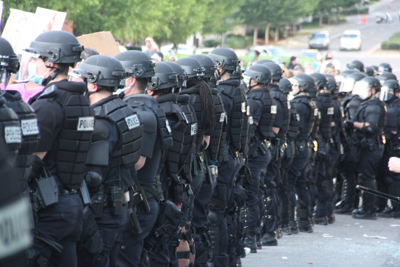


MNPD officers in riot gear on May 30
For those newly engaged in local politics after a month of high-energy protests and organized actions, last week’s Metro Council budget debate was likely a disappointment.
A group calling itself the Nashville People’s Budget Coalition, made up of several long-standing community organizations, marshaled that new energy to the Metro Council: phone calls, emails, public testimony and rallies outside the Metro Courthouse, all asking the body to spend drastically less on policing. Their most optimistic proposal, carried by Councilmember Ginny Welsch of District 16, would have redirected more than $100 million from policing to social services and other priorities, but it failed to gain traction. Smaller bites at the apple, including one from Councilmember Sean Parker, failed as well.
The coalition and other like-minded people were left hoping for the next best option: Budget Committee chair Bob Mendes’ alternative to Mayor John Cooper’s budget. Mendes imagined keeping spending on Metro Police flat from the current year: no increase, but no reduction.
But the mayor and police representatives warned that eliminating the $2.6 million increase for police would result in the loss of an incoming class of 48 recruits. Their warnings were enough to convince a majority of councilmembers to support an amendment restoring the added police funds, leaving the People’s Budget Coalition with little to show for their advocacy efforts.
That doesn’t mean they’re demoralized, though: They started the conversation, and they have a group of councilmembers on their side.
“Although they didn’t listen to us this time, it’s changed the political weather,” says Dawn Harrington of Free Hearts, one of the coalition organizations. “It’s changed what is politically viable.”
She’s right: Increases to police funding in the past have been routine, and now a growing number of councilmembers agree, at least conceptually, that less could be spent on policing. Some of the councilmembers who back the coalition’s principles don’t think it’s feasible until there’s an infrastructure in place that can take on some current police responsibilities, like mental health emergencies and other calls that don’t necessitate weapons or force.
“For me, it simply means limiting the scope of what an armed police officer will do and what handles which type of calls,” says District 29 Councilmember Delishia Porterfield. “If you relieve them of some of those duties that are not associated with their job, that frees them so you don’t have such a long wait when you do need an actual police officer to respond.”
District 2 Councilmember Kyontzè Toombs, vice chair of the Budget Committee, says it is important to engage with the mayor’s office earlier, because the mayor has more time with the budget than the council does due to the process set forth by the Metro Charter.
“That’s something you start working on now,” she says. “You can’t wait until after the mayor has proposed his budget. That’s something you start working on today and keep working on so when it’s budget season, there’s a plan in place.”
But the mayor’s actions during this budget process — using his primary negotiating effort to advocate for added police spending — left some advocates and councilmembers skeptical of his willingness to engage in the conversation. Harrington said she was “shocked and energized” by the move, and that new participants in the process who felt betrayed were also energized, not demoralized, by the move.
“I don’t know what his intentions were, but for me specifically it felt like a slap in the face against the thousands of people that said they wanted to see their taxpayer dollars going into things like education and city services and social services,” says Councilmember Porterfield. “I understand why people are frustrated and why people feel as though we didn’t listen.”
The newly formed coalition is planning ongoing events and calls to action in the coming months in an effort to keep people engaged in the budget process and Metro government more generally. One benefit of the effort the past few weeks, says Cecilia Prado of Workers’ Dignity, is a growing unity among the people represented by the coalition organizations: immigrant rights activists, Black Lives Matter and more.
“We have the people on our side, and the people have spoken,” says Prado.



Post a comment as anonymous
Report
Watch this discussion.
(0) comments
Welcome to the discussion.
Log In
Welcome to the discussion.
Keep it clean. Please avoid obscene, vulgar, lewd, racist or otherwise abusive language. Comments featuring hate speech or threatening or violent content will not be tolerated.
PLEASE TURN OFF YOUR CAPS LOCK.
Be truthful. Don't knowingly lie or mislead.
Be proactive. Use the “report” link on any comment that violates our comment policy.
Share with us. We'd love to hear your feedback.