
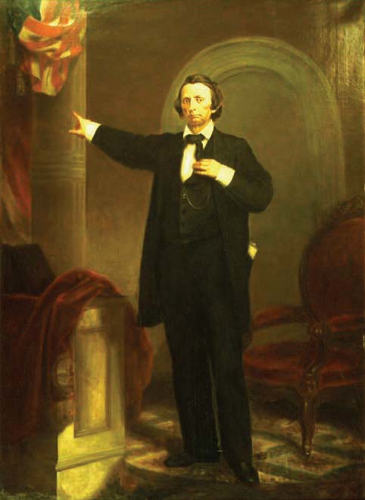
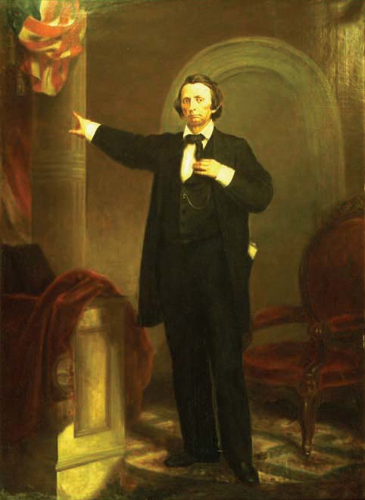
Back in April 1987, the Tennessee Capitol unveiled a newly renovated library, complete with a restored portrait of former Gov. William G. “Parson” Brownlow. According to news reports at the time, the portrait had been damaged by decades of Democratic legislators walking past it, spitting tobacco juice at Brownlow’s image.
Brownlow was a Methodist minister from Knoxville turned much-loathed newspaper editor (he was hanged in effigy in other states) who became a politician and in 1865, the first Republican governor of Tennessee. Which is to say, Brownlow was a Unionist presiding over a fiercely divided state at the end of the war and during Reconstruction. He later served as a U.S. senator.

At one time Brownlow owned slaves and supported the practice, but he changed his mind in the face of a dissolving union. Brownlow is the reason Tennessee became the first Southern state to rejoin the union, and his (questionably violent) tactics are how the the state passed the 13th and 14th Amendments, abolishing slavery and establishing due process and equal protection under the law, respectively. But Brownlow also prevented former Confederate sympathizers from voting and used martial law to counter violence from the Ku Klux Klan across the state — and as such, he repeatedly came into conflict with former slave-trader and Confederate Gen. Nathan Bedford Forrest, who at that point was the Klan’s Grand Wizard.
In the 1970s, Sen. Douglas Henry, a Nashville Democrat, had a bust of Forrest installed in the Capitol with the financial support of the Sons of Confederate Veterans. A decade later, within a month of the Brownlow portrait’s reinstallation, the Capitol Restoration Committee — led by Henry and with nary a Republican on it — voted to move Brownlow’s visage to the Tennessee State Museum for all time.
According to a New York Times report at the time, Henry said the painting had to go “to avoid having impressionable school children come to the conclusion that we rank among our highest principles of government, worthy of emulation, the manipulation of elections, however sincere the manipulator, and the denial of civil liberties to Tennesseans, either in general or by means of armed force in particular.”
Henry’s arguments for removing Brownlow’s portrait sound awfully similar to those who have tried, and failed, to get the bust of Forrest removed from the Capitol since it was installed in 1978. When the State Capitol Commission voted two weeks ago to keep the bust, the group — made up almost entirely of Republicans — said that to remove the statue of Forrest would be to pretend Tennessee’s history had happened differently than it did. However, despite a GOP supermajority since 2011, there’s been absolutely no push to bring Brownlow back to his place of honor in the Capitol.
“No one else has expressed that concern to me,” says state Sen. Jack Johnson, a Franklin Republican who voted to keep Forrest on display.
“I’ve never heard that mentioned,” added state Rep. Steve McDaniel (R-Parker’s Crossroads), a noted Civil War history buff who also voted to keep the Forrest bust. “I just know that some people don’t care for him.”
But the fact that Forrest still has a place in the Capitol and Brownlow does not is “lost cause” revisionism, says Knoxville historian and journalist Jack Neely.
“Brownlow was so much more a major figure in Tennessee history than Forrest was,” Neely says. “Forrest was just a general.”
Neely says Brownlow’s legacy is “extremely complicated” and that it’s possible his support of civil rights was “driven as much for vengeance [against former Confederates] as for love of his fellow men.”
“I think people don’t have the patience to dwell in that era to understand all the nuances of it,” Neely adds.
At the time of the portrait’s removal 30 years ago, critics called the move racially motivated. The Knoxville Journal, the now-defunct newspaper that was the descendant of Brownlow’s paper, the Knoxville Whig, wrote in an editorial, “Democrat powers in control in Nashville are insisting on humoring maintenance of allegiance to the Old South and to the party. … If there were a leader among them, he or she ought to take these latter-day Confederates out onto some sheltered veranda and let them whistle Dixie in unison as they whiz upwind. Indeed, they aren’t worth the lead for a good shooting.”
But despite the often-petty interparty politics at the Capitol, Republicans aren’t pushing for Brownlow’s portrait’s return. Johnson says he’d “be happy to consider it”; McDaniel says he didn’t know whether he’d support the move. House Speaker Beth Harwell and Lt. Gov. Randy McNally both declined to comment on the matter.
Gov. Bill Haslam says he still wants the Forrest bust moved but wouldn’t “get into all of that” about Brownlow, although he does say, with a laugh, “He was the last governor from Knoxville before me.”
It seems that if Brownlow ever does return to the Capitol, it might be the party who removed him who brings him back. Sen. Jeff. Yarbro, who replaced Henry after his retirement, says he supports the portrait’s return.
“The history presented in the Capitol is selective at best,” Yarbro says. “You can’t understand Tennessee history without understanding Reconstruction, and that means grappling with both Forrest and Brownlow.”
Democratic Rep. John Ray Clemmons of Nashville had harsher words, especially for the constitutional officers on the Capitol Committee who voted to keep the bust in place in the name of “heritage.”
“Gov. Brownlow's portrait should be hanging in the Capitol with his fellow governors,” Clemmons says. “I would recommend hanging it in Haslam's reserved spot on the Capitol wall if he hasn't already outsourced his spot to a corporate donor. Gov. Brownlow's portrait would further serve to remind Haslam, [state Treasurer David] Lillard and [Secretary of State Tre] Hargett what a Republican with conviction actually looks like.”
Rep. Raumesh Akbari of Memphis also said she thinks Brownlow should return.
“Unlike Forrest, I don’t think he stood for hate,” Akbari says of Brownlow. “And his actions were about unity — he brought Tennessee back into the Union. I mean, he was a governor! I think all governors deserve to have their portraits circulated in the Capitol — even Andrew Jackson.”



