



The Gardner School
Julia Monson and her husband aren’t technically parents yet, but they’re already having trouble finding child care in Nashville. She’s due at the end of July and hopes to go back to her job as a real estate agent in October. They both work full time. Since their child care search began in April, they’ve joined four wait lists, and the most promising option is a center that said the couple might have a spot in January — no guarantees.
“I’m just getting on wait lists and seeing what happens,” says Monson. “I’m going to have to come up with some sort of contingency plan though. Maybe I’ll get lucky. But I could also win the lottery tomorrow.”
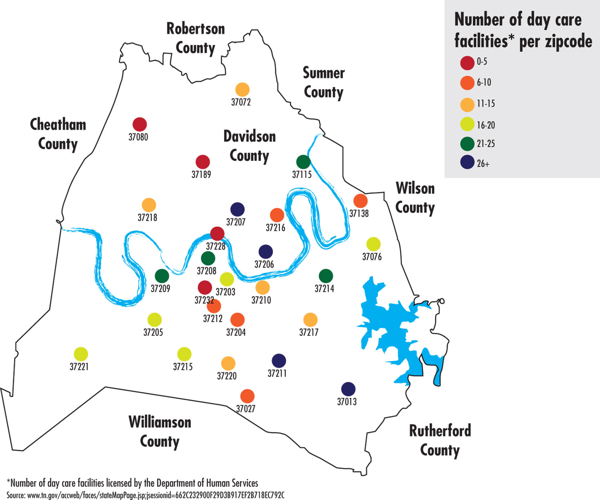
Many new parents who have moved to Nashville in recent years don’t have family members nearby to lean on when it comes to caring for their young children. They turn to child care centers to take care of the kids while they work — and often have trouble finding a spot. According to 2016 census data, children ages 5 and under make up 7.1 percent of Nashville’s population — that’s roughly 47,000 kids. In 2016, the Bureau of Labor Statistics reported that among 56.3 percent of married couples with a child under the age of 6, both parents work. Nashville currently has 203 child care centers licensed by the Tennessee Department of Human Services.
In an effort to supply the demand of Nashville newcomers living and working downtown, The Gardner School (an educational preschool franchise with locations in six states) opened its fourth Tennessee location in Midtown Nashville in 2011. Each of the four preschools enrolls 120 to 160 kids between the ages of 6 weeks and 5 years old. According to Christy Wilson, director of The Gardner School of Franklin, Gardner’s Midtown location has the longest wait list at a year-and-a-half to two years.
“We filled up pretty much right off the bat,” says Wilson, who was the executive director of the Midtown school when it opened. “It was record numbers from the very beginning.”
Parents have to be choosy when it comes to which wait lists they jump on — some centers charge a fee to be added to the list. Some give priority to siblings of current enrollees, or to members of the church if the child care center is church-sponsored.
The Gardner School suburb locations in Brentwood and Franklin have more flexibility when it comes to openings, Wilson says. Suburbs tend to have more centers, but for families who work or live downtown, that means reckoning with traffic.

Brenda Jarvis of South Nashville works at Vanderbilt University. She initially enrolled her son at a day care in Brentwood, but found traffic during her commute was brutal. She says it took her an hour to an hour-and-a-half each way, every day, and it was often a close call making it there to pick up her son by 6 p.m.
“We changed day cares midway, only because of the traffic, because of the time,” says Jarvis. “They were nice people, they took good care of our child, but the drive was just killing me.”
Jarvis says getting into one of Vanderbilt’s five child care centers was a blessing. The Vanderbilt centers serve only employees of the university and medical center, and Jarvis was on the wait list for 14 months before her son got in.
Rhonda Laird, who works with Tennessee Early Childhood Training Alliance, says employer-sponsored programs could be a solution to the child care scarcity in Nashville. TECTA provides connections for people who wish to work in early childhood education, including training, scholarships and certifications.
“One of the things we need to see in the Nashville area, especially, is for businesses to step up to have more employer-sponsored programs, or at least aid parents in finding quality care,” Laird says.
Of the top 10 employers in the Nashville area, only Vanderbilt Medical Center, Vanderbilt University and HCA Healthcare offer child care on site, according to the companies’ websites. Saint Thomas Health closed its center in 2017.
To be licensed, a child care center must have a ratio of 1 adult to 4 children for ages 6 weeks to 15 months, with no more than eight children in the group. That ratio goes up to 1 to 6 once kids graduate to the toddler group, and 1 to 7 for 2-year-olds.
Joyce Bridges, director of the Child Care Resource and Referral Network of Tennessee, says difficulty maintaining this ratio, especially in the youngest age groups, is one reason why early child care centers close their doors.
“The cost of delivering care is very high, to maintain a good, safe ratio,” says Bridges. “I don’t question the ratio at all. As a consumer, you want the ratio to be low enough that you know your child is getting safe care. It’s just expensive to do that.”
Both TECTA and the Child Care Resource and Referral Network look to encourage more caregivers to get into the field, but it can be difficult — child care providers often don’t receive health care benefits or paid vacation time. Additionally, according to Child Care Aware of America, providers in the state of Tennessee make an average yearly salary of $20,480.
The Gardner School’s Wilson says finding quality child care is worth the wait, and parents who can afford it may need to go alternate routes in the meantime — such as using a nanny.
“I always tell them, no matter when you get in, from the time that you get in until the time your child graduates, it’s still going to so be worth that time, because of all that we invest into those kids,” Wilson says.
That may be so. But the wait can be disheartening.
“It’s just frustrating,” says Monson. “I tell everyone I know now, ‘If you plan on having kids, look on wait lists.’ My friends tell me that they’re pregnant, I’m like, ‘Start looking.’ I don’t care if you just took that pregnancy test yesterday. It’s not too early.”
Bridges says the need for more child care doesn’t only affect parents and caregivers — the economic impact on the community at large is tremendous.
“Where are you going to find people to work in business and industry if they don’t have a place to keep their children?” says Bridges. “If they go to school to get qualified to work in all of these industries, what are they going to do if they have children? Where are those children going to be? When you’re actually on the job, how distracted are you if your child is not in a secure, stable setting?”



Post a comment as anonymous
Report
Watch this discussion.
(0) comments
Welcome to the discussion.
Log In
Welcome to the discussion.
Keep it clean. Please avoid obscene, vulgar, lewd, racist or otherwise abusive language. Comments featuring hate speech or threatening or violent content will not be tolerated.
PLEASE TURN OFF YOUR CAPS LOCK.
Be truthful. Don't knowingly lie or mislead.
Be proactive. Use the “report” link on any comment that violates our comment policy.
Share with us. We'd love to hear your feedback.