


It's a Tuesday night at the Megachurch of Country Music, and Brad Paisley has just finished a five-song set of radio-friendly red meat, ending on a full-throated rendition of "Mud on the Tires." Even with just an acoustic guitar and his voice, he's got the crowd eating out of his hand. And then he starts into a story about someone he met recently.
She's from Japan, Paisley explains, and as far as he knows, she was the first Japanese performer ever on the Grand Ole Opry. She performed for its 39th birthday celebration, in 1964. This year will mark its 90th.
"Bill Anderson introduced her then," Paisley continues. "She followed Johnny Cash, and has been singing country music ever since. She went back to Japan and has basically held the torch for us for a long, long time back there."
The crowd roars its approval.
Paisley jokes that his one regret is that neither Porter Wagoner nor Grandpa Jones is here, "because they never got anybody's name right." And, he says with a wide smirk, "they would butcher this next name in a way that you can't even imagine."
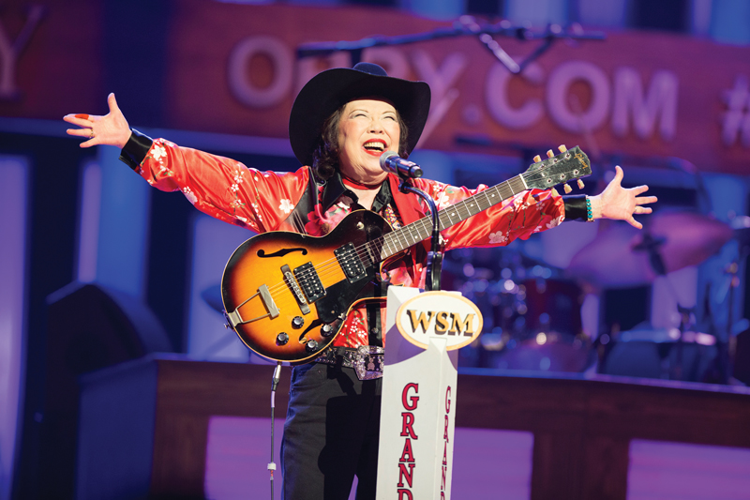
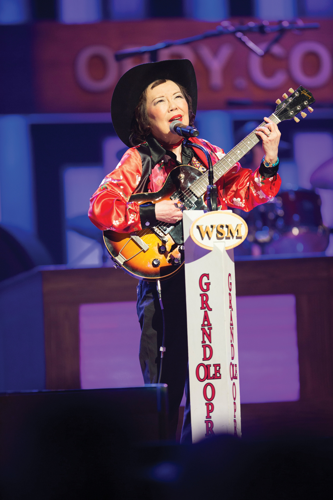
That name belongs to Tomi Fujiyama, who walks onstage clad in a red satin Western shirt and a black cowboy hat, a red-and-yellow sunburst guitar slung over her shoulder. The house band is partway through the intro to "Tennessee Waltz" when Fujiyama stops at the edge of the stage and bows deeply to the audience.
Then she looks up like she's about to start singing, but a stagehand rushes out and points her to the microphone at the center of the stage. She's in no hurry for this moment to end, it seems, so the band circles back through the intro again.
Fujiyama ambles over to the storied wood-plank circle that was taken from the stage she stood on 51 years before — the stage at the Ryman Auditorium. There, as a 23-year-old singer on her first visit to the United States, she was so overcome with joy that she burst into tears after singing only a few notes.
A half-century later, Tomi Fujiyama, now 75, says she might cry again. Then again, there might be an upside to that.
"Maybe Paisley ... hold me?" she wonders, then cackles gleefully. Clutching herself around the shoulders, she starts humming "Love Me Tender."
Nine hours before her appearance on the Opry, the bubbly, effusive singer is sitting in the Nashville Scene conference room. Her husband Shoichi Bamba sits to one side of her, with filmmaker Josh Bishop on the other. She's wearing a black cowboy hat, and her hands dart around her face as she talks.
Fujiyama remembers Opry members Lonzo and Oscar approaching her back in 1964 and telling her they could get her on the show. "Is this real?" she recalls thinking. At the time, she was playing three shows a day at a Las Vegas hotel, seven days a week. She was exhausted and had signed the contract not knowing how to read English.
At the time, she didn't know what to believe. But then November came, and she flew to Nashville, where she remembers seeing horses at the airport.
"Backstage, I'm waiting," she recalls. "Many people waiting." Marty Robbins performed. Then Johnny Cash. Then someone gave her a push. She could hear her introduction.
"From many, many miles away — not Japanese," she says. "At that time, 'Oriental.' They call me 'Oriental.' "
She remembers walking out as the band started the introduction to "Tennessee Waltz." "I'm walking, but [the] microphone is still too far," she recalls. The band ran through the intro three times before she reached the microphone. The 23-year-old Fujiyama started to sing, but then ...
"Wow! I couldn't sing it. Couldn't stop" — the 75-year-old Fujiyama runs her hands in front of her face emphatically at the memory — "crying, crying, crying."
Finally, she was able to make it through the song. When she finished, the crowd leapt to its feet. In the end, she played three encores before they let her leave the stage. The memory remains vivid.
"Like yesterday," Fujiyama says. "It was a big night. I never forget. So this is why [I've been] waiting for one more chance."
So when Brad Paisley introduces her 51 years later, he will say this: "It's been a dream of hers to come back here, and when I heard she wanted to come back on the Opry, I just talked to them backstage and said, 'Hey, you guys, what do you think? And they said, 'That'd be great, let's have her back.' "
And maybe it was that easy — for Brad Paisley, at least. For Bishop and Fujiyama, the path was somewhat bumpier. Bishop first met her in 2004, and he says he knew "within five minutes" he wanted to help tell her story.
"I didn't know it was going to take 11 years," the filmmaker says. "I didn't know that it would be so difficult to get her on that stage."
The way he originally drew it up, his documentary Made in Japan — which details Fujiyama's career and won a Special Jury Prize at the Nashville Film Festival last month — was supposed to end with her playing the Opry again. But after many attempts, even after landing Fujiyama an appearance on WSM with Eddie Stubbs, they just couldn't break through the Gaylord bureaucracy.
And so they did the next best thing: They rented out the Ryman and filmed Fujiyama onstage, playing to an empty house, performing on a make-believe Opry. That was 2008. Over the years, the movie collected influential supporters, including executive producers such as Super Size Me director Morgan Spurlock and actor Elijah Wood (who signed on as narrator).
It wasn't until March of this year that the movie finally made its world premiere at South by Southwest, capped by the muted, mildly downbeat ending Bishop shot at the Ryman. Ironically, the Austin visit would make that ending obsolete. While visiting the city, Jimmy Kimmel had both Paisley and Fujiyama on for a taping of his show. Paisley told Fujiyama he would make her Opry return happen.
And so he did. When Made in Japan screened at the recently concluded NaFF, with Fujiyama tearfully accepting yet another standing ovation, audiences learned the Opry was about to provide a new ending — one five decades in the making.
So Fujiyama would finally get her wish. She would get that hug from Paisley, too — but not before she delivered a rendition of "Tennessee Waltz" that would have people stopping her on the street for the rest of her time in Nashville.
Standing outside the Best Western Music Row, Fujiyama says she plans to get some rest when she gets back to Japan. "It's just go, go, go, the last few weeks," she says. But after some rest, she'll get back to performing regularly again. Just then, a man and woman walk up wearing huge smiles.
"We saw you play at the Opry last night," the woman says. "You were wonderful. Just wonderful. Thank you so much."
Twenty-some hours after the appearance, Fujiyama says she still can't quite believe what happened — that it feels like she's drifting in and out of a dream.
"But it's true," she says, beaming.
It's true that when she got to her dressing room, she found a card that read "Welcome Back Tomi," signed by Opry management, and it's true that she was moved to tears by the gesture. It's true that Bill Anderson stopped by to see her. It's true that when she finally got to the microphone, she sang a few notes, and kept on singing. It's true that when she hit the first high note in the middle of the word "Tennessee," the crowd erupted into cheers. And just as the film about her life became instrumental in rewriting its own ending, Fujiyama's performance took on its own meta-layer.
"I remember the night," she sang, "and the Tennessee Waltz."
It's true that when the song ended, the crowd cheered for her again.
"When the curtain came down, she completely broke down, and Brad ran out, and they had a moment," Bishop says. "We shot all of this, by the way." He and his crew also landed an on-camera interview with Paisley, and as Bishop puts it, "He said he thinks the reason they wouldn't let her on all these years is they just honestly didn't understand how good she was."
Opry general manager Pete Fisher also talked on camera, offering an explanation why Fujiyama might have been turned away. He said that in any given year, the show lays out an overarching booking philosophy and tries to stay within it. (Not to mention the deluge of requests they receive to appear on or return to the Opry.) Whatever the reasons, Bishop says what matters is they eventually brought Fujiyama back. "They were forced to face something, and they did," he says. "And they were very gracious about it."
Then he adds, "People always seem to be amazed by the fact that it took the film 11 years to be told, and that I actually stuck with it for 11 years. ... But I think people like Tomi, who do it for no reason other than just to be doing it, and just literally never stop doing it — that's amazing."
Asked what Paisley said to her in that moment, as the curtain fell and the two embraced onstage, Fujiyama says he told her, "You're OK, you're OK. You did a good job."
"I heard, but I cannot say nothing," she says. "My heart is so happy."



