
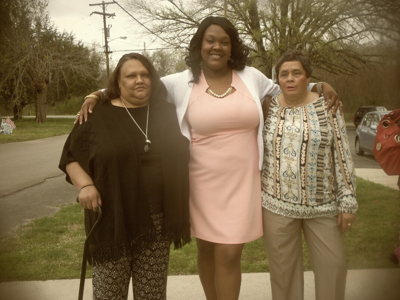


From left: Dadra Porter, Brittany Porter and Martha Porter
On May 10, Dadra Porter, an incarcerated woman at what was then called the Tennessee Prison for Women in Nashville, wrote a letter to the prison advocacy organization Free Hearts. The group, which is run by formerly incarcerated women, has spent much of the past six months working with the families of incarcerated people and advocating for their release amid the coronavirus pandemic. Porter’s letter was a plea for help.
“I am 50 years old and have severe medical issues,” Porter wrote, citing diabetes and heart problems. “If I get the virus I won’t survive.”
About three months later, in early August, Porter — known to other women at the prison as “Red” — was reeling from the news that her mother, Martha Porter, had died on the outside when she started feeling sick. One of Porter’s daughters, Keshia Porter, says that her mother’s concerns about feeling ill were dismissed by prison staff as symptoms of grief. Dawn Harrington is the executive director of Free Hearts, and she kept in touch with Porter after receiving her letter. Harrington says she heard the same thing from other women inside the prison.
A woman who has been incarcerated at the prison for 17 years wrote a letter to the Scene dated Sept. 9 in which she says she saw Porter being wheeled around in a wheelchair by other inmates. As weeks went by, other women who knew Porter started advocating for her inside the prison, asking for her to receive medical attention. According to the incarcerated woman who wrote to the Scene, by late August, Porter was hallucinating and having trouble breathing.
“If it weren’t for [the other incarcerated women at the prison], my mama probably would have died in her cell,” Keshia tells the Scene.
Keshia and her older sister Brittany kept in close touch with their mother. Keshia says that before her mother fell ill, she spoke to her on the phone every day. The last time the two spoke was on Aug. 23. On Aug. 28, Keshia received word — not from prison officials, but through her mother’s cellmate — that her mother had been taken to the emergency room. Dadra Porter died on Sept. 1, with officials confirming she had tested positive for COVID-19. Keshia only learned of her mother’s death through a call from the prison chaplain, who she’d gotten to know.
“I don’t have closure, and I’m truly upset,” Keshia says.
Outbreaks in May put two Tennessee prisons among the worst COVID-19 hotspots in the country. Since then, the state has seen another wave of infections in its prisons. As of Sept. 16, the worst of the state’s outbreaks is at the Nashville prison formerly known as the Tennessee Prison for Women, which was recently renamed the Debra K. Johnson Rehabilitation Center. After a recent round of mass testing, 186 women incarcerated at the prison tested positive for COVID-19, with dozens of tests still pending. Porter is the only woman to have died at the prison so far.
“All inmates in the general population are checked twice weekly for symptoms,” Tennessee Department of Correction spokesperson Dorinda Carter tells the Scene in an emailed statement. “If someone is identified with symptoms, that person is tested and contact tracing is conducted to determine whether targeted or mass testing is needed. There have been several rounds of mass and targeted testing at the women’s prison since May. One of the challenges we face is with inmates not being forthcoming about possible symptoms due to concerns about being placed in isolation or quarantine. We have worked to ensure that they understand that neither of these measures is punitive and access to necessary services and utilities are the same as they would be in general population.”
In all, 16 Tennessee prisoners have died across the state after testing positive for COVID-19. Advocacy groups like Free Hearts have pleaded with Gov. Bill Lee to grant clemency to older and medically vulnerable inmates during the pandemic, but he has not done so.
All the while, fear and confusion have spread throughout the community of incarcerated women and their loved ones on the outside. As prison officials have tried to contain the virus by quarantining infected and possibly exposed women, advocates and family members say the incarcerated women themselves have rarely received clear information about why they are being moved to a different unit, or what is being done to keep them safe.
“The idea appears to be that you’re not entitled to know anything,” says Wanda, whose daughter is incarcerated at the prison. “ ‘If it’s something you need to know, we’ll tell you.’ ”
Wanda asks that the Scene identify her solely by her first name, and not name her daughter at all. She’s concerned about opening her daughter up to retaliation on the inside — and she’s not the only one. Harrington says other family members and incarcerated women have been afraid about the repercussions of speaking on conditions at the prison and the concerns they have.
Wanda says supporting her daughter during incarceration has “not been easy, and it’s not been cheap.” Her daughter works, but she makes less than a dollar an hour, and half of that goes to paying off court costs. The rest goes toward food and clothes and phone calls, with Wanda chipping in to make up the difference. Wanda says she has concerns about the conditions at the prison, but also sees it as a rather small ship being battered by the pandemic’s enormous waves.
“It’s a worldwide problem, and it’s hard for one location to address a worldwide problem,” Wanda says. “I think most people there are scared to death of it, and I think [my daughter] has a healthy respect for it.”
The woman who wrote to the Scene expressed concern about the struggle women inside were facing getting tested — a struggle seemingly illustrated in the weeks leading up to Porter’s death. But the woman also described precautions being taken at the prison. Inmates from county jails have continued to be moved into the facility — a fact that has worried family members and advocates — but the woman did say that new arrivals are being kept at a distance from each other and quarantined for their first 14 days at the prison.
Like many on the inside, this woman is looking ahead to upcoming court dates and hoping they will lead to her release. The heart of her message comes at the end of a 10-page letter, in neatly handwritten half-cursive.
“I want to make it out of prison alive.”



