
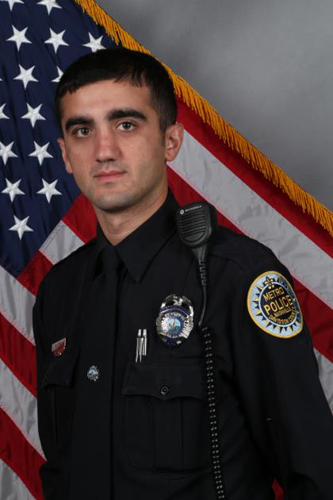
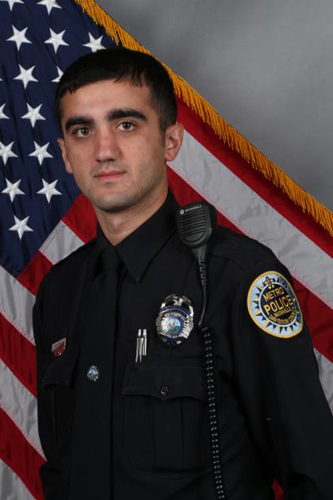


Jiyayi Suleyman
In a May 2017 performance review, a Metro Nashville Police Department supervisor praised Detective Jiyayi Suleyman, writing that the Kurdish-American officer had “developed his role as a detective.”
“Detective Suleyman is motivated and continues to show initiative,” the supervisor added later in the note. “Detective Suleyman has shown a good quality of work and has made good job related decisions. Detective Suleyman is motivated and continues to show initiative. Detective Suleyman has done an excellent job at developing [confidential informants] and preparing great case files.”
In a letter dated Dec. 31, 2017, Metro Police Chief Steve Anderson praised Suleyman for his work busting up a Mexican heroin distribution ring. It was one of five such commendations the young detective received last year.
But less than three months later, Suleyman — who had attracted positive headlines for himself and the department as Nashville’s first Kurdish-American police officer — resigned after nearly six years on the force, amid an internal investigation into his ties to the Kurdish Pride Gang. The MNPD did not make any public statements about the matter, but a recent report from WSMV-TV broke the news under a headline that regurgitated the department’s allegations and even punched them up a bit: “Gang member infiltrates Metro Police Department.”
The Scene reviewed Suleyman’s personnel file, which contains documents detailing the conclusions drawn from the MNPD’s investigation. In the file, investigators note Suleyman’s “very strong ties to members of the KPG community,” say he continued his relationship with gang members who had been arrested for narcotics and firearms sales, and cite photographs of Suleyman “dressed in gang paraphernalia and making hand gestures associated with” KPG. They also say he used a department database to look up “several known KPG members and subjects associated with the KPG organization with no apparent reason or ongoing investigation.”
Additionally, the investigative report describes popular Kurdish-owned restaurant House of Kabob as a sort of nexus of KPG activity, with employees who are involved with or associated with gang members. The restaurant’s owner, Hamid Hasan, told WSMV that no gang activity occurred in his restaurant.
The situation appears to raise thorny questions for the police department. Some say the MNPD has unjustly turned on an officer it once celebrated, internally as well as publicly. But if the department’s conclusions are accurate, a gang member operated from within the MNPD for years without detection.
In response to the Scene’s request for comment, MNPD spokesperson Kris Mumford says: “During the pre-employment process with the MNPD Suleyman did not disclose any affiliation with a gang. In Suleyman’s application packet for employment, he denied any involvement with any gangs or organizations of any kind.
“He resigned with discipline pending in March,” she continues. “There is a continuing criminal investigation.”
Suleyman and his attorney also declined to comment for this story through a friend of the family.
WSMV’s story — which frames Suleyman’s departure as an open-and-shut case that has brought shame to Kurds in Nashville — and the internal findings it revealed have riled some in the Kurdish community who suggest Suleyman is essentially being railroaded. They also say the episode is indicative of larger problems with the relationship between the MNPD and the Nashville community known as Little Kurdistan, home to the largest population of Kurds in the United States.
“It’s disappointing, but it’s not shocking,” says Drost Kokoye, a board member with the American Muslim Advisory Council whose family came to Nashville as refugees in the late ’90s. “[The] Metro Nashville Police Department for a long time has lumped in the Kurdish community of Nashville to be synonymous with Kurdish Pride Gang.”
When Kokoye posted the WSMV story on Facebook, it elicited a similar response from another Kurdish community member: “They labeled us all as gang members long ago. If you were ever pulled over and Kurdish and someone had weed or something on them, they automatically considered you KPG.”
In 2007, The New York Times spotlighted KPG — which had some 20 to 30 members at the time — as the only Kurdish street gang in America, and reported the group’s alleged involvement in a number of burglaries and violent crimes, including two alleged rapes. Even then, some in the community said KPG was receiving outsized attention compared to other gangs in the city. Kokoye, who was raised in South Nashville alongside the Suleyman family, says young Kurds like her attending Nashville-area schools at the time lived under unfair suspicion.
“I’m not saying KPG never existed,” Kokoye says. “I’m saying KPG certainly isn’t to the caliber that Metro Nashville Police Department is trying to blame it for today.”
The MNPD’s characterization of House of Kabob also bothers some community members.
“House of Kabob is one of the best restaurants, where you can see business executives, legislators — normal folks from all backgrounds go there,” says Jeger Ali, who works as a family-involvement specialist for Metro Nashville Public Schools. He came to Nashville nine years ago on a Special Immigrant Visa after working with the U.S. military during the war in Iraq. Though Ali concedes that Suleyman might have violated department policies, he questions the conclusions drawn from the officer’s “associations” with gang members in a community where pretty much everyone knows each other.
“This really tells me they still don’t understand some of the cultural things about communities in Nashville,” says Ali.
Suleyman — whose family arrived in Nashville in 1991 as refugees — joined the Metro police department in 2012. The same year, the MNPD sued KPG, declaring its members a public nuisance and banning them from gathering in certain parks and neighborhoods. A couple years later, he told Public Radio International’s The World: “I took this job to bridge the gap between not only the Kurdish community but the Muslim community with the police department.”
Kokoye says Suleyman’s hiring was seen in the Kurdish community as a sign of progress — a sign that “they’re finally seeing us as individual people and … we’re not all criminalized by our local police department anymore.”
She says she is “not at liberty to discuss the reasons” for Suleyman’s resignation but questions whether the associations that were seen as an asset when he was brought on the force are now being used against him.
“If you have somebody from within a marginalized community on the police department, obviously a role that that person is going to play for the police department is the surveillance of that community,” says Kokoye. “So what is it that suddenly went from that being a part of his job to now they’re no longer happy with the work that [Suleyman] is doing? What role is it that [Suleyman] was not willing to play that Metro Nashville wasn’t happy with that now they’ve decided to use all of that to criminalize him?”



