
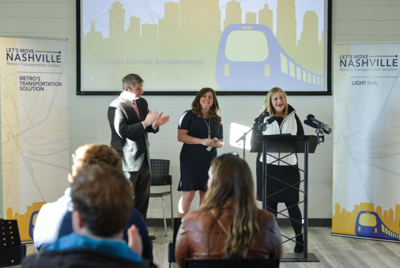


Photo: Michael W. Bunch
It’s been six months since Mayor Megan Barry used her State of Metro address to make the opening pitch for a massive transit expansion with light rail at the center of the system, the kind of project that alters a city and defines a mayor’s legacy. And a lot has happened since that April morning.
The controversy surrounding a proposed development at Fort Negley Park — fueled by concerns about historic preservation and irritation over the apparent coziness between yet another mayoral administration and wealthy developers — has festered. The Barry administration secured approval for a $275 million Major League Soccer stadium project (contingent on MLS awarding Nashville an expansion franchise this month), and most recently, Barry announced plans to end inpatient care at Nashville General Hospital — plans that were seemingly kept private until after the Metro Council approved the soccer stadium proposal.
With all that blowing in the political wind, the transit effort is about to kick into high gear. In late October, Barry revealed the details of a $5.2 billion plan — which she called “the largest project in modern Nashville history” — that would see 26 miles of light rail on four major corridors by 2032. It also includes a downtown tunnel. The plan would be funded by several tax increases, including a surcharge on the sales tax — 0.5 percent at first, and a full 1 percent by 2023.
But before any tracks can be laid, the plan — more specifically, the funding scheme for the proposed transit plan — has two hurdles to clear. First, the Metro Council must vote to put the question on the May 2018 ballot, which it seems likely to do. Arguing that a plan this massive and costly should not be put to the voters is a tough sell. And the administration appears confident that the council will approve the referendum. So much so, in fact, that they did not object to a bill sponsored by At-Large Councilmember Bob Mendes, and passed last month, that will require the referendum language to go before council in the form of a bill rather than a resolution — meaning it will require three readings instead of one.
The real test will be getting the public on board. It’s not hard to convince most Nashvillians that something needs to be done about worsening traffic, but that’s not the question that will be on the ballot. The question, instead, will be whether Nashville should pay for a transit plan by raising the sales tax, along with the business and excise tax, the hotel/motel tax and the local rental car tax. The route-level details of the plan won’t be up for a vote, but voters now know the basic outline of the plan they’d be funding.
The Barry administration has shown some flexibility when it comes to the details of the plan. After a backlash resulting from the original plan’s Charlotte Avenue route — which stopped well short of growing neighborhoods like Sylvan Park and the Nations — Barry announced an amendment to the plan that would bring light rail as far west as White Bridge Road. That should satisfy at least some pro-transit neighbors along Charlotte Avenue who were peeved when Karl Dean’s ill-fated transit plan, The Amp, was proposed for old folks on West End who didn’t want it. RIP.
But there are still pieces of the proposal that could prove thorny. Even though the administration argues that half will be paid by people outside the county, the proposed sales tax hike will disproportionately burden poor Nashvillians and, as a result, may turn off those voters as well as many progressive ones. The plan calls for subsidizing transit rides for people living below the poverty line, but how good is that if they are the ones bearing such a large brunt of the funding on the front end? Moreover, there are the inevitable concerns about how to make sure there is some affordable housing along transit routes. The mayor has established a task force to look at the issue, and that will undoubtedly be a sticking point for many of the people whose support she will need come May — people who are not thrilled with the way her administration has handled proposed development at Fort Negley and the abandonment of Nashville General Hospital.
On top of all that is the question of how much enthusiastic support the mayor will get from council members during the campaign, assuming they approve the referendum first. The Barry administration kept the council decidedly out of the loop in the months before they were ready to make the plan public but will now be hoping for members to act as surrogates, selling the plan to constituents ahead of an election that is now less than six months away.
The mayor has gotten her way for the most part, nearly two-and-a-half years into her first term. But this is her biggest ask yet.



