
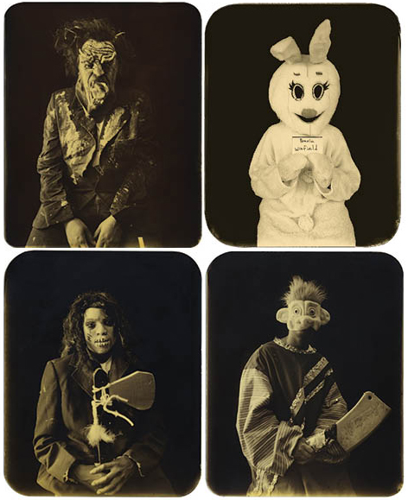


Clockwise from top left: “LCIW81,” “LCIW91,” “LCIW82,” “LCIW85"
It looks like a simple nature photograph at first, if a little off-balance, of a bare-branched tree against a dark sky. Standing in front of the tree is a huddle of formally dressed men in fedoras with their backs to the photographer, and a blurred couple, moving too quickly for the camera's slow shutter speed, walking arm-in-arm, the woman's pin curls and fluffy coat straight out of Brassaï's Paris.
They must be there for something, but it isn't visible in the photograph. It's obviously a historical photograph, but it looks as if a crowd were dispersing from a press conference, or men have gathered fresh from a hunt for unexceptional trees.
On another wall is a different series, black-and-white photographs of costumed people, formally posed with blank expressions. In one, a figure in a sequined gown holds tightly onto an oversized meat cleaver with a bundle of messy tape wrapped around its handle. A big-eared half-face mask — a play on fluffy-haired plastic troll dolls — resembles a monkey with unblinking black eyes.
Both are ominous, haunting photographs on their own, without any background information. As it turns out, though, the most chilling thing about them is what's not on display: the stories behind them.
The tree photo is a work by Ken Gonzales-Day, a California-based artist who appropriates historical photographs of lynchings in the West and Midwest in a series titled Erased Lynchings. He has digitally removed from the tree's branches the bodies of murdered Mexicans and African-Americans, which were the true subjects of the original photographs. The people standing around in them were mostly curious bystanders.
By removing the hanging bodies, Gonzales-Day incriminates the perpetrators as well as the spectators in a way that so subverts expectation that it highlights the voyeuristic impulses of the viewer. Those photographs, so easy to read as crime-scene photos through a contemporary lens, were originally intended as fodder for souvenir postcards. The artist hints at this by framing the back of a postcard, where a single line is written in cursive: "This is what he got."

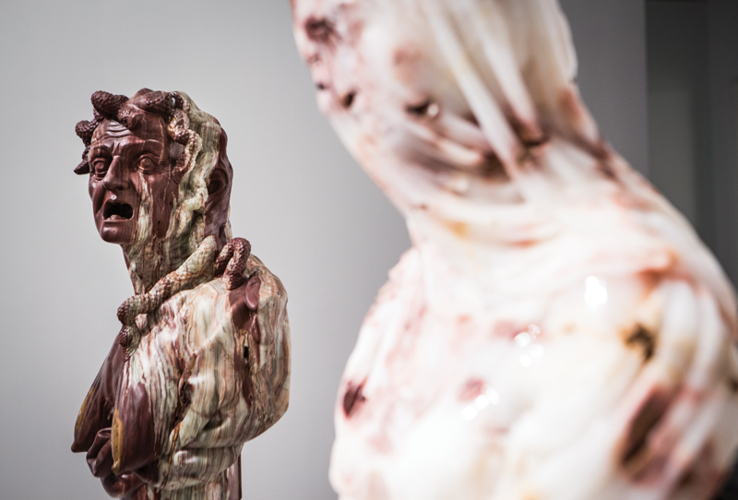
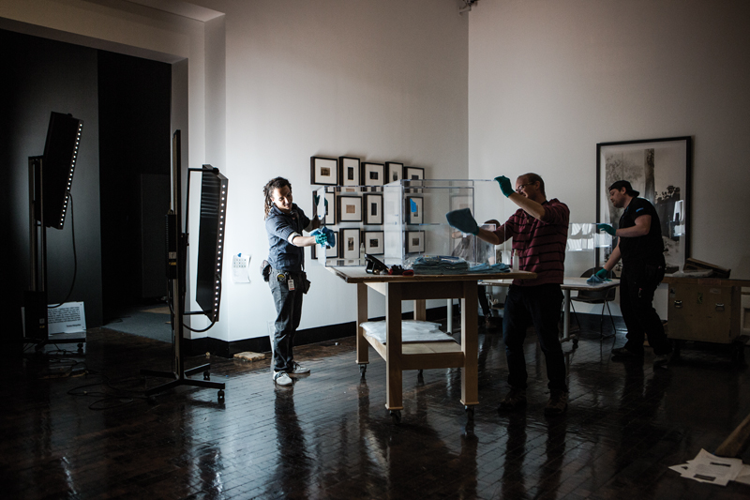
Barry X Ball’s “envy/purity” during installation
The costumed troll is part of a series photographer Deborah Luster shot in a New Orleans penitentiary. The Halloween mask covers the face of someone serving time for an unknown crime. Luster began taking photographs for her series One Big Self in 1998, 10 years after her mother was murdered by a contract killer while she was asleep in her bed.
The gap between what's told and what's withheld — something French film theorist Christian Metz calls the "off-frame" — triggers the imagination, and that's what Frist chief curator Mark Scala hopes will draw viewers into Phantom Bodies: The Human Aura in Art, the third and final installment in his trilogy of exhibits about the body in contemporary art. Phantom Bodies is an extension of his 2012 Frist exhibit Fairy Tales, Monsters and the Genetic Imagination, itself an extension of 2009's Paint Made Flesh.
The Frist is the de facto center of Nashville's art scene — its best-attended fine-arts space, and the only one with the resources to mount regular exhibits of this size and scope. Like most fine-arts institutions, it has a financial mandate to give its audience what it wants, and it does so regularly with exhibits of Old Masters, the Impressionists and other surefire attractions. Providing such works in the flesh is a public service in itself, no question.

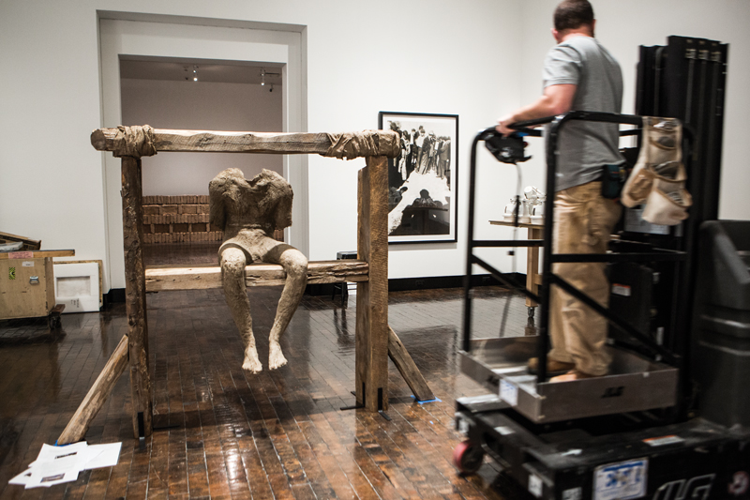
Placing artwork during installation of Phantom Bodies
But it's through the unexpected contemporary art exhibits that Scala has curated that the Frist offers something rarer and perhaps more urgently needed — art that can inspire, provoke and move an audience in completely unexpected ways.
In addition to bringing work by artists such as Jenny Saville, Eric Fischl, Cindy Sherman and Kiki Smith to Nashville, the first two exhibits in Scala's curatorial trilogy made audiences think. The works of Saville and Fischl, for example, were framed to demonstrate ways that artists can use paint as a stand-in for physicality — pigment and texture as skin and bone. And the Sherman and Smith works, from the Fairy Tales exhibit, were showcased as reimagining familiar tropes of the human body.
Like the two previous exhibits, Phantom Bodies is about the body — Scala is fascinated by how artists depict our fleshly presence. But in the new exhibition, he digs even deeper, examining the idea of the body after death, in transition, hidden away. The title of the show, which features 38 works by some of the world's most influential contemporary artists, is derived from the phenomenon of the phantom limb, the missing arm or leg that amputees feel as if it were still attached. The exhibit offers art that symbolizes something Scala describes as "the presence of an absence."
"The absence of the body," Scala says, his pastel Oxford shirt a welcome splash of color in the stately Frist boardroom, "is like the idea of the phantom limb. If your arm is missing and you feel it to be there, you have both absence and the body, both at once. It's a feeling of the body. It's not that it's gone completely, it's not that it's erased — there's some residual thing left.
"So can you extend that if you lose a husband or a wife or a child? Or if you lose a village? Or if you lose a tribe or a race of people? What is left, and how do we feel it?"

Placing artwork during installation of Phantom Bodies
Those are difficult questions. Organizing an entire exhibit around such heady themes might seem forbiddingly esoteric, if the curator didn't know his audience as well as Scala does.
"There are a lot of really intellectually curious people here," he says. "People who go out on a limb and want new experiences. I've gotten really good feedback from the other two shows, because I've put things together in such a way that it seems familiar. People like interesting things," he says — punctuating the comment with a sly shrug, as if it's the most ordinary thing in the world to organize large-scale exhibitions that stretch an audience's capacity to connect.
Art museums have changed a lot in recent years, shifting their missions from repositories that preserve the past to exhibition spaces that contend with the present — and through their selection of artists to champion, anticipate the future. The Frist, which opened in 2001, has maintained a mission that's ambitious and broad-reaching, yet even so it attempts only a few truly risky endeavors — such as Katie Delmez's groundbreaking Carrie Mae Weems exhibit (the artist's first major retrospective). But as Scala said at a panel discussion last year at Vanderbilt's Curb Center, the Frist attempts to function like a mini-Metropolitan Museum of Art. The off-frame of this comment, so to speak, is that it cannot also attempt to be a mini-New Museum or a mini-Art Basel.

Placing artwork during installation of Phantom Bodies
The Frist — which isn't a collecting institution but a center for changing art exhibits — wears its burden of needing to please most of the people most of the time with relative ease. Frist Center shows have certainly hit the audience-approval mark — the Italian Style show and Watch Me Move: The Animation Show are two recent examples. Its blockbuster shows are often paired with smaller, more introspective exhibits, as when 2013's smash automobile-as-art show Sensuous Steel was exhibited at the same time as Vik Muniz's photographs of garbage arranged in the form of iconic artworks.
But if the Frist is to be taken seriously as an art institution, its curators have to take chances. Audiences may line up to see work by Norman Rockwell and Andy Warhol, but what about the work they may not even know about — work that might piss them off or make them uncomfortable, yet may well prove to be some of the most significant of its time? When even institutions such as MoMA experience severe backlash for blatantly commercial-minded exhibitions of Björk and Tim Burton, playing it safe runs as big or bigger a risk of failure than potentially displeasing the audience.
So while Phantom Bodies may not have the instant appeal of some of the Frist's most popular recent shows, it may prove more vital in coming years to the center's health and aspirations — as a challenge to the city's tastes, and an invitation to local audiences to consider art in ways that go beyond history or brand-name awareness. It may offend, it may displease, it may overwhelm. Particularly as it incorporates the theme of the spirit — a taboo for artists and institutions that balk at religion, and a possible offense to devout viewers who shun anything that isn't explicit representation.
"When I was doing research [for Phantom Bodies], I looked for exhibitions of contemporary art that had as their theme spirituality," Scala says. "And you know, there are lots and lots of artists who work with these ideas, and there was no problem finding those artists. But I really didn't see much in the way of exhibitions. And I think that the art world oftentimes doesn't acknowledge that force, for whatever reason. I'm not saying these artists are out to prove the existence of a soul, but they're speculating about the existence of the soul. They're speculating about something other than the mechanistic view of the body."

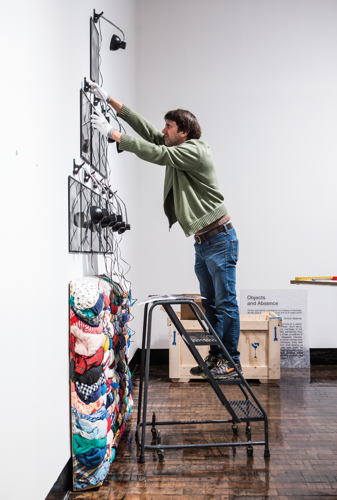
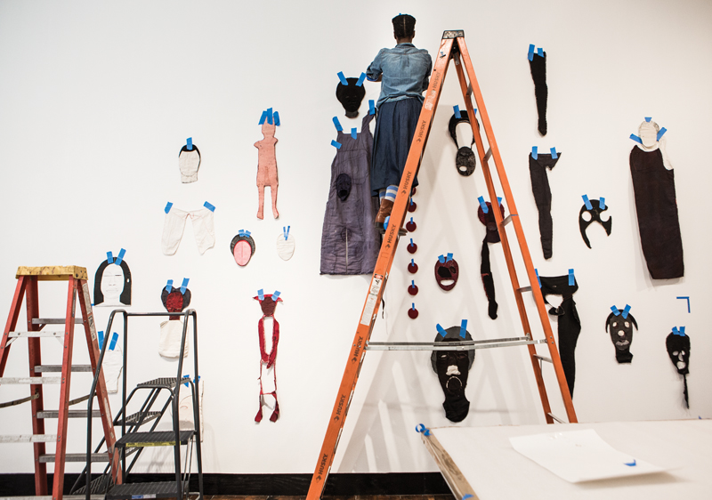
Alicia Henry Installing “Untitled (Brown, Red, White and blue)”
Alicia Henry is the only Nashville artist with work in Phantom Bodies. The Fisk professor and former Guggenheim fellow, who is represented locally by Zeitgeist Gallery, has created textile-based figures and masks that hang on the gallery walls like detached shadows from a children's cartoon, or Michelangelo's flayed skin on the Sistine Chapel ceiling. Made from ordinary materials such as cotton and leather, Henry's works are almost uncomfortably familiar — you can almost imagine the works whispering to each other when the lights go down at night. But even if the works in "Untitled" could climb from the walls, slowly shimmy up your back and hold on to the back of your hair, they still might not be as deeply affecting as they are.
Damien Hirst's "The Unbearable Lightness of Being" is an 8-by-5-foot oval canvas that could be a piece of stained glass or a mandala, depending on the viewer's perspective. The kaleidoscopic pattern is made entirely out of butterfly wings arranged in a painstakingly careful way that borders on ostentation. It doesn't hurt to put a work by Hirst, one of the world's most successful and divisive contemporary artists, in an exhibition, regardless of its focus. But when the theme of the exhibit is to explore how artists deal with ideas about the human spirit, "Unbearable Lightness" brings ideas about of the extraordinary beauty of natural order side by side with the dumb monotony of life — this is, after all, a work of well-organized dead bugs. As Scala says, "The aura is in the audience; the art is just materials."
Scala speaks in complete sentences, with rarely an out-of-place "like" or "um," in an uninflected low voice that underscores his thoughtful but relaxed nature. When he expresses excitement about an artist or a piece of work, he most often does it with a pointed grin or a dry, sideways look. In conversations about his exhibits, particularly the science-skewed work in 2012's Fairy Tales, Monsters and the Genetic Imagination, he credits his father, a scientist who provided him with a scientific frame through which to view art. His father's death opens yet another window of perspective onto the work in Phantom Bodies.
Scala explains that his father suffered from dementia for the last five years of his life.
"It was like he was dead before he was dead, which informed me, because you're watching somebody slip away. So you're able to grieve slowly, and your grieving gets worse as time passes, but then when the end comes, you're grieving and you're relieved at the same time. The sadness was unbearable — and that's not just what this show's about, but it certainly helped me think about what other people have experienced."
The last work viewers will see in Phantom Bodies is Bill Viola's "Isolde's Ascension (The Shape of Light in Space After Death)," a nearly 11-minute video played in a loop. Like Hirst's "Unbearable Lightness," "Ascension" will likely stir the contemplative atmosphere of a chapel in the dark, private alcove where it plays. It's a video piece, but it also has elements of modern dance and color field paintings. The black screen is first colored with a small inky blue oval, which becomes larger with hypnotic slowness until its subject — a body jumping or falling in water — becomes clear, like a photograph coming into focus.
But the video is inverted, so the surface of the water is at the bottom of the frame. As the body falls, it appears to be ascending. Anyone who has experienced the death of someone they loved will immediately recognize the spiritual aspects of this work, regardless of their beliefs, as the shadowy body seems to rise until it's outside the visible field. Some will say this is a camera trick and that it's really falling. Others will feel the trick is that this moment could be made visible in the first place.
"I don't want to saturate or sate people with melancholy," Scala says. "But I also want people to think about spirituality, and all the questions that we all think about anyway, and the mundanity of it. Every single person in history who is not alive now has died, and somebody has missed them. And somebody has felt terrible and sad, and has had to come to terms with the loss of them.
"It's central to the human core, to what we are."

Post a comment as anonymous
Report
Watch this discussion.
(0) comments
Welcome to the discussion.
Log In
Welcome to the discussion.
Keep it clean. Please avoid obscene, vulgar, lewd, racist or otherwise abusive language. Comments featuring hate speech or threatening or violent content will not be tolerated.
PLEASE TURN OFF YOUR CAPS LOCK.
Be truthful. Don't knowingly lie or mislead.
Be proactive. Use the “report” link on any comment that violates our comment policy.
Share with us. We'd love to hear your feedback.