
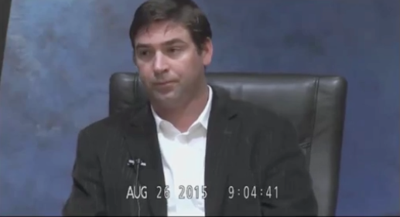


David Chase
In late 2014 and well into 2015, talk in Nashville’s media circles was that Bill Fletcher, of the consulting firm Fletcher Rowley, was working reporters on behalf of David Chase, the developer who had been arrested and charged with assaulting his ex-girlfriend twice in 24 hours in June 2014. The veteran Democratic political consultant was trying to quell the public relations crisis facing Chase, the Chase family, and their prominent construction company D.F. Chase, Inc. after the incident and the array of public controversies that followed.
Fletcher, in fact, was angry when Pith noted his work for the Chases at the time. But it turns out working pliable reporters is the least of what Fletcher is accused of doing.
An incident less than two years ago that sparked controversy for, among other things, appearing to expose a good-old-boy network that led to Chase’s early release — leaving a woman at risk after she had allegedly already been assaulted — has now led to a tangled web of legal maneuvers and allegations that include extortion, blackmail and possible bribery.
In documents obtained by the Scene — including transcripts of sworn testimony and text messages between David Chase and his mother, Sandra Chase — Fletcher is accused of coming to the Chases with a request for $2 million to make it all go away. The allegations arise from an ongoing civil lawsuit filed by David Chase against an assortment of people he claims conspired against him.
In one deposition, Nashville attorney Brian Manookian, who represents seven of the defendants in the suit brought by David Chase, asks Chase's father Dean Chase whether Fletcher “ever attempted to extort you and your family?” After some back and forth between lawyers, Chase's father says, “In my opinion, I thought he did.”
Dean Chase also says that someone approached him for $2 million. When Manookian asks if the request was for “payment for legitimate work,” Chase says “no.”
In a separate deposition, Sandra Chase says that Fletcher made that request. Later on, after direct questions about whether the Chases' “perception” was that Fletcher wanted the money to bribe someone, she says: “I think Dean inferred that that was the purpose.”
In a text message with his mother, David Chase says that Funk "blackmailed" him.
If Fletcher made the request he is accused of making, it’s not clear under what circumstances he did so — whether on his own or on someone else’s behalf. Both he and Davidson County District Attorney Glenn Funk have fought against testifying in the case.
Messages left for Fletcher by the Scene have not yet been returned. We will update with any response. Fletcher strongly denies the charges. "I have never proposed any payments of any kind to anyone regarding the criminal case," he said in an email to the Scene. His full statement is below.
Funk rejects any suggestion of wrongdoing on his part and tells the Scene he had no part in anything Fletcher might have been doing. When reached Thursday morning, he says he first became aware of the Chases' statements that someone had approached them and asked for $2 million in late 2015 and first saw partial transcripts of their depositions last month, when WSMV-Channel 4 approached his office about them. A letter from Manookian addressed to Funk on Sept. 1, 2015 details the allegations that had come up in the depositions and other documents. Funk tells the Scene that he didn't respond to the letter because he didn't want to get dragged into the case.
“Our position was this case was closed and we’re moving on," he says.
When he was approached about testifying in the case, Funk says he went to state Attorney General Herbert Slatery. Funk says the AG told him the state would pay for representation. Funk's personal attorneys subsequently objected to the move to have him deposed.
As for Fletcher, Funk says he has only ever had one interaction with the consultant.
“My knowledge of Bill Fletcher is, when I was first deciding to run for DA, I talked to John Rowley about potentially hiring Fletcher Rowley. But ultimately they decided to work for [my opponent] Rob McGuire, not for me," Funk says. "As I was leaving John Rowley’s office, he introduced me to Bill Fletcher as I was walking out of the office. It was a 30-second conversation. [The] only time I’ve ever talked to Bill Fletcher was January 2014.
“I didn’t have any idea that he had any relationship with this case, and I didn’t have any conversation with him about any money or anything like that,” he adds.
Funk points to another part of Sandra Chase's deposition: When asked if she got "the sense that Bill Fletcher’s request for $2 million was to give to Glenn Funk," she says, “I did not get that feeling." Later on, after more questioning, Sandra Chase says, “I did not get that feeling at all, that Glenn Funk asked for a bribe, no.”
Asked about David Chase's statement in a text message that Funk "blackmailed" him, Funk says:
“My impression from reading these limited amounts of transcripts was he felt like it was blackmail for our office to say you have to dismiss your federal lawsuit for us to go ahead and dismiss this case. That’s not blackmail.”
Dean Chase was already accustomed to paying out large sums of money on behalf of his son. According to his testimony, he shelled out $600,000 for his criminal defense and would later give David tens of thousands dollars more to live on, after David stepped aside as developer for the high-profile Virgin Hotel planned for Music Row and left his family’s company. But according to the documents, the Chases say they turned down Fletcher’s offer and fired him.
Eventually, the criminal charges against David Chase did go away. Funk announced on July 1, 2015, that his office was dismissing the charges, citing problems with the alleged victim’s credibility. But Funk has now acknowledged that he did so with a condition: Chase would have to drop a federal lawsuit he had filed a month earlier against the Metro Nashville Police Department and a group of individual officers. Chase filed a motion to do just that on the same day his criminal charges were dropped.
That kind of deal, known as a “release-dismissal agreement,” is legal and not rare, Funk says in a statement. Darryl K. Brown, a law professor at the University of Virginia, tells the Scene “this kind of agreement is entirely legal, even though it sometimes looks kind of shady.”
“There are obvious things to worry about in these cases,” Brown says. “For one, either side might file their case as a way to have some negotiating leverage against the other. Someone charged with a crime might file the civil suit in hopes of having something to trade and getting the charges dismissed, and a prosecutor in theory could file charges as leverage against someone who has earlier filed a civil suit against the city.”
This isn't the first controversy Funk has found himself involved in, directly or not, since he took office. In February of last year, News Channel 5 reported that Funk had accepted a job with the state as a special prosecutor before he was sworn in, allowing him to qualify for a sweeter pension plan. Slatery announced in December that although Funk had broken the law, he didn't know that at the time, and would not be prosecuted.
Here is Funk’s statement in its entirety:
Assistant District Attorney Katy Miller handled the David Chase case from the time of his arrest in June 2014, through the dismissal in July, 2015. General Miller is a veteran trial attorney who has worked in the office for over 30 years. After a thorough review of the evidence, General Miller decided to dismiss this case primarily based on inconsistent statements made under oath by Lauren Bull, as well as other issues affecting Ms. Bull’s credibility. The state agreed to dismiss the charges on June 28, 2015.Mr. Chase’s dismissal of a federal lawsuit, which included the Metropolitan Nashville Police Department as a defendant, was a condition precedent to having the charges dismissed on that date. This condition was designed to bring closure to the case because the District Attorney’s Office did not want the disposition or the publicity of a high profile domestic violence case to deter victims from reporting domestic violence or having the courage to come to court. In addition, this condition saved the taxpayers and the Metropolitan Government from the time and costs of defending against a federal lawsuit.
The District Attorney is charged to pursue justice. General Miller’s decision, approved by General Funk, was based solely on the facts, the law, support for victims of domestic violence and the best interests of the community. The factual reasons for the dismissal of the criminal charges against Mr. Chase were filed in writing with the court at the time the dismissal was announced and are a matter of public record. Conditioning dismissal of criminal charges on dismissal of a civil lawsuit is referred to as a “release-dismissal agreement.” Such release-dismissal agreements are routinely used by prosecutors throughout the United States, and were approved by the United States Supreme Court nearly thirty years ago.
Update (5:30 p.m.): Bill Fletcher sends Pith this statement, deny all allegations:
Allegations made in media reports about my business relationship with the Chase family with regard to criminal charges filed and then dropped against David Chase are completely false.I have never proposed any payments of any kind to anyone regarding the criminal case.
I never had any contact at all with District Attorney Glenn Funk, anyone in the Office of the District Attorney, or anyone representing Mr. Funk or his office in my representation of Mr. David Chase, his family or the D.F. Chase Company.
I will explore all my options to see to it that these false and scurrilous allegations are corrected on the public record.



