
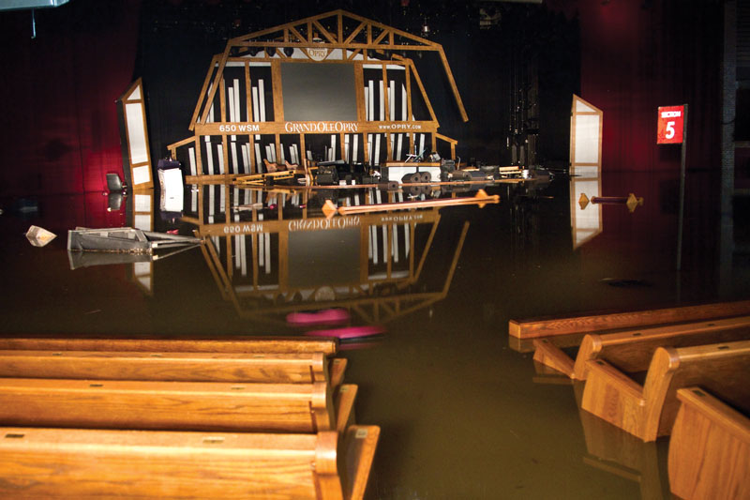
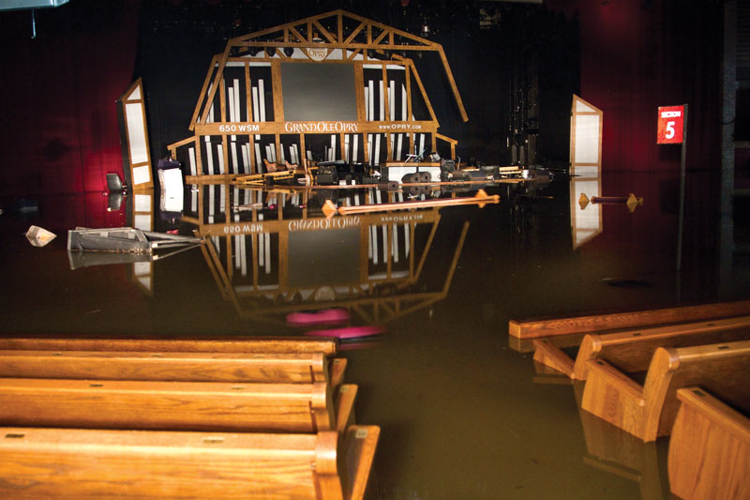


Even as rains continued to beat down on Middle Tennessee on Sunday, May 2, 2010, and the waters of the nearby Cumberland River continued to rise, the staff of the Grand Ole Opry House — home, as any good Nashvillian knows, of America's longest-running continuous radio program — had no idea just what sort of damage was even possible.
"I mean, we considered the Opry House to basically be on higher ground, and we didn't necessarily think, even when the water came into the complex, that it necessarily would impact the Opry House," says Steve Buchanan, president of the Opry Entertainment Group, which — in addition to the Grand Ole Opry House and the nearby television archives — oversees WSM-AM and the Ryman Auditorium. Buchanan has been with the Opry for 30 years.
Throughout the day on Sunday, staff rushed to the Opry's various facilities to move equipment, archival footage and the Opry Museum's "most prized possessions" to higher ground. Staff evacuated by 11 p.m., when the floodwaters overflowed a 100-year floodwall surrounding the Opry facility and began to enter the building.
"What ultimately happened was that the water came in and truly just overwhelmed all of those facilities, including the Opry House, where we had 46 inches of water throughout the backstage area and on the stage," says Buchanan. "And if you'd been standing at the foot of the stage in the audience, you'd be underwater completely."
On Monday, crew entered the Opry House in boats to retrieve the building's iconic podium and mic stands along with what little gear wasn't damaged. The Opry's first move, Buchanan recalls, was a scramble to find a venue for Tuesday night's Grand Ole Opry broadcast. The Ryman Auditorium — famously home to the show from 1943 until the Opry House was built in 1974 — had a previously booked engagement, and so the show took place at another early home of the Opry, War Memorial Auditorium.
"It was very important to us — just in terms of our own legacy and probably even more so in terms of symbolically — that this would not deter us from continuing to do what we do," Buchanan recalls. "I think that it was a great symbol of ultimately what we saw over the coming weeks, the strength and resilience of the city. Both of our U.S. senators from the state attended that performance."
Over the next several weeks, the Opry bounced around to whatever venue was available — the Ryman, War Memorial, Two Rivers Baptist Church, TPAC's Andrew Jackson Hall and Lipscomb University's Allen Arena — all while remediation crews cleaned and disinfected the building. Then came months of rebuilding, but with a silver lining: Buchanan and his team used reconstruction as an opportunity to enhance backstage areas like the green room and dressing rooms, "really kind of in tribute to all of the various elements and personalities that have made up the Opry through the years."
On Sept. 28, 2010, the Grand Ole Opry house reopened, its famed 6-foot circle of wood center-stage newly restored, with a performance of "Let the Circle Be Unbroken" by Brad Paisley and the late, great Little Jimmy Dickens.
"It definitely was an emotional moment," says Buchanan. "Because of the rich history of the Ryman, the Opry House in some ways had never received the accolades for all that has happened there. And it really was kind of the first time the spotlight was on the Opry House, for all that has happened within its walls."
In 2012, the Opry's parent company — then called the Gaylord Entertainment Co. — sued the U.S. Army Corps of Engineers, seeking $250 million in damages for its various properties and alleging negligence in delaying the release of water from Old Hickory Dam. The suit was dismissed in 2013, and an appeal in January of this year upheld that ruling; Gaylord, now known as Ryman Hospitality Properties, has since filed an appeal to overturn the ruling.



