
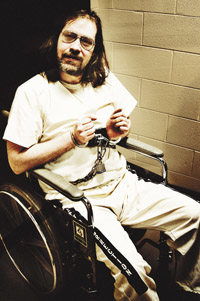
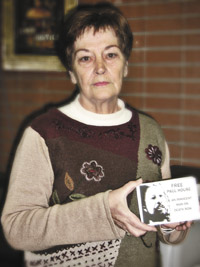
Paul House sat shackled in a windowless room tucked inside the concrete Union County Courthouse in rural East Tennessee. The prisoner’s mother waited with him and grasped her youngest son’s cuffed hands, struggling to hold back tears. House tried to console her, even with his own life at stake.
Authorities had accused the burly 23-year-old of kidnapping, raping and murdering a young woman, and he would face execution if convicted. Yet on this bleak, blustery morning in February 1986, House calmly and confidently comforted his mother, telling her that a jury would never convict an innocent man.
Unable to observe the majority of her son’s trial because she was to testify as a witness, Joyce House spent the next four days pacing the cold tile corridor outside the courtroom. While she was waiting, a Union County sheriff’s deputy approached her in the hallway and said that even he was skeptical they had the right suspect. He told her that he expected an acquittal.
When the jury announced it had reached a decision, Joyce found a seat on a long bench in the wood-paneled courtroom packed with curious onlookers. With his freedom and his life in jeopardy, the defendant was undoubtedly nervous, despite his confidence and unwavering claim of innocence. The next few agonizing minutes dragged on until finally the jury foreman stood to read the verdict: guilty.
Joyce was stunned and unable to move, while her son, once so full of hope, couldn’t believe the jury’s words.
“Paul was devastated,” she recalls now. “When I went back to see him, he was in shock and he said, ‘Evidently, the justice system doesn’t work, does it mom?’ ”
The very next morning—just hours before the jury was to impose a sentence—House attempted suicide, slashing his wrists with the blade from a disposable razor. After paramedics rushed House by helicopter to a hospital in nearby Knoxville, corrections officers found a handwritten letter in his jail cell professing his innocence.
Within a few hours of trying to kill himself, House was stitched and bandaged, and then transported to the courthouse to learn his fate. Once again his mother took the stand, this time reading for the jury the note her son had written proclaiming he was innocent. After deliberating for two hours, the jury sentenced House to be executed for the rape and murder of Carolyn Muncey.
Years after the trial, DNA testing proved House did not rape Muncey, and that the semen found on her nightgown belonged to her husband. Experts also concluded the blood on House’s blue jeans did not come directly from the victim at the crime scene, but instead spilled from vials of blood taken during the autopsy. In addition, several witnesses who did not testify at trial claimed the victim’s husband confessed to killing his wife.
Despite these revelations, House remains in prison, where in 2001 he was diagnosed with chronic multiple sclerosis. The 46-year-old inmate cannot walk (he uses a wheelchair), bathe or even feed himself without assistance, and yet the state continues to maintain he is a flight risk and a danger to society.
Then finally, in 2006, it seemed justice might finally prevail when the U.S. Supreme Court reviewed the case and declared “no reasonable juror” would convict House given the evidence now available. Never before had the nation’s highest court gone so far in declaring an inmate was likely innocent.
In the wake of the unprecedented Supreme Court ruling, the case was sent back to federal court, where it lingered until December 2007 when a judge declared House’s conviction unconstitutional and ordered the state to either retry him or release him within 180 days.
Again, it appeared House was on the verge of vindication.
But rather than acknowledge defeat—never mind admitting error—the very same prosecutor who tried House for capital murder 23 years ago announced he was going to take one more shot at convicting the ailing man for murder. But this time around, he’d have to come up with a different motive for the crime, given that the theory he argued the first time around—that House killed Muncey to cover up rape—had been shredded by the emergence of scientific evidence.
Over the years, the plight of Paul House, and the state’s continued prosecution of him, has prompted outright disbelief. CNN and The Washington Post have reported on this otherwise unremarkable Tennessee defendant, while the late Ed Bradley of 60 Minutes interviewed House several years ago before traveling to Luttrell, Tenn., to uncover details about the murder. Closer to home, one of the most distinguished judges in Nashville can’t believe that House remains in prison.
“This is the first time in our history, so far as I know, that it has ever happened that the Supreme Court has made such a ruling and the state has gone forward to prosecute the guy anyways,” U.S. Circuit Judge Gilbert S. Merritt tells the Scene. The Nashville-based judge sits on the 6th U.S. Circuit Court of Appeals, which has reviewed the convoluted case several times over the years, as recently as last week. “Why, after all this evidence has poured in that House is innocent of the crime, does the state continue to so zealously defend the situation? The reason is because state prosecutors typically never admit error.”
That’s a sentiment echoed by many critics of prosecutor Paul Phillips, the longtime district attorney general of Tennessee’s 8th District, which includes rural Union County. The fact that he’s not seeking the death penalty this time offers little relief given that the ill inmate might very well die in prison before the legal wrangling in his case ends.
Frustrated by this “sad situation,” Judge Merritt says, “I do not think the state should be able to retry this guy who has been on death row for 22 years and has multiple sclerosis and probably not too many years left to live.”
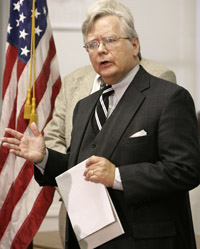
For three decades, Assistant District Attorney Paul Phillips has had the final say on who should and should not be tried in the five rural counties he oversees. The entrenched prosecutor is a native of East Tennessee, and comes from a family with an impressive legal pedigree—his brother is U.S. District Judge Thomas W. Phillips from the Eastern District of Tennessee.
Over the last six months, Phillips has sat beside lawyers with the state attorney general’s office as they argued that House does not deserve a new trial. Typically decked out in dark three-piece suits, the husky, white-haired prosecutor has appeared stern and unwavering during most proceedings, but on a few occasions has become visibly flustered by remarks from House’s lawyer Stephen Kissinger. At one point, when Kissinger argued that Phillips had previously announced he intended to seek the death penalty again, the prosecutor jumped from his seat, holding his finger in the air and shouting, “I did not. I did not say that.”
But the transcript from the hearing on Feb. 28, 2008, doesn’t lie. Phillips most certainly did make that statement: “We will retry Mr. House.… I would expect that we would seek capital punishment.”
Although the prosecutor later stated in court that he would not seek the death penalty because of House’s chronic illness, some have speculated the decision instead stems from having a weak case, suggesting that the state might even offer a plea deal.
Having personally prosecuted hundreds upon hundreds of criminal cases, Phillips, a Vanderbilt Law School graduate, has established a reputation as an aggressive lawyer with a knack for persuading juries. Colleagues say he’s a tough yet fair-minded attorney, and even the defense lawyers he opposes in the courtroom have described him as reasonable. Which is why his decision to retry Paul House is so befuddling.
“I’m puzzled at why Paul Phillips is proceeding in this manner,” says Randall Reagan, a Knoxville-based defense lawyer. Having known Phillips for at least 30 years, Reagan calls him a hard-nosed prosecutor, but one who has always been willing to listen.
So what explains Phillips’ deaf ear when the highest court in the land has essentially telegraphed the message to back off?
“Phillips personally prosecuted this case back then, so I’m sure he’s heavily invested in it emotionally, intellectually, professionally,” Reagan says. “And sometimes prosecutors hate to admit mistakes.”
If Phillips simply conceded that House might have spent half his life on death row for a crime he didn’t commit, it would trigger renewed attacks on Tennessee’s already controversial capital justice system. In fact, if some death penalty advocates had their way, House would have been executed years ago. It would also be demoralizing for Phillips (or any prosecutor) to admit that one of the biggest cases he ever tried—one that had a tiny East Tennessee town buzzing over 20 years ago—turned out to be built on a fundamental misreading of the evidence.
Some lawyers believe Phillips has simply lost his perspective in the case. Even without admitting error, Phillips could just cite the Supreme Court’s decision that “no reasonable juror” would convict House and drop the case, particularly since retrying the matter 23 years after the crime will be a challenge of Olympian proportions. Perhaps the most difficult task will be tracking down witnesses after all these years, many of whom have moved away. Even the ones who can be located might have a tough time remembering events that occurred more than 20 years ago. There’s even a handful of witnesses who have died, or are too sick to testify.
But Phillips is taking a hard line, refusing to budge.
“It’s a way to justify the time House spent on death row, a way to justify the loss of his youth and reputation, and it’s a way to try to justify a broken capital system in Tennessee,” says Robert Kurtz, a defense lawyer who practices throughout East Tennessee, including Union County.
In the close-knit, poor country town of Luttrell, Tenn., word spread quickly on the morning of Sunday July 14, 1985, that Carolyn Muncey was missing. Situated in the shadows of the Smoky Mountains, the town of less than four square miles and 1,000 people was buzzing with the news that something had happened.
The young wife and mother had not been seen since the night before, and her husband, William Hubert Muncey Jr., called police at 2 a.m. to report his wife wasn’t home when he returned to their dilapidated cabin after a night out drinking and dancing at the local recreation center.
On the last night she was seen alive, Muncey tucked in her children—10-year-old Lora and 8-year-old Matthew—and apparently went looking for her husband, known around town as Little Hube. Although he was supposed to be digging a grave that night (one of many odd jobs he performed to make a meager living), it was no surprise he had shrugged off work in exchange for booze. Witnesses reportedly saw the couple arguing outside the recreation center, and one woman claimed the hard-drinking and often-abusive Little Hube grabbed his wife by the arm and hit her—a typical occurrence in public, according to friends and neighbors. Following the violent scuffle, Carolyn Muncey returned home.
At about 11 p.m., neighbor Pam Luttrell said she heard “a car rev its motor as it went down the road,” a trademark of Little Hube’s as he approached home. Two hours later, he banged on her trailer door in search of his wife.
Although Little Hube initially told police he remained at the dance until after midnight, the town’s police chief—who was serving as a security guard at the recreation center that night—saw him leave shortly after 10 p.m. and never saw him return.
By the next morning, police and volunteers were canvassing overgrown fields, empty barns and dense forest in search of the missing woman.
At the height of the late afternoon heat, two local residents were scouring a wooded area about 100 yards from the Muncey’s home when they found Carolyn’s bruised and bloodied body down an embankment and partially concealed under some brush. The victim had bruises on her arms, legs and neck, a black eye, and both hands were bloodstained up to the wrists. The county medical examiner later determined she died from blunt force trauma to the head, causing her brain to hemorrhage.
Despite Little Hube’s abusive history, and the fact that he lied about what time he left the dance, law enforcement quickly zeroed in on a different suspect: a pot-smoking, unemployed ex-con named Paul House.
An outsider with a criminal past, House had moved to Luttrell only four months earlier. The 23-year-old was hardly a model citizen, having recently been released from prison in Utah where he served time for a sexual assault. On parole at the time, House moved to the small East Tennessee town where his mother had relocated with her new husband.
During his brief time in Luttrell, House had become acquainted with the Munceys, who lived about two miles away from the trailer he shared with his new girlfriend.
Upon learning of Carolyn Muncey’s disappearance, House later told police he borrowed his girlfriend’s car and headed over to visit Little Hube. As he drove to the remote cabin, House accidentally missed the secluded dirt driveway and as a result parked on the road, walking a short distance along the wooded perimeter to their home. That’s when a local farmer spotted him near what turned out to be the crime scene, later reporting the suspicious sighting to police.
Later that evening, House agreed to a voluntary interview at the local jail, where he answered questions about his whereabouts the night before. House claimed he had been watching television with his girlfriend all night. In fact, he went for a walk alone at about 10:30 p.m. House’s girlfriend later claimed that when he did return to the trailer he was sweating profusely and missing his shoes. He said he had gotten in a fight with a few locals who “called him some names” and told him he “didn’t belong here.”
Because of House’s criminal record and the fact that he lied to police, police considered him a suspect. But Little Hube also lied about his whereabouts, and had abused his wife, according to people who knew them both. So why wasn’t he a suspect?
Instead, police arrested House less than a week after the murder.
Weeks after the slaying, Union County’s News Leader published a story in which Paul Phillips—the young and determined local prosecutor—announced plans to charge House with capital murder. In that same edition, Little Hube was portrayed as a grieving widower, saying he knew of no reason why anyone would want to kill his wife and that “there will never be another woman like her.”
On the night House was hauled into custody, curious residents swarmed the jail in the nearby county seat of Maynardville looking for answers. And as the steamy summer gave way to frigid mountain air, talk of the grisly murder continued to dominate conversations at local watering holes, greasy spoons and even church functions.
By the time of trial seven months later, locals were eager to see someone punished for a crime that shook their town. Typically, bar brawls, car accidents and bad weather dominated the headlines and the gossip in Luttrell. Now it was murder.
In the beginning, there was little doubt that House was guilty, until the victim’s brother, Ricky Green, took the stand, casting serious doubt on whether the state had the right man. Green testified that his sister called him a few days before her death and said she wanted to bring her children and stay with him. “She said her and Little Hube had been into it and she said she was wanting to leave Little Hube, she was wanting to get out and she was scared,” Green testified. Upon cross-examination, Phillips hammered away at Green, pointing out that he was a beautician who “worked on ladies’ hair.” It’s a tactic some say was clearly intended to bias the jury in a small town where rumors already were swirling that the witness was gay.
Ultimately, Phillips argued that the semen found on the victim’s nightgown and panties belonged to House, and that blood found on his blue jeans came from the victim. With such seemingly cut-and-dried scientific evidence, it didn’t take long for Phillips to convince a jury that House was the murderer.
In the years following House’s conviction, exonerating evidence mounted, mostly because of the advancement of DNA testing. Not only did this new evidence strongly suggest House was innocent, but in some cases it shed light on questionable investigative tactics and possible prosecutorial misconduct.
The post-conviction lawyer representing House sought additional DNA testing, and learned that the semen found on Muncey’s clothing did not belong to House after all, but rather to the victim’s husband.
At the time of the trial, testing a semen sample required obtaining blood and saliva from the suspected source. Although both blood and saliva belonging to House were submitted to the lab for testing, that wasn’t the case for the victim’s husband. An FBI agent later testified that he was surprised that the prosecutor had not submitted the husband’s blood and saliva for testing as well. Had Little Hube been tested, it would have revealed that he was just as likely the source of the semen as House, providing a compelling argument of reasonable doubt for the defense.
The new post-conviction DNA evidence obliterated the state’s argument that House murdered Muncey after raping her, but the state has since downplayed the information. Instead, state prosecutors cavalierly suggest that just because he didn’t rape her doesn’t mean he didn’t kill her, conveniently forgetting that rape was the only motive presented at trial. In fact, rape was one of the aggravating factors the state used to seek the death penalty.
As it turned out, other scientific evidence presented at trial was also unreliable.
During a hearing in federal court in 1999, Dr. Cleland Blake, assistant chief medical examiner for Tennessee, testified that the bloodstains on House’s jeans did not come directly from the victim at the crime scene, but instead from vials of blood taken during the autopsy. It also was revealed that at least three-fourths of a test tube of blood from the autopsy disappeared at the time House’s jeans and the blood samples were being transported (in the same Styrofoam box) to the FBI crime lab, suggesting the blood either was spilled, or worse, intentionally planted on the clothing.
As significant as this scientific proof was to House’s innocence claim, it’s only a fraction of the unsettling evidence uncovered, some of which points to an ineffective defense, as well as a prosecution riddled with holes and questionable tactics:
• Little Hube told a TBI agent that he had sex with his wife the morning before she died, information that was turned over to the prosecution, but not to the defense. This would have provided an alternate explanation for the semen found on the victim.
• Following House’s arrest, but before his trial, law enforcement found the tennis shoes worn by the suspect the night of the murder. The TBI issued a report indicating there were no traces of blood on the shoes. The prosecution received the report, but did not share it with the defense.
• The FBI agent who testified at the trial failed to mention that not a single cotton fiber from the victim’s nightgown, bra or panties was found on House’s jeans, even though cotton is easily transferred when brushed up against denim. Although he did not divulge this on the stand, the observation was clearly indicated in his investigative notes.
• Hazel Miller—a friend of the Munceys’—claimed that a few months before the murder, Little Hube stated after an argument with his wife that he was going to get rid of her “one way or another.” Miller was never called to testify.
• Several months after the murder, Union County residents Penny Letner and Kathy Parker alleged they were at a party with Little Hube when he drunkenly confessed to accidentally killing his wife during an argument. Parker said she went to the courthouse the next day to tell the sheriff, but was told he was too busy.
• House was only away from his trailer for about an hour on the night of the murder, according to the testimony of his former girlfriend. That means the out-of-shape suspect would have had to sprint two miles to the Munceys’ home, lure the victim outside, kill her and drag her body down an embankment, then race two miles back home in a mere 60 minutes.
But despite a slew of favorable evidence, the 1999 evidentiary hearing in federal court did not go House’s way, and his string of judicial misfortune continued for years.
Then came the U.S. Supreme Court decision in 2006 casting serious doubt on House’s guilt, and ordering the lower court to revisit the case. Because the Supreme Court considers only about 150 carefully chosen cases each year, it’s remarkable that the justices even heard House’s appeal, not to mention that the majority ruled in his favor.
“The central forensic proof connecting House to the crime—the blood and semen—has been called into question,” Supreme Court Justice Anthony M. Kennedy wrote on behalf of the majority. “This is the rare case where—had the jury heard all the conflicting testimony—it is more likely than not that no reasonable juror viewing the record as a whole would lack reasonable doubt.”
Hunched over in a gray wheelchair, head hanging down, House sat in a federal courtroom in Nashville on May 28, 2008, as the man who prosecuted him for murder years ago strolled past him, stepping up to the podium before the judge.
Wearing a pinstripe suit and matching vest, Phillips informed U.S. District Court Judge Harry S. Mattice Jr. that the state still has every intention of prosecuting House, although this time they will not seek the death penalty due to his “present health.”
The frail and ghostly white House cannot walk, yet his bony arms and legs were shackled. There’s no question he’s dying from multiple sclerosis, a disease greatly exacerbated by stress and exhaustion. But that has not prevented Phillips and other state lawyers from repeatedly arguing that House poses a flight risk and a danger to society if released pending trial.
During the hearing, House’s lawyer, Stephen Kissinger, argued that the state should be barred from retrying his client. The federal public defender from Knoxville has worked tirelessly for more than a decade to prove House is innocent, and was passionate as usual in his argument. Kissinger reasoned that when the judge ordered the state to either retry House or release him, he gave the prosecutor 180 days to commence a new trial. That 180 days has since lapsed, and he argued the state has lost its chance because a trial is not underway. In addition, he said the state has intentionally delayed justice by filing frivolous appeals, which they ultimately lost.
But Judge Mattice determined that because the state had at least taken steps toward retrying House, he could not bar them from forging ahead with a second attempt to convict House.
Immediately, Kissinger appealed the decision to the 6th U.S. Circuit Court of Appeals, and last week a three-judge panel of the court took the unusual step of holding an emergency hearing in Nashville (the court is based in Cincinnati) to consider the appeal.
At the very least, Kissinger is asking that his client be released to the custody of his mother until his case is resolved, either by the federal courts prohibiting another prosecution, or by a jury in Union County. Although House has not been transferred to Union County because of his medical needs, he is officially being held on $500,000 bond set by the judge there. Not surprisingly, neither House nor his family can afford that amount to secure his freedom, at least temporarily.
“I believe the state has attempted to delay a resolution in this matter,” Kissinger says. “I think they have manipulated the court system in order to basically carry out a plan to keep Mr. House incarcerated basically as long as they darn well please. Mr. Phillips has no interest in who’s guilty in this case, he has no interest in justice. He has interest in vindicating his actions 22 years ago.”
After recently learning that the prosecution has been covertly preparing for a retrial without bothering to appoint House a state public defender, he feels just as strongly that the state is abusing its power.
Last month, Phillips appeared before Union County Criminal Court Judge Shayne Sexton seeking an order directing the Tennessee Department of Correction to continue holding House because the county jail lacks the proper medical facilities. Although House had no lawyer present to weigh in, Judge Sexton granted the request. (By the way, Sexton worked for Phillips as an assistant prosecutor for 10 years before winning his current judgeship.)
But perhaps even more troubling is Phillips’ additional request to perform more scientific testing unbeknownst to House. The prosecutor sought permission to again test House’s blue jeans and tennis shoes in search of cells belonging to the victim. Once again, Judge Sexton granted the motion, even though a protective order issued in 1998 prohibits the state from performing such testing without notifying the defense. If defense counsel had been privy to the request, Kissinger says the lawyer could have argued such testing cannot produce any evidence of value because House’s clothing has repeatedly been in contact with the victim’s clothing.
In fact, Kissinger says he’s personally handled both her nightgown and his blue jeans on numerous occasions, which is all it takes to transfer cells.
“Even if you get a positive result—which I highly doubt—but even if you do, it doesn’t mean anything,” Kissinger says. “If he wants to test something, he should test something that makes a difference, but he’s not going to do that.”
One such test that Kissinger believes is crucial is the analysis of the blood found under Carolyn Muncey’s fingernails, which apparently has never been examined.
“When we had our opportunity to do that kind of testing, the state was telling us that they had no idea where the [fingernail] scrapings were located,” Kissinger says. Once the case reached the court of appeals, Kissinger was reviewing the evidence in the Union County Clerk’s Office when he found a manila envelope labeled “fingernail scrapings.” “By that time, however, we were already on appeal, and there was no way to get any test results into evidence because that part of the case was over.”
In other words, a simple test that could effectively prove whether House is innocent—or guilty, for that matter—has never been performed.



