
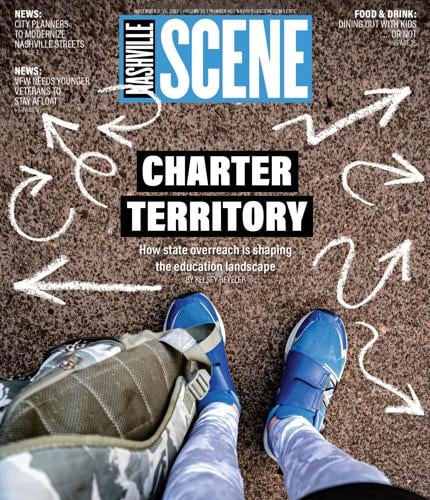

Walk into just about any school in Nashville and you’ll see classrooms and hallways filled with shuffling students and energetic teachers. Inspirational messages and art projects will line the walls. Some students will be happy to be there, others won’t. School staff will be there to manage the day.
Some of these schools are traditional public schools, some are public charter schools, and some are private. Regardless, each is tasked with the huge responsibility of educating young Nashvillians, and each has its own ecosystem of relationships, needs and history. There is a wide range of school options in Nashville, from public neighborhood and magnet schools to charter schools and private institutions. On its surface, “school choice” describes the simple act of enrolling in the best possible school for a specific student — though financial or logistical barriers prevent many families from accessing all of them.
Ansley Erickson is an associate professor of history and education policy at Columbia University’s Teachers College. Her book Making the Unequal Metropolis examines how desegregation-era policies shaped inequities in Nashville’s school system — a topic she also dove into with a 2015 cover story for the Scene.
“In lots of places, school choice has opened up avenues for further segregation,” Erickson tells the Scene.
She explains that the concept of school choice is fraught with a history of white parents resisting desegregation by avoiding certain public schools or exiting the public system altogether. Erickson notes that it also became a mechanism for Black families to take agency in their children’s education and seek better options when the public system was failing them. She points out that school choice isn’t a one-sided phenomenon, and schools can exercise choice in which students they accept.
“It’s always been a little bit of a misnomer, because it sounds like the choice is all on the parents’ side,” she says. “But usually, there’s selectivity happening in other places too.”
Local and state leaders on both sides of the aisle have facilitated a proliferation of school choice. Recently, the matter has been aggressively pushed by Gov. Bill Lee and state Republicans, who have fostered distrust in the public school system while also creating mechanisms for more charter schools to open in more districts, and for public dollars to go to private schools. Tennessee’s new education commissioner, Lizzette Gonzalez Reynolds, will likely help with the governor’s goals in that regard. (The Tennessee Department of Education would not fulfill the Scene’s request to interview Reynolds for this story.)
The issue of school choice has added to the already crippling tension between the state and Nashville, and it’s affecting students and their families — whom everyone involved purports to act in the best interest of. Below, we dive into the issue of school choice: the basics, the politics and the impact.
The Basics
Nashville students have more school options than ever. A parent’s decision to enroll or not enroll can rely on myriad factors, from an institution’s academic rigor to its atmosphere. The state just released a controversial new grading system that rates schools on an A-to-F scale. Proponents say it will provide straightforward information about how schools are performing; critics worry it will cast an oversimplified metric onto schools that could motivate students and teachers to search for other options.
Many will tell you that visiting a school is the best way to determine whether it’s the best fit. Test scores are just one indicator of a school’s performance, but in fact, they often correlate with socioeconomic factors: Economically disadvantaged students often underperform due to a lack of access to basic needs such as food and consistent housing. Do schools deserve to be faulted or stigmatized for factors outside of their control?
Tait Danhausen, who is the head of middle schools for Nashville’s LEAD charter network, has his own framework for considering schools. “I don’t think it matters if your school is really successful or not successful,” says Danhausen. Instead, he says, he bases his perception on three questions: Are students loved? Are they safe? Are schools being honest about their students’ academic performance?
Within the public school umbrella, families can attend their zoned neighborhood schools (the default option) or apply to other open-enrollment schools across the district via a lottery process. Transportation isn’t provided to non-zoned schools, however, and Nashville’s lacking public transit system could do better to augment that.
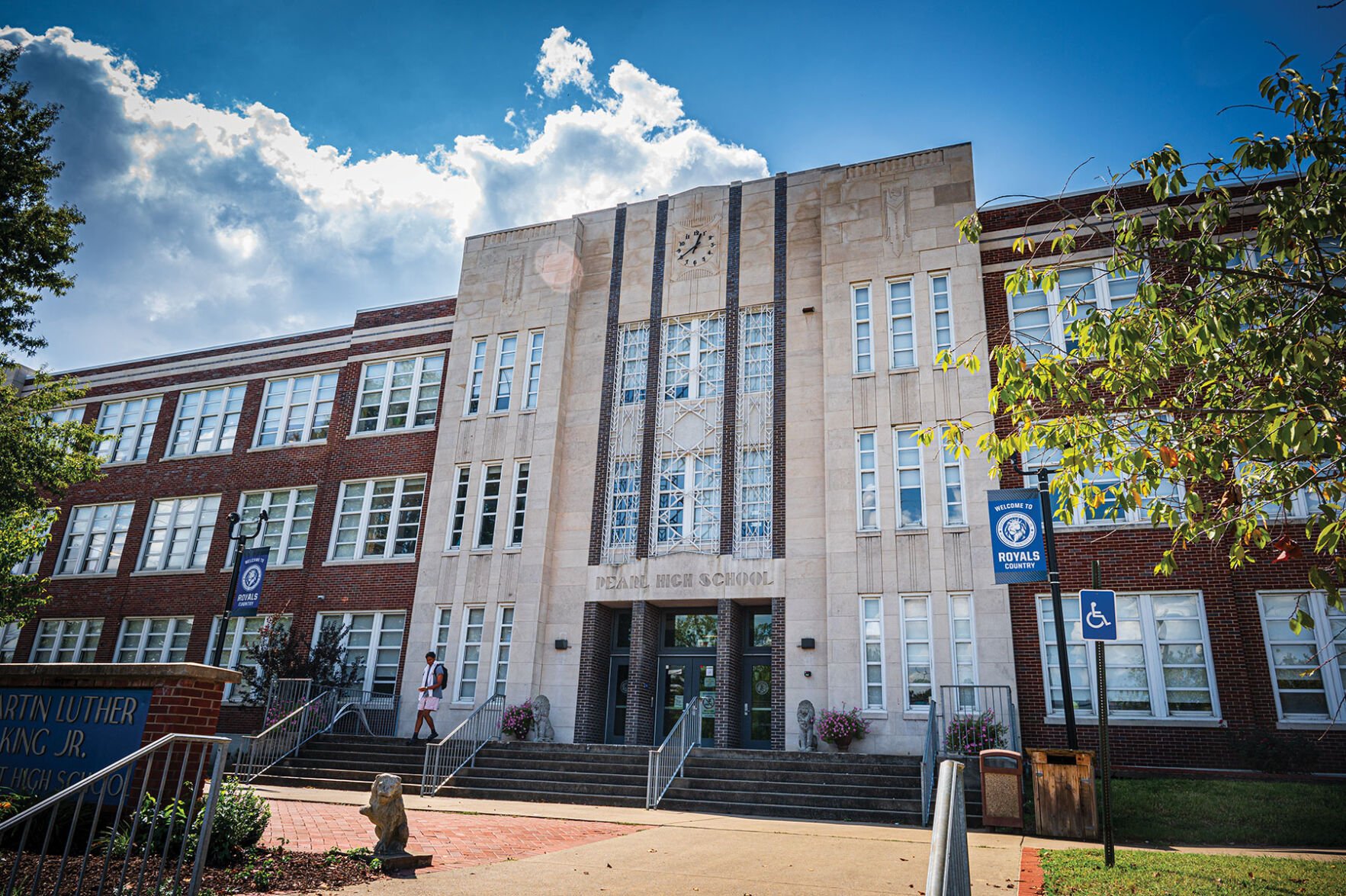
Martin Luther King Jr. Magnet High School
Among the district’s enrollment options are a plethora of programs and focuses. Within Nashville’s high schools are the Academies of Nashville — 35 different “academies” within 12 of the city’s largest neighborhood high schools — which teach students skills surrounding specific career tracks. Magnet schools are public schools that offer specific programs in fields such as STEM or the arts. Magnets were initially created to help desegregate the school system by attracting more families to different schools, and they’re still being used for that purpose in Nashville.
Academic magnet school Hume-Fogg Academic High School is among the state’s best-performing public schools. But its student body's demographics do not reflect the district’s immense diversity. White students account for the majority of Hume-Fogg's enrollment, even though they don’t make up the bulk of the district. The Metro Nashville Public Schools board is considering ways to diversify academic magnet schools by eliminating a preference for students who come from specific middle schools.
“Parents shouldn’t have to try to figure out high school when their child is in fifth grade,” MNPS parent Amy Powell tells the Scene via email. “Not putting them on a specific pathway allows them to explore the best options for where they are in eighth grade. … MNPS has so many wonderful options! Let our families explore them at the right time and have equal opportunities to pursue them.”
For children to attend a charter school, families must first fill out an application. Charter schools receive public funds and must comply with state and federal requirements, but they have their own boards and operate independently of the district with more autonomy. Critics complain that charters divert funding from traditional public schools and “cherry-pick” their students. Legally they’re not allowed to turn students away, but according to The Washington Post’s Valerie Strauss, charters sometimes use other mechanisms like targeted recruiting or discouragement of students to try to curate student bodies. MNPS schools have been accused of engaging in these practices. “There are MNPS schools that push kids out,” Gini Pupo-Walker, former MNPS board member and executive director of the Education Trust in Tennessee, recently told the Scene. “It’s not just charters that do it.”
But as with all schools, charters are not a monolith — conversations about any schools within a certain classification usually require more nuanced, ground-level considerations. Some of them perform well and offer the innovative models they were brought in to create. Others don’t. Since charters started appearing in Nashville, six of them have been closed down. Dwayne Tucker is the CEO of charter network LEAD Public Schools and admits that both charters and traditional public schools are guilty of picking “the metric that fits us at that time” to demonstrate certain points.
All these factors make the school choice conversation more complicated than simply “public or private?” But even that seemingly binary choice is less straightforward than it used to be. The state’s Education Savings Account program — commonly referred to as school vouchers — provides qualifying students roughly $8,000 a year to put toward private school education. Families who meet a certain income threshold can apply. The money can be put toward private education, but it’s not necessarily enough to cover tuition, as private school tuition often exceeds that figure.
The Politics
Education policy — from the local school board level to legislation passed by the Tennessee General Assembly — affects the school choice conversation in ways that parents don’t always track. It takes a lot of time and energy to keep up with constantly changing policies, and changes aren’t always communicated effectively. Some issues, however, garner a lot of attention and spark loud, emotional discourse among community members.
Consider the state’s controversial Education Savings Account legislation. It barely passed in 2019 and was quickly litigated in Davidson and Shelby counties for targeting those two districts. It’s a common trend we’re seeing in Nashville, particularly over the past year: the state attempting to impose its agenda on Metro. Nashville has successfully used the Tennessee Constitution’s Home Rule Amendment, which preempts the state from targeting specific counties, to stop state overreach. Multiple judges agreed that the ESA legislation violated the Home Rule Amendment by singling out Nashville and Memphis, but after three years of legal battles, the Tennessee Supreme Court found that the ESA program didn't violate the state's Home Rule Amendment.
Just months later, the TDOE was distributing ESAs, even though it wasn’t allowed to work on the program while it was being litigated. Since it began in 2022, the program has more than quadrupled its statewide enrollment and has already been expanded to include students from the Hamilton County School District. Chalkbeat Tennessee reported in August that the state had to settle for a contract with a young company with no experience in statewide voucher distribution to run the program.
Critics have many concerns regarding ESAs. Apart from the fact that the state effectively forced them onto school districts, they’re another mechanism to divert funds from public schools. Vouchers also allow tax dollars to subsidize education in religious institutions, which the Supreme Court ruled valid in Carson v. Makin. Private schools don’t have to follow federal requirements, such as providing students with disabilities an individualized education plan. “In the name of choice, parents and children with disabilities are really asked to give up a big chunk of their rights,” says Erickson.
Unlike public schools, private schools can turn students away outright. In Florida, one private school that accepted more than $1.6 million in tax dollars via vouchers has openly stated that it will refuse admission to LGBTQ students.
Even still, Senate Education Committee Chair Jon Lundberg (R-Bristol), who co-sponsored a bill to expand ESAs earlier this year, tells the Scene he wouldn’t be surprised by further expansion. If ESAs follow the same path as charter schools, they will initially be reserved for certain students and then made more widely available.
Mary Batiwalla, who used to work for the TDOE, including as the department’s executive director of accountability, tells the Scene she thinks the aforementioned A-to-F accountability system is driven by a desire to “to expand policy around school privatization.”
“A lot of times [ESA advocates] don’t like to use the term ‘privatization,’” she says. “They like to use the term ‘school choice.’”
Alongside the possibility of ESA expansion, you can bet on more charter schools opening across the state, and contention around who gets to decide that. Traditionally, that’s the role of school boards. Public school boards are composed of elected officials who — among other tasks like setting the budget and hiring superintendents — decide whether charters can operate in districts.
We’ve seen several instances in which school boards don’t approve charters that other politicians want, and that can get messy. See the Great Hearts debate of 2012, when the MNPS board — citing diversity concerns — denied the charter school four times despite a state order to approve it and support from then-Mayor Karl Dean. That decision cost MNPS more than $3 million in funding withheld by the state and further stoked the flames of the charter school debate.
We’re starting to see charters pop up in suburban counties. Among those leading that charge is the controversial American Classical Education. ACE is a charter operator affiliated with Michigan’s conservative Hillsdale College. In 2021, Gov. Lee announced a partnership with Hillsdale to establish a statewide presence of charters. The announcement raised eyebrows, as charters have traditionally been relegated to urban school districts, and concerns about ACE’s conservative 1776 curriculum quickly arose. Opposition grew stronger when Hillsdale President Larry Arnn was recorded insulting public school teachers. (Lee, who was with Arnn when he made the statement, provided no pushback then or thereafter.) ACE applied to open in three suburban districts — all three applications were denied by local school boards.
A major difference between the Great Hearts controversy and the ACE story? The Tennessee Public Charter School Commission. A nine-member appellate body appointed by Gov. Lee, the charter commission began hearing appeals of charters that were denied by school boards in 2021. Its members get the final say over the locally elected officials representing the school district and are tasked with authorizing the schools they approve — meaning the commission serves as its own school district.
All three ACE charters applied to the commission after being rejected, but withdrew their applications in 2022 before a final decision was made. They came back with fresh applications this year in Rutherford, Maury and Madison counties. The Rutherford County Schools board approved its ACE application. The other two applications went back to the charter commission, which approved the school for the Jackson-Madison County School District but not for the Maury County Public Schools district.
After three years, the charter commission has agreed to authorize nine charter schools in Nashville alone. The current makeup of the MNPS board isn’t particularly friendly to charters, and openly bemoans the charter commission. District 6 representative Cheryl Mayes went as far as to call them “those yahoos” during a September board meeting.
Among the school board’s major concerns with charters: funding. MNPS has to foot the bill when charters set up in Nashville — around $212 million was allocated to charters in this year’s budget. Lawmakers passed a new education funding formula in 2022 to replace its 30-year-old predecessor. It’s not friendly to Nashville, and the state’s push to consider forgoing federal education funds could also decrease district funding. State money is attached to students in the formula, and it goes where they go. Public schools can’t easily cut their operational costs when students — and the funding attached to them — leave.
“We’re getting to a place where our per-pupil cost is like a housing bubble,” says current MNPS board chair Rachael Anne Elrod. “It continues to go up because we’re having to fill in the holes for all those fixed costs, but again, the charter schools get that increased per-pupil [funding] every year.”
In August, Tennessee hired Bren Elliott as the new state turnaround superintendent. Elliott is responsible for overseeing the Achievement School District, which was created as a mechanism for the state to take over the lowest-performing schools by giving them to charter operators to turn around. Those efforts have been largely unsuccessful. (The Scene attempted to interview Elliott to discuss the future of the ASD, but the TDOE would not fulfill that request.) Ask local education stakeholders what’s going on with the ASD, and no one is entirely sure. LEAD Brick Church is the only ASD school left in Nashville, and its CEO Dwayne Tucker says that, from his understanding, the state might “look more to taking out clusters of schools.”
As state leaders push school choice and force schools to compete for students and funding, the battle for local control rages on. Elrod anticipates continued efforts toward a state takeover of the MNPS board.
“Because charters don’t affect the majority of those legislators, they’re not interested in hearing how it affects us either,” says Elrod. “In some cases, the cruelty is the point.”
“I would say, like most things where we have enjoyed local control and have local authorizing bodies, we want to retain that as much as possible,” Mayor Freddie O’Connell recently told the Scene.
Can a local school system create an environment that provides a rich array of choice for families while also creating an environment for neighborhood public schools to thrive?
“I think we could imagine a system that gives parents a lot of choice and also really pays attention to equity,” says Erickson. “Very few school choice systems, if any, have actually achieved that. And so if it’s the goal, then you’d have to build a system with that goal in mind.”
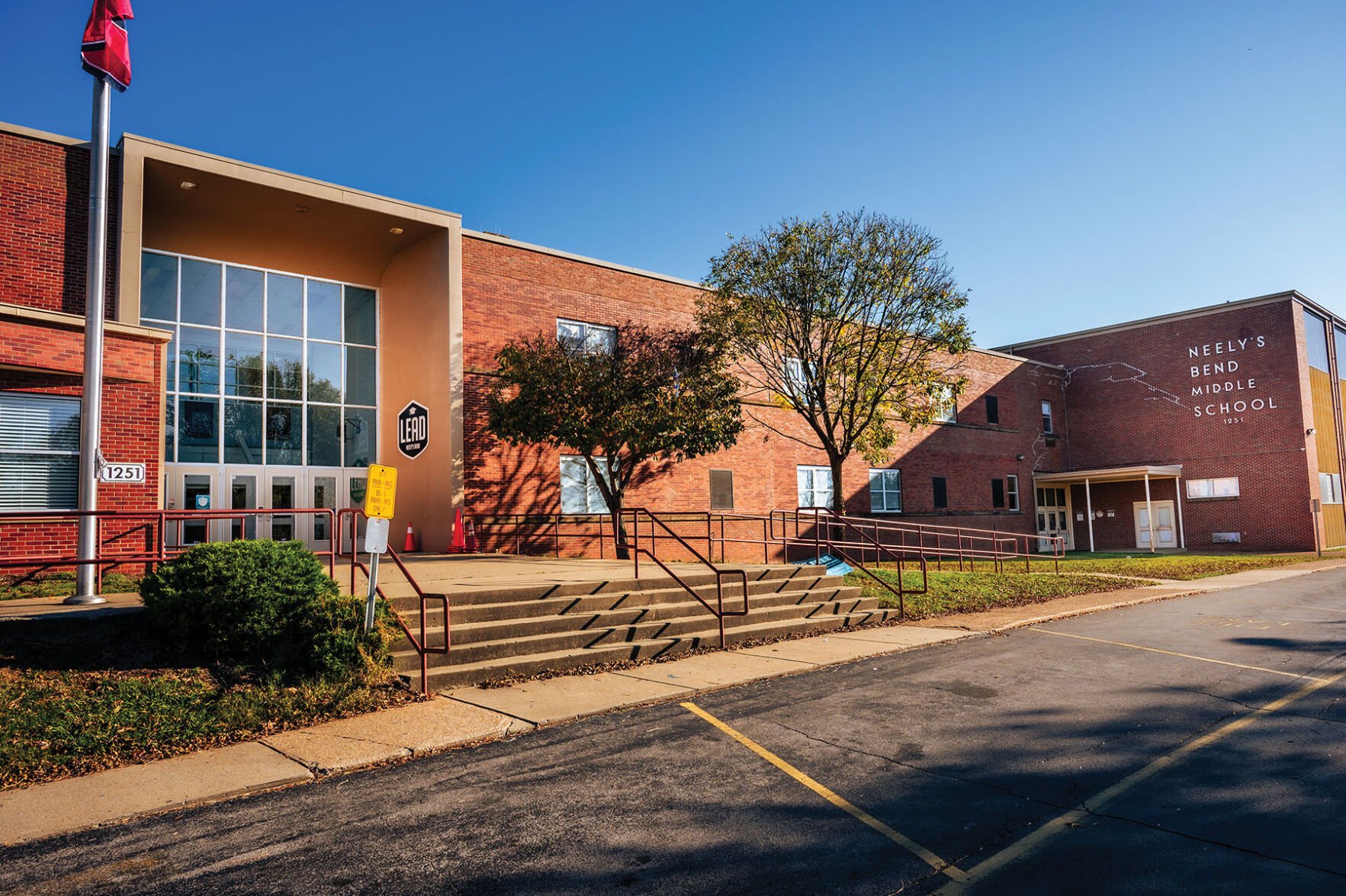
LEAD Neely’s Bend
The Impact
Amid the political battles, students and families are caught in the crossfire.
Earlier this year, MNPS sounded the alarm when LEAD Neely’s Bend applied to exit the ASD because it had improved enough to move off of the priority list — that is, the list of schools that perform in the bottom 5 percent in the state. LEAD didn’t fill out an application to go through MNPS — it didn’t have to. ASD charter operators can circumvent school boards entirely and apply directly to the charter commission. The application was accepted, and in January LEAD Neely’s Bend became a charter-commission-run school rather than an ASD school. The major difference for students is that it moved from being a zoned to a choice-only option, so families now have to apply to send their kids there. With no other zoned middle schools in that area, MNPS had to change the configuration of nearby schools so that middle school students in the Hunters Lane cluster would have a guaranteed seat.
Moniqueca — who asked the Scene not to use her last name — is the parent of two students in LEAD Neely’s Bend. She has kids in elementary through high school who have attended several different kinds of schools. She wasn’t fully aware of the changes as they were happening at LEAD Neely’s Bend, and when an MNPS enrollment center employee told her it was no longer the zoned school, and to attend it would mean leaving the MNPS district, she didn’t believe it. It wasn’t until a LEAD employee started explaining the situation later that it clicked for Moniqueca. She says she received an email from the district telling her that her child’s zoned school was now Madison Middle, even though it traditionally had been Neely’s Bend. She says that when she called LEAD about this, she was told to disregard the letter.
LEAD also asked Moniqueca to write a letter of support to help Neely’s Bend exit the priority list. She didn’t realize it would also be part of an application to separate the school from MNPS. She says if she had realized that, she wouldn’t have written it.
“Admittedly, a challenge was explaining how within the same conversation you’re celebrating coming off the list, and then essentially you don’t have a home,” LEAD’s director of engagement and family enrollment Corey Burton tells the Scene. Burton says they made sure families knew that LEAD would still be operating the school. A January Facebook post from LEAD Neely’s Bend does indicate that the school is now a charter commission school.
Moniqueca describes the situation as “confusing,” “frustrating” and “convoluted.” She says she felt “a lot of underhandedness,” and a lack of proper communication from both sides.
This kind of complication is a symptom of multiple education authorities operating within the same county. Students can switch school districts without even knowing it, which can create lags in student record transfers or confusion regarding who to turn to when problems arise.
“If a situation happens at a charter school — and it often does — [parents will] come to us,” says Elrod. “We will have to say, ‘Please talk to your board.’”
In 2012, the Scene named a charter school teacher and a traditional public school teacher as our Nashvillians of the Year. In his writeup, then-Scene reporter Steven Hale made a point that still stands: Regardless of whether they’re working in a traditional public school or a charter school, good teachers are the key to a good education — and we need more of them.
Tucker thinks the “extreme politicization of education,” including conversations around school safety and which books students can access, is presenting challenges for those considering the teaching profession.
“If you’re thinking about entering the education field as a career … it’s a different set of attention being focused for, in some cases, just political points — for both parties,” says Tucker. “At some point it begins to take a toll [on] people who want to enter education to have a career.”
“I really just want better communication and the understanding that parents need to have information to be able to make these decisions,” says parent Moniqueca. “We’re making uninformed choices, and it’s very frustrating. … I feel like there just should be a lot of support from the top down, and more focus on the students and more focus on the families. That needs to be the priority.”
Regardless of who is operating the school, or what kind of school it is, every student deserves a quality education.
Correction: A previous version of this story noted Martin Luther King Jr. Magnet High School as an academic magnet school with a majority-white student body, but this is incorrect. Forty-eight percent of the school's enrollment is white. We apologize for the error.




Post a comment as anonymous
Report
Watch this discussion.
(0) comments
Welcome to the discussion.
Log In
Welcome to the discussion.
Keep it clean. Please avoid obscene, vulgar, lewd, racist or otherwise abusive language. Comments featuring hate speech or threatening or violent content will not be tolerated.
PLEASE TURN OFF YOUR CAPS LOCK.
Be truthful. Don't knowingly lie or mislead.
Be proactive. Use the “report” link on any comment that violates our comment policy.
Share with us. We'd love to hear your feedback.