


Caroline Randall Williams
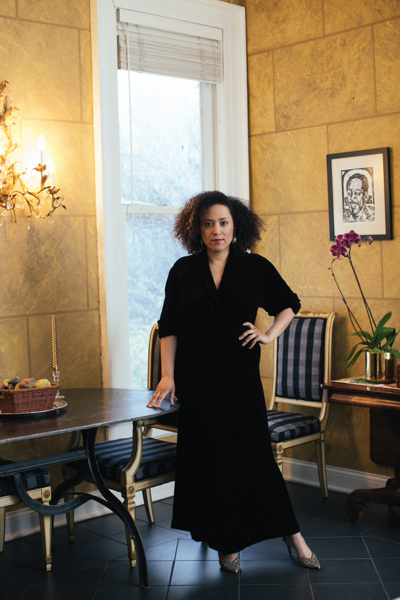
Poet Caroline Randall Williams sits in a cream-colored barrel chair, a mug of coffee balanced on its wide arm. She wears a black sweaterdress and black ballet-style flats. Behind her, intricate sconces flank a woodcut portrait of author and activist James Baldwin made by local artist Michael McBride. White orchids rest on a large square coffee table. Her home — the Blair House, as she calls it — was built in 1913, an American Foursquare with big picture windows and a wrap-around porch.
“There’s something a little Southern Gothic about the whole thing,” says Williams.
While she’s undoubtedly anchored in the contemporary world, Williams’ writing carries the rhythms of Zora Neale Hurston, William Faulkner and Eudora Welty. It’s easy to imagine Williams looking out at Blair Boulevard from her big second-floor windows, notebook in hand. Her mother bought the house in the ’90s when Williams was a child, and she says it’s one of the things that keeps her grounded.
“This house was bought by a black woman who paid for it making art,” she says. “I’ll be damned if I’m the one that lets it pass out of our family’s hands.”
Williams’ heritage could be considered Nashville African-American royalty. Her great-grandfather was the Harlem Renaissance novelist and poet Arna Bontemps. Her grandfather was the prominent civil rights attorney Avon Williams. Her mother, Alice Randall, is an acclaimed novelist and country music songwriter whose work has spent time on both The New York Times’ bestseller list and Billboard’s Hot Country Songs.
While getting her MFA at Ole Miss, Williams came across an article in the Daily Mail — reading the tabloid is a guilty pleasure she cheerfully owns. The piece posited that the so-called Dark Lady of Shakespeare’s sonnets was not a Mediterranean woman, as most scholars have theorized, but rather a black woman known as Black Luce (or Lucy Negro) who owned a brothel and ran in the same social circles as Shakespeare.
Captivated by the possibility that Shakespeare had a black lover, Williams traveled to England to meet Duncan Salkeld, the professor who wrote that Daily Mail article. She wanted to bring Black Luce to life. The result — her 2015 book of poetry Lucy Negro, Redux — was just re-released by Third Man Books. In it, Lucy owns her sexuality and blackness unapologetically. “I am not a partridge or a ruby,” reads one poem. “I am a potato, a beetroot. Not a precious bird or jewel, but a dirt-dug tube. Rustle me up, rub me all over, and I will muddle your interiors with flecks of brown earth.”
Williams has just wrapped up the premiere of Lucy Negro Redux, a Nashville Ballet production that is based on her book. Williams performed in the ballet — sauntering across the stage reciting her poems — alongside prima ballerina Kayla Rowser and noted musician Rhiannon Giddens.
Ballet is an art form so rooted in whiteness that black ballerinas have long needed to dye their shoes — Capezio, the leading dance shoe maker, doesn’t offer any pointe shoes that aren’t pink, even though ballet shoes are supposed to match the dancer’s skin tone to visually extend the line of the leg. The Nashville Ballet’s production of Lucy cracked the art form open and smeared its guts on the wall. It’s a gorgeous, bloody, sexy, rollicking proclamation that, as the Bard wrote, “Beauty herself is black.”
Lucy Negro, Redux isn’t the first time Williams has rewritten the rules. With her mother, she wrote the NAACP Image Award-winning Soul Food Love, a cookbook that reclaims soul food by mining its traditions and reshaping the cuisine with more healthy ingredients. Though the two books seem quite different, they have clear ancestral ties to black Southern womanhood that Williams says she is “trying to excavate from a historical, emotional, creative standpoint.”
“Lucy is a book about the body,” says Williams. “About loving your body, loving the way you look, navigating that space. Soul Food Love is also a book about carrying a Southern body through space, and figuring out how to healthily sustain it and keep its stories alive.
“I cook for people for the same reason I write,” she continues. “I want them to feel nourished and sustained and loved and heard and witnessed and chronicled. … Putting a meal together comes from the same emotional place — in terms of acts of service — that writing a poem does.”



