

There have been so many seminal and earth-shattering events in 2020. But one of them was predestined 233 years ago, when the Founding Fathers laid this out in Article I, Section 2 of the Constitution: “The actual Enumeration shall be made within three Years after the first Meeting of the Congress of the United States, and within every subsequent Term of ten Years, in such Manner as they shall by Law direct.”
As billboards and endless radio and television ads have drilled into our collective brain, the decennial census is extraordinarily important for a lot of material reasons — namely that billions of federal dollars are distributed based on numbers for things like schools and roads and a cavalcade of other programs. Of course, James Madison et al. didn’t necessarily intend that to be the case. They just wanted a count so the states could be represented correctly in the House. That, ultimately, is the raison d’être for the census.
Notice, too, the original wording is vague on exactly how the lines for congressional districts are drawn, leaving it to future congresses to “by Law direct.” In their infinite wisdom, they left the decision to the states themselves, and with de minimis guidance from the subsequent United States Supreme Court decisions, state legislatures have come up with a smorgasbord of redistricting systems.
Tennessee’s, for better or worse, is among the least complicated — and therefore the least restricted. The General Assembly is the decider. There’s no blue-ribbon panel, and with Republicans holding a super-duper majority, there’s no real need for or attempt at bipartisanship. The GOP held the reins and the pens following the 2010 count, and it was a fairly rancor-free process, though a few incumbent Republicans were drawn together in state legislative districts.
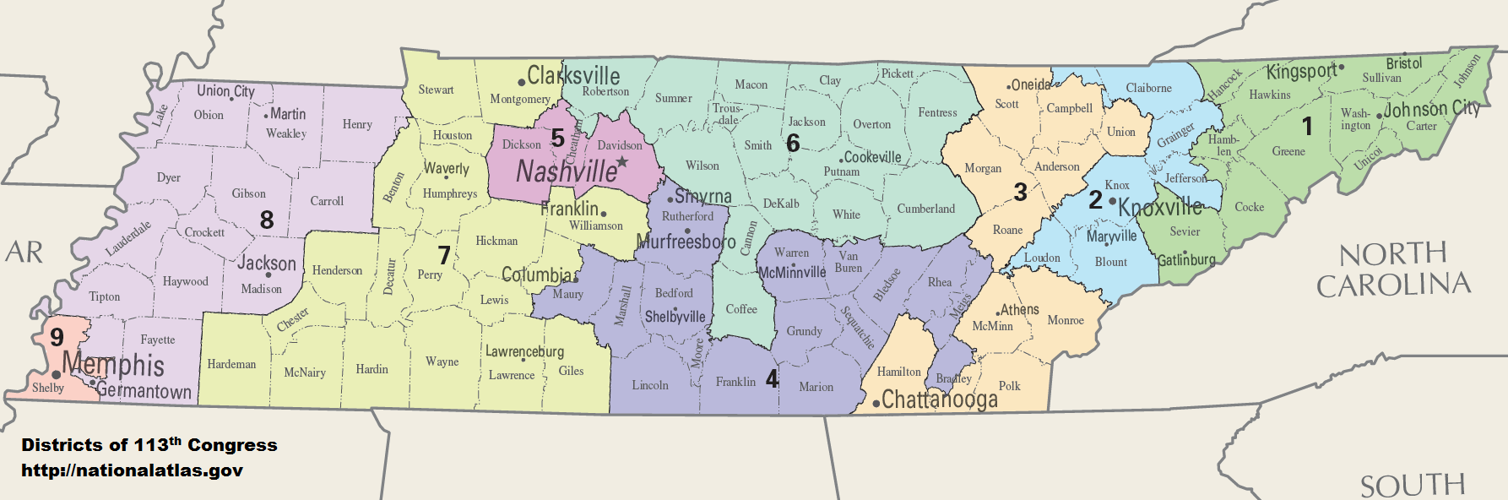
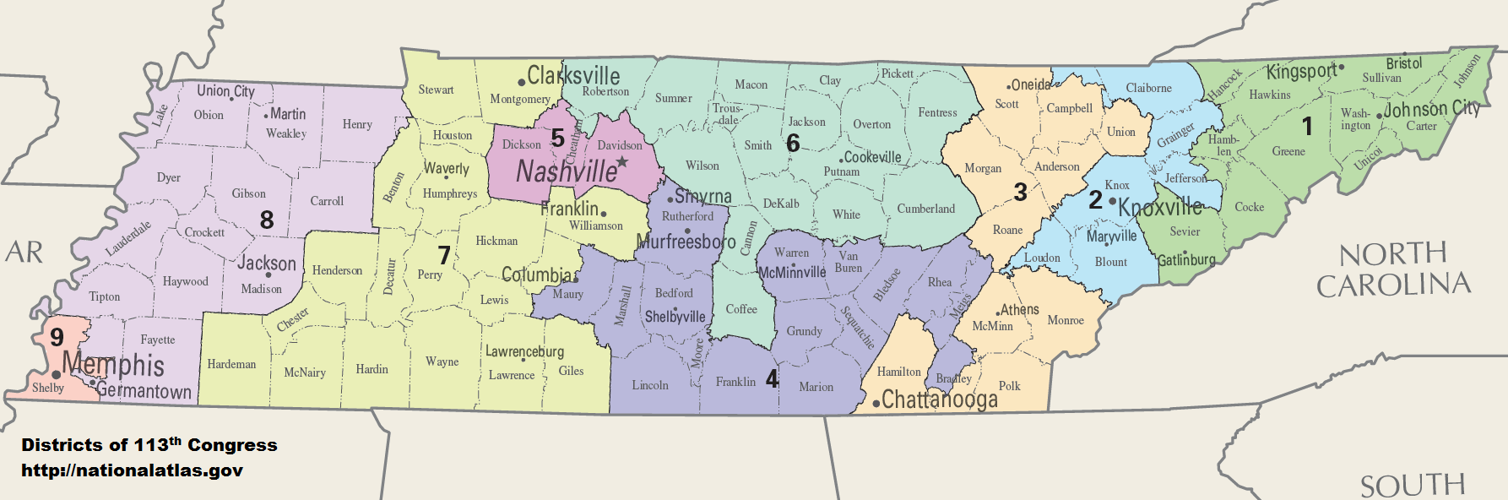
Given that population estimates show Tennessee is going to maintain its nine U.S. House seats, and that the distribution is roughly the same as it was a decade ago, one might expect the map to look essentially the same — with two safe Democratic seats centered on Nashville and Memphis and the rest of the state sliced into seven rock-ribbed Republican districts.
As they are drawn, Tennessee’s congressional districts, incredibly, make a lot of sense. They lack the oddball anomalies — one-block-wide land bridges snaking through territory deemed safe by this or that party or little islets tied by a string to a broader district — that have drawn court challenges elsewhere. East Tennessee’s 3rd District, represented by Republican Chuck Fleischmann, is the “weirdest”: Roane and McMinn counties are connected by a narrow strip, and the rest of the district loops down to the Georgia border, U-turning to take in Hamilton County, leaving Chattanooga and its clutch of Democrats outnumbered overwhelmingly by East Tennessee Republicans who’ve been with the GOP for 150 years.
When Republicans finally fully flipped Southern states in the ’90s and 2000s, there was much wailing and gnashing of teeth from Democrats about the Republican majority vengefully wielding the redistricting pen that had been denied them since Reconstruction. (There was, apparently, no sense of irony from Democrats that a big reason they stayed in power so long in the South was because they got to draw the districts.) Certainly, in many of Tennessee’s neighbors, that fear proved true. But looking at Tennessee’s historical district maps, the current one makes more sense than the past few that were drawn by Democrats. The post-2000 map featured a 4th District that stretched from the Memphis suburbs up Interstate 40, splitting like a Y just west of Nashville, with one arm diving into Williamson County and the other up toward the Kentucky border — lumping together Republicans from the suburbs of the state’s two biggest cities and military voters in Clarksville. After the 1990 census, Cleveland was a near-exclave of the Knoxville-centered 2nd District, with the 3rd District receiving a similarly sized exclave just north of the Bradley County seat.
The point of this rehashing is that it’s possible to be too clever by half in an effort to consolidate power. Tennessee Republicans don’t need to draw funky lines because they have such a structural advantage anyway. After all, just two years ago, the most popular Tennessee Democratic politician in decades lost a U.S. Senate race by 11 points.
By all accounts, Republicans are going to maintain huge majorities in both chambers of the General Assembly after November, despite sunshiny predictions from Democratic operatives that some suburban seats are in play. (For more on that see our story on p. 12.) Not even the happiest Democratic warrior — the one with the lyrics to “Happy Days Are Here Again” tattooed on their arm and a donkey named “Truman” — sees the party flipping 24 House seats and winning 12 of the 16 Senate races.
But with a 7-2 Congressional majority, is there an incentive for Tennessee Republicans to gerrymander their way into a bigger advantage? Sure. In 2018, Republicans lost seven seats in California, halving the GOP’s representation from the Golden State. As formerly reliable Republican areas of California go blue, the party is looking to pick up seats elsewhere — and deeply conservative Tennessee is one place it could do so.
There are nightmare scenarios. It’s virtually impossible for the Republicans to get a full nine-seat sweep, particularly because Memphis is densely populated and overwhelmingly Democratic. But there are maps that reduce the Democratic advantage in the Bluff City by splitting Shelby County three ways, though the 9th District would still be more than three-quarters Democratic. Worse for Democrats is the prospect that Republicans divide most of Middle and West Tennessee into five roughly drawn isosceles triangles with their apexes joining in Davidson County, splitting the other left-leaning blue blob in the red sea that is the Volunteer State and leaving Nashville’s voters demographically overwhelmed by their exurban Republican neighbors. That would also destroy the so-called Jackson District, a Nashville-based House seat that’s existed since, well, Andrew Jackson. In two critical cases in its 2019 session, the Supreme Court of the United States ruled that districts drawn for partisan advantage cannot be challenged in the courts, essentially giving legislatures free rein.
So certainly the temptation — and permission — exists for legislative Republicans to do what they will with the congressional map, but they’d be wise to pay heed that they aren’t engaging in the sort of inverse of what C.S. Lewis called “chronological snobbery.” That is, they mustn’t assume that what is true now will hold five years in the future. Take, for example, Rutherford County. Murfreesboro’s population is surging, as is that of the in-between-burbs of Smyrna and La Vergne. Rutherford gave Donald Trump 60 percent of its vote in 2016, roughly reflecting the state number.
Population estimates show that Murfreesboro has grown 36 percent since the 2010 census, and the county at-large by 26 percent. Rutherford is currently the state’s fifth-largest county, and demographers predict it will be the third-largest before 2050.
In large part because of the Fort Campbell Army installation, Montgomery County has the state’s lowest median age, but Rutherford isn’t much older. Job growth is strong and the cost of living is lower than in Nashville, so it’s easy to see why MTSU graduates are increasingly deciding to stay in the Bucket City — and why other young people are moving there.
So let’s say legislative Republicans engage in the nightmare 8-1 scenario, centering one of their districts on Murfreesboro, considering its strong current Republican tilt. But then the district gets younger and more liberal rapidly, throwing the district into play. And let’s say the same thing happens in Clarksville. Suddenly there are two competitive districts where there were once none. Leaving well enough alone would have, in this hypothetical, maintained a 7-2 advantage for the GOP, but now there’s a chance it could go 6-3. As the great political philosopher DJ Khaled would say, “Congratulations, you played yourself.”
Advocates for redistricting reform say the hyperpartisan process driven by politicians only furthers ideological divide, that lumping like-minded voters together in gerrymandered wiggleworms pushes candidates further left or right. Further, state legislatures are unlikely to give up this power, perhaps the most consequential way state-level politicians can shape national policy.
Rep. Jim Cooper — the longtime Nashville Democrat and certainly a man with a personal and political interest in not seeing Nashville sliced up like a chess pie — is one of Congress’ biggest advocates for change. After one of his first major primary challenges in years from the more progressive Keeda Haynes, Cooper is unopposed in the general. He regularly introduces a bill that would require states to set up bipartisan redistricting commissions, charged with drawing districts that tie together contiguous communities and taking public comment before finalizing the maps. For what it’s worth, polling and statistics site FiveThirtyEight developed an algorithm to maximize compact districts, and such a map would produce seven reliable Republican seats, a Memphis-centered blue seat and a new 5th District encompassing the northwest half of Davidson County and reaching up to Clarksville — which the site says would have 76 percent chance of returning a Republican. Another map from the site tries to remain true to county boundaries and produces a 7-2 map with the 5th District’s Democratic advantage at 80 percent (the current district has an 88 percent advantage for the Dems).
Cooper’s bill never makes it out of subcommittee.



