
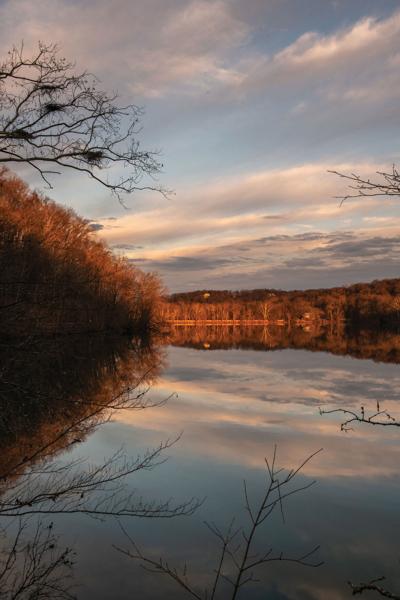


Radnor Lake
The Metro Planning Department is preparing to undertake an 18-month project to assess Davidson County’s environment and strategize ways to address the issues identified in the study.
In an exclusive to the Scene, Metro’s assistant director of long-range planning John Houghton and planning manager for ecological design Harriett Brooks share details about the upcoming study — called the Ecological Conservation Strategy, set to launch April 17 — and the process of growth with conservation in mind.
“Because it’s a unique, stand-alone ecological study, it does give us an opportunity to understand the county’s ecosystems in a much more specific and detailed way than we ever have, and then correspondingly develop those tools and strategies to address those different conditions,” Houghton says.
Brooks and Houghton both say Metro has not taken a close look at the county’s environmental resources since the Nashville Next plan, which was adopted in 2015 — and that the Ecological Conservation Strategy will be the first countywide environmental plan since Metro’s 2011 Open Space Plan. Houghton says the city has recently been primarily focused on housing and transportation, and the environment is the third leg of the stool for a comprehensive plan for Nashville’s future.
“I think it’s understanding that we can grow and we can have all three of these things, and we should be doing better with all three, but they’re not all necessarily going to happen in exactly the same place,” Brooks tells the Scene. “The first thing we need to know to get there is to really understand … what are our existing conditions today, and then start from there to think about how we create a sense of balance and sort of stability for people. Also, how do we prioritize where growth is appropriate and where conservation might be more appropriate?”
The project will be carried out in two phases, with public engagement planned for each milestone. The first phase will examine existing conditions of the environment and trends of change over the past 10 or more years. Brooks says that phase will include geospatial analysis to get hard data of environmental conditions, which will then be paired with the community sentiments to analyze where Metro’s priorities should be.
“The team is really tasked with creating a toolbox and a suite of all of these different types of solutions,” Brooks says. “Specific to the needs … we have, based on the growth that we’ve been having, the specific natural resources that we have in Davidson County, and then how we’re projecting or thinking growth will continue to happen in the future, so that we can try to attack the problem from several different areas.”
The second phase will be to propose actions — which could range from land acquisition to easements to policy and regulations — to tackle the challenges that are found. Brooks says this is a time to determine best practices that could be legislative, but also to open a door for public-private partnerships with conservation groups. Then will come putting the findings into practice with pilot projects.
“With those draft tools in place, we want to then test them, in two different extremes,” Houghton says. “The Highland Rim in northwest Davidson County, one of our most valuable ecological areas, and then also the downtown riverfront, sort of the other end of the spectrum — really intense density and development.”
When it comes to implementation, part of the project will include precedent research to examine other cities of similar size and geography.
“What are some innovative things that designers or local governments have been able to implement to really help provide more public accessibility and vibrancy to their downtown riverfronts?” Brooks says. “There are some really great examples of different projects happening all over the country, but especially in terms of midsized cities like Nashville.”
The Ecological Conservation Strategy’s website and community survey will go live on April 17, and Metro Planning staff will be present to discuss the project at two Earth Day events on April 18: Nashville Earth Day in Centennial Park, and Earth Day in the Hood at Claiborne Family of Faith Worship Center (81 Claiborne St.). There will also be a community open house April 28 at the Cumberland River Compact (1320 Adams St., No. 1040).

Stories on the local tree canopy, Tennessee quarries, the endangered Nashville crayfish and more — plus, how to get free trees and recycle your electronics



Post a comment as anonymous
Report
Watch this discussion.
(0) comments
Welcome to the discussion.
Log In
Welcome to the discussion.
Keep it clean. Please avoid obscene, vulgar, lewd, racist or otherwise abusive language. Comments featuring hate speech or threatening or violent content will not be tolerated.
PLEASE TURN OFF YOUR CAPS LOCK.
Be truthful. Don't knowingly lie or mislead.
Be proactive. Use the “report” link on any comment that violates our comment policy.
Share with us. We'd love to hear your feedback.