
Jay West
Vice mayor
By Liz Garrigan
With the passing of Jay West in March, Nashville lost a character who could well be considered the most humble and self-deprecating public servant in its history. West, who was 65, served 12 years as an at-large Metro Council member before becoming a one-term vice mayor, a relatively thankless role as cat herder and parliamentarian. Shortly after being elected to the job in 1995, he described his candidacy as having a “dull platform — ‘If elected, I will change little.’ ”
Indeed, his entire life could be described as just a little bit dull, filled not so much with standout moments of exemplary performance or victories as with unflashy and workmanlike competence.
When he ran for mayor in 1999, one of his elementary school teachers told me that as a child West was very much the way he was in adulthood. “He didn’t make all A’s or anything, but he was a good, average student,” former Ransom Elementary School teacher Mary Smith said at the time.
Even his wife described his culinary adventures as often unsuccessful, but added, “He has a good time with his spices.”
A surprise baby who came along a full decade after his older brother Ben, Jay wasn’t doted upon by his parents. He was born the same year that his father, Ben West Sr., was elected mayor and was raised mostly by an African-American nanny.
What he lacked in star power, he more than made up for in personality and goodwill. He returned his own phone calls, never took himself too seriously, and was the first to acknowledge his ordinariness.
He was “one of the unique politicians even politicians liked to be around,” says former Mayor Bill Purcell, who bested both Dick Fulton and Jay West in the 1999 mayoral election. “Jay was the quintessential good guy,” Purcell continues. “He believed in the government, and knew how good it could be and would be if the people inside it would allow it. A happy warrior, he was kind to literally everyone and had a joke or anecdote readily available to cheer up any sour or boring moment, and there were many such occasions.”
Once, during a 1999 mayoral debate, West’s chair slid off the dais on the 20th floor of a building and crashed against a plate glass window, appearing likely to launch him out the window. Says Purcell, “His recovery was spontaneous and classic.”
Just like Jay West himself.
Buck McPherson
Fire marshal and sheriff
By Keel Hunt
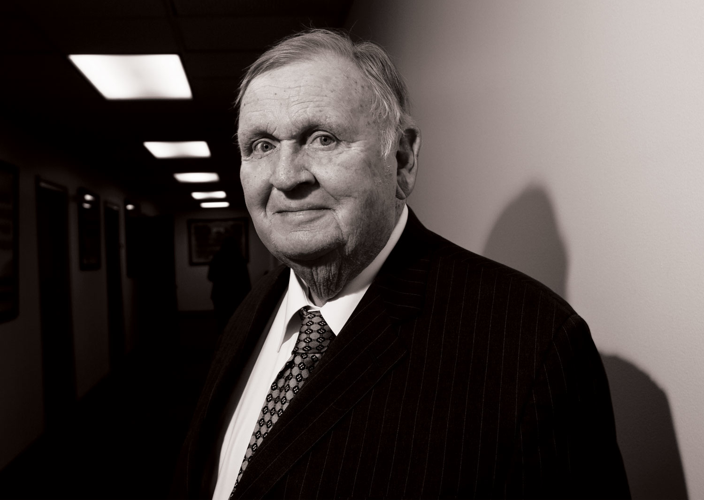
Back in the day when Nashville politics were colorful — that is to say, from the 1960s through the early 1980s — Buck McPherson on any day was at or near the true center of the real action.
In that era, there were no Republicans to speak of, and mayors came mostly from East Nashville. Beverly Briley, Dick Fulton and Bill Boner ruled city hall, Fate Thomas was the sheriff, and all politicians great and small would beat a constant path from courthouse or state Capitol or Washington to the front office at 1100 Broadway. That is where John Seigenthaler of The Tennessean held court and worked the levers of local political power. The one who understood them all was Buck McPherson.
But before all that, Buck grew up in Goodlettsville as the second-oldest of five children. His parents, Houston and Amelia, were in a group of seven couples who founded the Madison Church of Christ, long before it became an important megachurch. Buck was a standout football player at Goodlettsville High School and played at the University of Georgia on a football scholarship, until a knee injury sidelined him.
He met Briley in the pre-Metro era and ran the old county motor pool. Later he was safety director at the Metro Public Works Department. And then he met Fate. Some say Sheriff Thomas, a Catholic from North Nashville, knew he needed a liaison with a Church of Christ base. In any case, Buck became Fate’s chief deputy. Others say Fate needed a handler, too.
You did not always see Buck, but he likely saw you. You could see his hand and his handiwork. Buck also championed the sheriff’s department’s boxing team for young men, and some of his charges went on to win AAU and Golden Gloves titles. Buck would later serve on the state’s boxing commission.
When Lamar Alexander ran for governor in 1978, he became the unlikely (for a Republican) beneficiary of deep resentments that year within the state’s Democratic Party. Chiefly, this derived from the shambles that Democrat Jake Butcher left in his wake after winning his party’s gubernatorial nomination that year. The Knoxville banker had ridiculed and spurned Bob Clement and Dick Fulton, who had both opposed him in the Democratic primary. Neither unity nor mending fences was Butcher’s cup of tea, and as the general election campaigns resumed, Alexander cultivated the support of many in Clement’s statewide organization and others in Fulton’s Nashville circle, notably Thomas and McPherson.
After that, Butcher could not unify the Democratic Party, and he lost badly to Alexander that November. In due course, Buck joined the new administration as the state’s fire marshal.
When Alexander’s first term ended in 1983, Buck returned to the sheriff’s office, which by this time was in some disarray. He hoped to succeed Thomas in the next sheriff’s election. Among those in the know, it was said that Fate had promised to step aside when that current term ended, but it never happened. When that next election rolled around, Fate was already in his own trouble with the law; the sheriff eventually spent four years in prison for corruption.

Bill Giannini
Bill Giannini
GOP politico
By Cari Wade Gervin
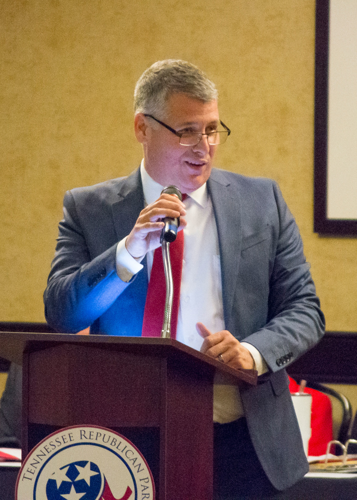
Bill Giannini died in a car crash on Dec. 14, in the middle of the afternoon, on I-40 between Nashville and Memphis.
It still feels surreal typing those words, trying to wrap one’s head around the fact that someone you were just planning to call — but got too busy and distracted and put it off for another day — now won’t ever be able to answer.
It still feels surreal that you had become friends, of a sort, with Giannini, whose often inflammatory partisan political stances were the opposite of anything you believe. But that was Giannini’s gift.
“He’s just that way — he was always one of those that listened to both sides,” says Nelia Dempsey, who was one of Giannini’s oldest and closest friends, both in and out of the political realm.
Giannini was better known in Memphis political circles than in Nashville, even though he had lived in Mt. Juliet for the past six years, first serving as an assistant, then deputy insurance commissioner in Gov. Bill Haslam’s administration. Earlier in 2017, Giannini launched Resolve Consulting, which he swore to me over the summer would never become a lobbying firm once his yearlong ban from lobbying was up in November. (Dempsey laughs at this.)
But before moving his family here — his wife and children, all four kids younger than 18 — Giannini had served as the head of the Shelby County Republican Party and the Shelby County Election Commission. According to Dempsey and others, he was planning to return to Shelby County in 2018 to run for the seat of state Senate Majority Leader Mark Norris (R-Collierville), after Norris’ federal judgeship appointment was formally confirmed.
That’s why Giannini was driving to Memphis that day, to spend the weekend talking to friends and donors about a campaign. But something happened, no one knows exactly what — a cardiac event, or maybe he fell asleep — and Giannini’s BMW crossed the interstate median and hit an oncoming car. (That driver survived.)
Norris, who gave a eulogy at Giannini’s funeral, said he is devastated by the loss of his friend.
“He was heaven-sent, but with a devilish edge — which you could see in that twinkle in his eye,” Norris said. “Bill had a beguiling boyish quality that sometimes belied his drive to succeed — and his drive to help others.”
Dempsey says Giannini had a “contagious smile.” It’s true — Bill was hilarious.
“When Bill was talking to you, you felt like you were the only person in the room. He made you feel like you were the most important person to him at that time. That’s why he was so successful,” Dempsey says.
Bill Giannini was a lot of things — a political animal, a family man, a devout Christian — but Dempsey’s right. It’s for his ability to connect with so many people that Giannini will be most remembered … and most missed.

Douglas Henry
Douglas Henry
State senator
By Jeff Yarbro
Sen. Douglas Henry never seemed bound by the same strictures of time as everyone else.
People often mistook Sen. Henry, with his seersucker suits, Southern Democratic political orientation and chivalrous manner, as a throwback who did not change with the times. Some critics wanted him to catch up; some devotees thought this was the right approach and that times should stop changing so much. But either view evinces a mistaken impression of the man.
Sen. Henry wasn’t defined by the politics of his time — or any time, really.
To be certain, he spent the greater part of his life actively participating in the life of this state. Having served one term in the state House in the 1950s and then 11 terms in the Senate, Henry dedicated more years of life to service to his state than any elected official to come before him — and probably longer than any who will follow.
And his contributions could be felt across those decades of service, from the creation of Radnor Lake and the Land Trust for Tennessee, to the first child safety belt law, to his defense of a government that protected its most vulnerable, to his determination to protect the financial integrity of state government.
But while history will regard him as the longest-serving member of Tennessee’s General Assembly, he regarded history across a far wider span than his 44 years in the state Senate or his 90 years of life. He considered that history as very much alive. And for him, history’s ideas were a matter of some urgency.
In 2014, his was the first door I knocked on in the campaign to succeed him. During the first 10 minutes of our visit, Sen. Henry was taking issue with our seventh president: “I appreciate General Jackson’s military service in the Creek and Indian War, and the War of 1812, but I don’t care much for his political philosophy.” It was as if President Jackson were sitting there with us and deserved appropriate courtesy from the senator before Henry objected to a matter of principle that needed to be decided in the here and now.
That same flow of conversation with Sen. Henry could be repeated for the topic of Pericles’ Athens, Robespierre’s France, or any number of times and places. Whether reading classical verse or modern Japanese fiction, he was concerned with the things that matter to us as humans — the things that have always mattered to us.
He thought ideas mattered and that our consideration of them mattered too. No one agreed with Sen. Henry about everything — but it would have very much defeated the point for him if they did.
When I was the first-time candidate who unsuccessfully challenged him in 2010 or the senator who succeeded him, calling for advice, he always afforded me the same respect he displayed to literally hundreds of senators and thousands of citizens over the years.
It was this commitment to a genuine and meaningful common discourse that made Douglas Henry the quintessential senator and the example that we must all hope does not fade with the times.



